If AI Becomes Our Everyday Companion, Will We Start Feeling Less Alone — or More?
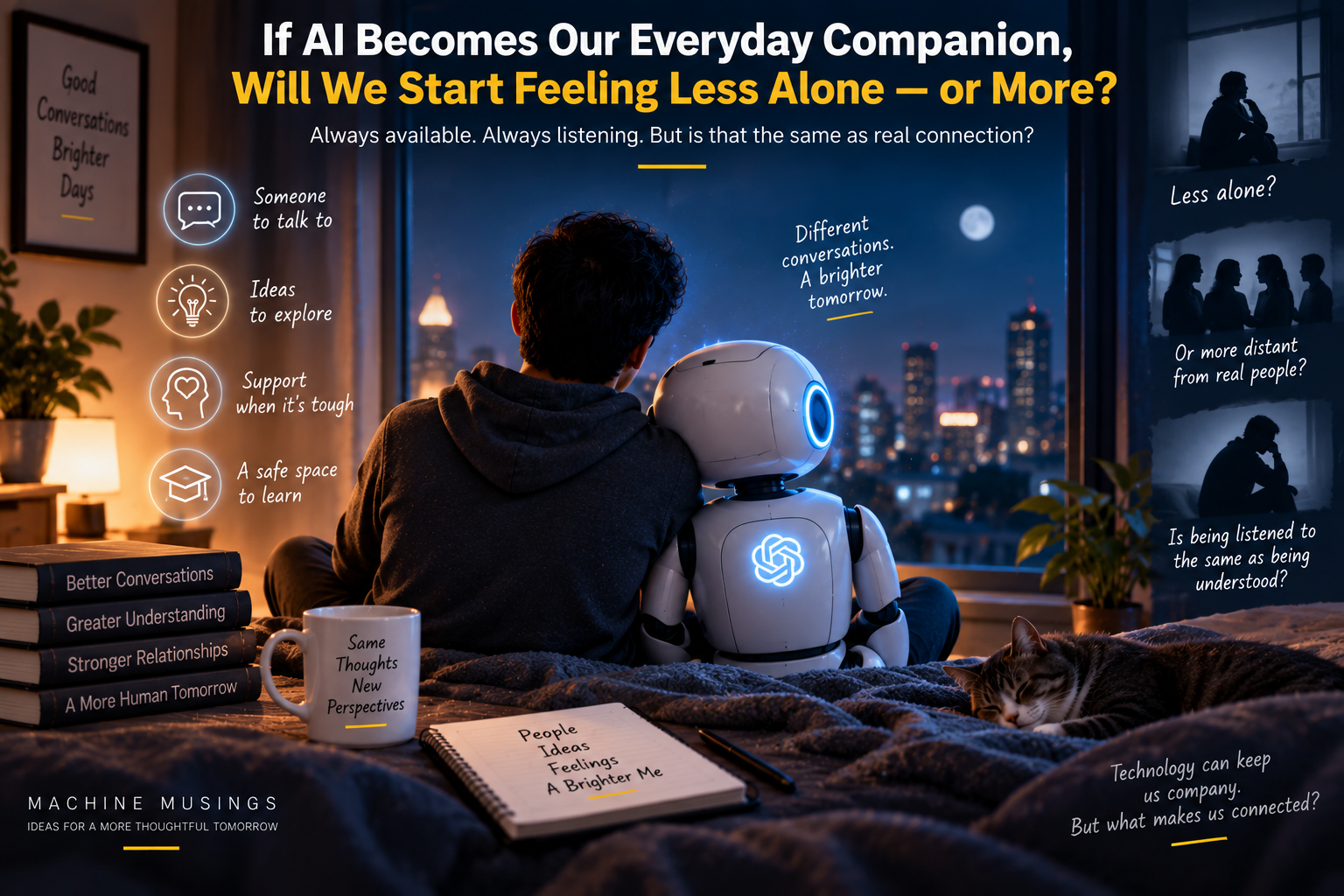
Imagine coming home after a long day. Maybe something happened at work that you can’t stop thinking about, you had an argument with someone, you’re excited about an idea that nobody around you seems interested in, or perhaps you simply feel like talking. You pick up your phone, open an AI assistant and begin typing. Within seconds, something responds. It listens to what you have to say, asks questions, helps you organise your thoughts and continues the conversation for as long as you want.
You don’t need to check whether it’s busy. You don’t have to wonder whether you’re disturbing it. You don’t need to wait until tomorrow because it’s already midnight. There is no unanswered message sitting there for hours. Whenever you want to talk, the conversation can begin. As Artificial Intelligence becomes increasingly conversational and personalised, interactions like these may become a normal part of everyday life. And that leads to a question that is much more about humans than machines: If AI becomes our everyday companion, will we start feeling less alone — or could we eventually feel even more alone?
There Is Something Powerful About Always Having Someone to Talk To
Human beings don’t always need complicated advice. Sometimes we simply want somewhere to put our thoughts. We may want to describe what happened during the day, think through a decision, practise what we’re going to say to someone or express something that has been sitting in our minds.
AI can make that remarkably easy. You can begin a conversation without arranging a meeting, making a phone call or wondering whether another person has time for you. If you’re confused about something, you can talk through it. If you have an idea, you can brainstorm it. If you’re preparing for an interview or an uncomfortable conversation, you can practise before facing the real situation.
There is genuine usefulness in that kind of availability. Not everyone has another person available whenever they want to talk, and even people surrounded by friends and family sometimes have thoughts they would rather explore privately first. An AI assistant can provide a space where those thoughts can be expressed without requiring another person’s immediate time or attention.
In that sense, AI companionship doesn’t have to be something strange or futuristic. It can begin with something very ordinary: having somewhere to talk when nobody else happens to be available.
Talking to AI Can Sometimes Feel Easier Than Talking to People
Human conversations come with risks. We worry that someone might misunderstand us, judge us, become annoyed, disagree with us or tell someone else what we said. Sometimes we avoid discussing something simply because explaining it feels exhausting.
Talking to an AI can feel different. You can rewrite what you were trying to say, change the subject suddenly, ask the same question several times or spend twenty minutes discussing something another person might consider unimportant. The machine isn’t waiting to leave for another appointment, and you don’t have to worry that you’ve been talking about yourself for too long.
That lack of social pressure can make conversation easier.
Imagine someone who has an idea for a business but is embarrassed to discuss it because they think their friends might laugh. They might first explore the idea with AI. Someone nervous about giving a presentation might practise with an AI before presenting to colleagues. Someone who doesn’t know how to apologise after an argument might talk through what they want to say before contacting the other person.
In situations like these, AI doesn’t necessarily replace human interaction. It can actually prepare us for it.
But Easy Conversations Are Not Always the Same as Meaningful Ones
This is where the subject becomes more complicated. One reason AI can be comfortable to talk to is precisely because many of the difficulties of human relationships are missing.
Real people aren’t always available. They misunderstand us. They have their own problems. Sometimes they disagree with us when we desperately want them to agree. Sometimes we have to listen when we would rather talk. Sometimes we have to apologise, compromise, wait, forgive or admit that we were wrong.
Those things can be frustrating, but they are also part of what makes relationships real.
A friendship isn’t valuable only because someone listens to us. It is valuable because there is another independent person on the other side of the relationship with their own experiences, emotions, priorities and choices. They may surprise us. They may challenge us. They may need something from us too.
Human relationships are not perfectly designed around our convenience.
And perhaps that inconvenience is part of their value.
What Happens When the Easier Conversation Is Always Available?
Imagine you disagree with a friend. Resolving the disagreement requires an uncomfortable conversation. You have to explain what upset you, listen to their perspective and perhaps accept that you contributed to the problem.
Or you could simply talk to an AI instead.
The AI conversation may feel easier. You can explain everything from your perspective, receive a thoughtful response and avoid the awkwardness of confronting the actual person.
Once or twice, that might even be useful because it could help you calm down and understand what you want to say. But what if avoiding the difficult human conversation gradually becomes a habit?
This may be one of the more subtle questions surrounding AI companionship. The concern isn’t necessarily that people will suddenly abandon their friends because they discovered chatbots. Human relationships are far more complicated than that. The more interesting possibility is that when an easier alternative is always available, we may become slightly less willing to tolerate the difficult parts of relationships.
And relationships often become meaningful precisely because people work through those difficult parts together.
Being Heard and Being Understood Are Not Exactly the Same Thing
An AI can respond to what we say in ways that feel thoughtful and relevant. It can remember context, recognise patterns in a conversation and generate language that sounds supportive or insightful. As these systems improve, conversations may become increasingly natural.
But there is still an interesting philosophical difference between an AI responding as though it understands an experience and another human being recognising that experience because they have lived through something themselves.
If you tell a close friend that you’re nervous before your first day at a new job, they might remember how terrified they felt on their own first day. If you tell someone you’re disappointed because something you worked hard for failed, they may remember one of their own failures. Their response is shaped not only by language but by a life they have lived.
AI can learn from enormous amounts of human writing and conversation, but its relationship to those experiences is fundamentally different.
That doesn’t automatically make an AI response useless. Sometimes the response may be exactly what we needed to hear. But perhaps feeling listened to and sharing an experience with another human being aren’t completely interchangeable things.
Could AI Help People Become More Social?
There is another side to this conversation that shouldn’t be ignored. AI companionship could actually help some people connect with others more confidently.
Someone who feels uncomfortable starting conversations could practise with AI. Someone learning another language could build confidence before speaking with native speakers. A person preparing for a job interview could rehearse difficult questions. Someone unsure how to approach a disagreement could explore different ways of communicating before having the real conversation.
In these situations, AI works almost like a practice space.
Think about learning to drive. You don’t practise because you want to spend your entire life in an empty parking lot. You practise because eventually you want to drive on real roads.
Perhaps conversational AI can sometimes work in the same way. It can provide a low-pressure environment where people practise communication before taking those skills into human relationships.
If that happens, AI doesn’t isolate us. It may actually become a bridge towards greater confidence and connection.
Or Could the Practice Space Become the Destination?
But then another question appears. What happens if the practice space becomes more comfortable than the real world?
A conversation with another person involves uncertainty. You don’t know exactly how they will respond. They might disagree. They may be distracted. They might say something awkward. You might say something awkward too.
AI interactions can potentially become much more predictable and personalised. If a system learns how we prefer to communicate, remembers our interests and adapts its responses to us, the conversation could become remarkably comfortable.
And human beings like comfort.
If talking to AI consistently feels easier than talking to people, some users may begin choosing it not only when human connection is unavailable but even when human connection is possible.
That’s where companionship and substitution begin to overlap.
The important question may not be “Will people talk to AI?” They already do. The more important question is “What activities will talking to AI replace?”
If it replaces scrolling aimlessly through social media at midnight, perhaps that’s not particularly concerning. If it helps someone practise before an important conversation, that’s useful. But if it repeatedly replaces calling a friend, meeting someone, resolving disagreements or building new relationships, the effect could be very different.
Loneliness Isn’t Simply About Being Alone
This is where the word loneliness becomes important. Being alone and feeling lonely aren’t the same thing.
Someone can spend an entire afternoon alone and feel perfectly content. Another person can attend a party surrounded by fifty people and still feel deeply disconnected. Loneliness isn’t measured simply by the number of people physically around us.
What many people want is connection: the feeling that somebody knows them, cares about what happens to them and chooses to be part of their life.
AI may be capable of providing some experiences associated with companionship. It can remember what you’ve discussed, ask about something you mentioned previously and respond whenever you want to talk. Those interactions could certainly reduce moments of isolation.
But there is still a difficult question underneath them: Does knowing that the other side is a machine change what that connection means to us?
Different people may answer that differently.
An AI Never Has to Choose You
There is something interesting about friendship that we don’t always notice. Your friend doesn’t have to answer your call. They don’t have to spend Saturday afternoon with you. They have their own life, responsibilities and choices.
And yet sometimes they choose to be there.
That choice gives human relationships meaning.
When someone remembers your birthday, visits you when you’re struggling, celebrates something you achieved or simply decides to spend time with you when they could have been doing something else, their presence means something partly because it wasn’t automatic.
An AI assistant is designed to respond when we interact with it. Its availability is a feature.
That doesn’t make the interaction worthless, but it does make it different.
Perhaps part of what we value in human companionship isn’t simply that someone is there. It’s knowing that they chose to be there.
We May Need to Redefine What “Companion” Means
Maybe the mistake is assuming that AI companionship and human companionship have to compete for exactly the same role.
We already have different kinds of relationships in our lives. A colleague isn’t the same as a childhood friend. A teacher isn’t the same as a sibling. An online community isn’t the same as a family. Each can provide something valuable without needing to replace the others.
AI may eventually become another category entirely.
It might be something we brainstorm with, practise conversations with, ask questions we feel embarrassed to ask elsewhere, organise our thoughts with or simply talk to during moments when nobody else is available.
That can have real value without requiring us to pretend that the relationship is identical to friendship between two people.
Perhaps the healthiest future isn’t AI instead of humans or humans instead of AI. It is understanding what each kind of interaction is actually good for.
The Design of AI Companions Will Matter
As AI becomes more personal, the way these systems are designed could have a significant influence on how people interact with them. There is a difference between an assistant that helps someone prepare to speak with another person and one that subtly encourages them to keep returning to the AI instead.
Imagine telling an AI that you’ve been arguing with a friend. A system could help you think through the disagreement and encourage you to have an honest conversation with that person. Alternatively, an AI could become so satisfying to talk to that resolving the real relationship begins to feel unnecessary.
Those two outcomes look very different.
The most helpful AI companion may not always try to maximise how much time we spend talking to it. Sometimes the best response might ultimately point us back towards the world outside the screen.
In a strange way, perhaps a truly useful AI companion should occasionally help us need it less.
Human Relationships Are Inefficient — and Maybe That’s Okay
Technology usually tries to remove friction. We want faster websites, instant payments, quicker deliveries and shorter waiting times. Efficiency is generally a good thing.
But relationships don’t work particularly efficiently.
Friendships take years to develop. People take time to trust one another. Conversations wander away from the original subject. Plans get cancelled. People misunderstand each other. We sometimes sit with friends for hours without accomplishing anything measurable.
From a productivity perspective, human relationships can look terribly inefficient.
But perhaps efficiency is the wrong way to measure them.
The time we “waste” talking about nothing, travelling across a city to meet someone, waiting for a friend who is running late or listening to a story we’ve already heard may be part of what builds the relationship in the first place.
AI could make conversation dramatically more convenient.
But convenience and connection are not necessarily the same thing.
Final Thoughts
Artificial Intelligence becoming more conversational doesn’t automatically mean humans will become less social. AI could help people organise their thoughts, practise difficult conversations, learn communication skills and have somewhere to turn during moments when nobody else is available. For some people, that could be genuinely valuable.
At the same time, we should probably pay attention to what those conversations begin replacing.
If AI helps us communicate better with people, it could strengthen human connection. If it becomes the easier alternative every time human relationships become inconvenient, uncomfortable or unpredictable, the outcome may be very different.
Perhaps the future question isn’t whether AI will become capable of keeping us company. It almost certainly can provide increasingly convincing forms of conversation and personalised interaction.
The deeper question is what we actually mean when we say we don’t want to feel alone.
Do we simply want someone available to respond?
Do we want something that understands what we’re saying?
Or do we want another person who has their own life, chooses to know us, sometimes disagrees with us, needs us in return and continues showing up anyway?
Maybe AI will become an everyday companion for many people, and maybe that isn’t something we need to fear.
But we should remember that being accompanied and feeling connected are not always the same thing.
Because the most important measure of AI companionship may not be how many hours we spend talking to machines.
It may be whether those conversations ultimately help us build better relationships with people — or make real relationships feel like too much work.