If AI Makes Creating Easy, Will Accomplishment Still Feel the Same?
Think about something you once created that made you genuinely proud. Maybe it was your first website, a piece of writing, a photograph, a presentation, a drawing, a video, a program, a piece of furniture, or simply something you had never managed to do before. The finished result probably mattered, but the feeling of accomplishment may have come from much more than the result itself. You remembered the mistakes, the moments when something refused to work, the tutorials you watched, the things you had to learn, the times you nearly gave up, and eventually the moment when everything finally came together. The finished creation became meaningful partly because you knew what it had taken to create it.
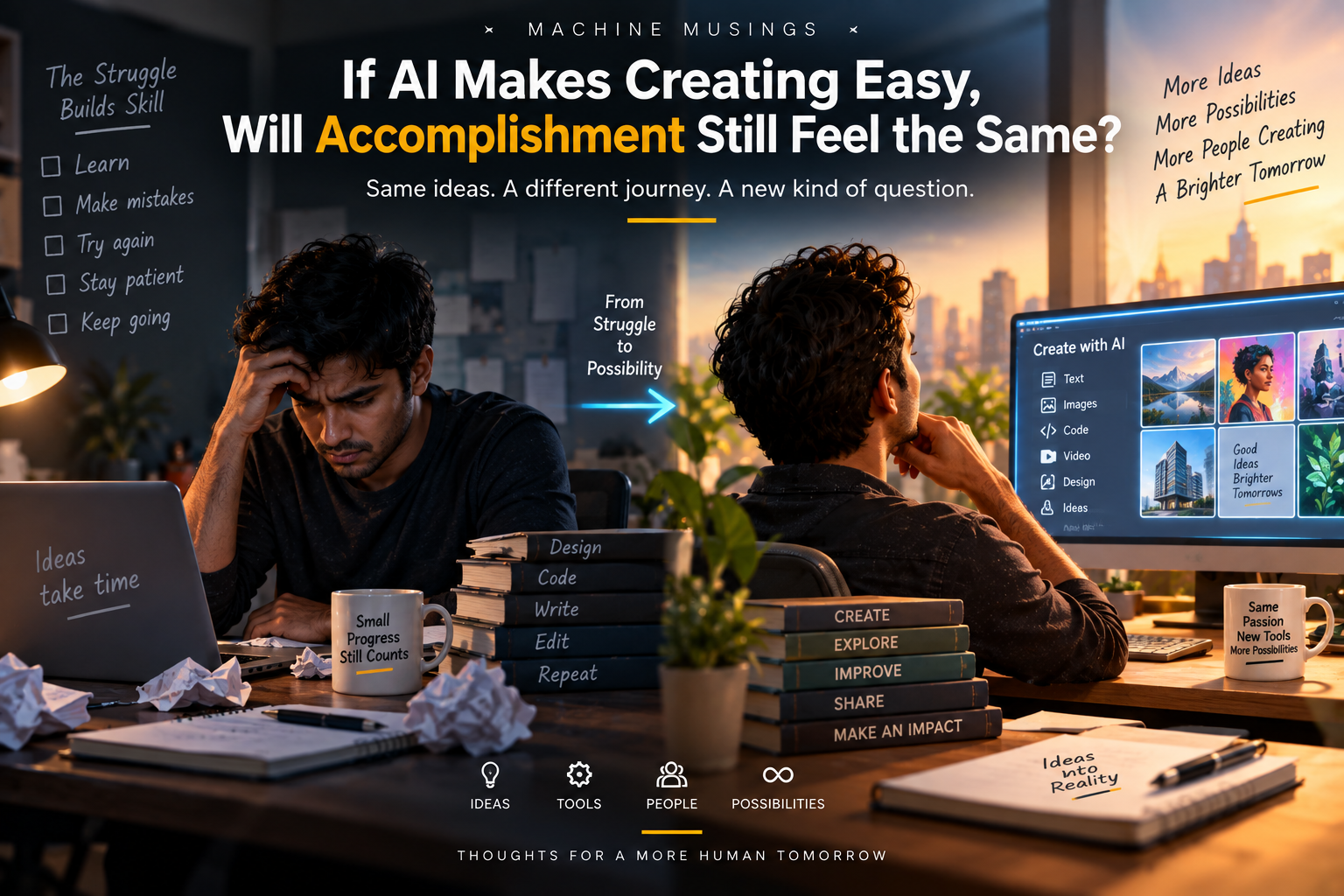
Artificial Intelligence is beginning to change that relationship between effort and creation. Tasks that once required hours, days, or even years of learning can sometimes be started within minutes with AI assistance. Someone who has never designed professionally can generate impressive visuals. A person with limited programming experience can describe an idea and receive working code. Someone who struggles to write can turn rough thoughts into organised text, while musicians, filmmakers, students, entrepreneurs, and creators can increasingly use AI to move from an idea to something tangible much faster than before. This is an extraordinary expansion of what ordinary people can attempt, but it also raises a surprisingly personal question: If AI makes creating easy, will accomplishment still feel the same?
Why Effort Changes How Achievement Feels
There is something different about accomplishing something that was difficult. When we struggle with a task and eventually succeed, the finished result becomes evidence that we were capable of overcoming the difficulty. A person completing their first long-distance run doesn’t feel proud only because they reached a particular location. The achievement includes the training, exhaustion, discipline, improvement, and decision to continue when stopping would have been easier. Someone learning to play an instrument may feel differently about performing a song after months of practice than they would about pressing a button that produced the same music perfectly.
Creative work often contains a similar relationship between difficulty and satisfaction. The frustrating parts of learning to write, design, code, photograph, edit, or build something aren’t always enjoyable while they are happening, but they can become part of why the final result feels personal. When we look back at something we created, we don’t see only the finished object; we remember the process that led to it. AI has the potential to shorten that process dramatically, which is incredibly useful, but shortening the process may also change the emotional relationship we have with the result.
We Have Always Invented Tools to Make Creating Easier
Of course, making creation easier isn’t something AI invented. Human beings have spent centuries building tools specifically because we don’t want every task to remain difficult forever. Cameras made it unnecessary to paint a scene in order to preserve its appearance. Word processors removed the need to rewrite an entire page because of one mistake. Digital editing made many filmmaking techniques faster and more accessible. Website builders allowed people to create websites without writing every line of code manually, while smartphones turned photography, video recording, editing, and publishing into things billions of people could do from a single device.
We rarely look at these developments and conclude that everything created with modern tools is meaningless because earlier generations had to work harder. A photographer using autofocus isn’t automatically less creative than someone manually adjusting every setting. An author using a word processor hasn’t somehow cheated because writers once used typewriters or wrote by hand. Technology has always removed friction from creativity, and in many cases removing that friction has allowed more people to participate. AI may therefore be part of a much longer story in which tools make difficult forms of creation accessible to people who previously couldn’t attempt them.
AI Changes the Distance Between an Idea and a Result
What makes AI particularly interesting is the speed at which it can reduce the distance between imagining something and seeing a version of it. In the past, someone might have had a great idea for an application but lacked programming knowledge. Another person might have imagined a beautiful illustration but lacked drawing skills. Someone else might have wanted to create a short film but lacked the equipment, editing experience, actors, or budget required to make it happen. Many ideas probably disappeared not because they were bad, but because the person who had them couldn’t cross the technical distance between imagination and execution.
AI can reduce some of that distance. A person can describe what they want, experiment with possibilities, receive assistance, make adjustments, and sometimes create something surprisingly sophisticated without first spending years developing every technical skill involved. That could unlock enormous amounts of creativity from people whose strongest ability isn’t necessarily execution but imagination. Someone who previously said, “I wish I knew how to make this,” may increasingly be able to say, “Let me try making it.” That change could be one of AI’s most positive effects on creativity because the opportunity to create would depend less on whether someone already possesses every technical ability required to begin.
But Does Easy Creation Feel Like Creation?
This is where things become complicated. Imagine spending several weeks building something yourself and finally seeing it work. Now imagine describing the same idea to an AI system and receiving a working version five minutes later. The second result might actually be better. It may contain fewer mistakes, look more professional, and accomplish the original goal more effectively. Yet the emotional experience of reaching that result could be very different because one involved a long process of learning and problem-solving while the other involved directing a tool capable of performing much of that work.
That doesn’t mean the second creation has no value. The idea still came from somewhere, someone still decided what they wanted, and someone may have spent considerable time refining the result. However, it does suggest that we may need to rethink what we mean when we say, “I made this.” Creating something with AI can involve different levels of human participation. One person might type a simple request and accept the first result, while another might spend hours experimenting, changing direction, combining outputs, rejecting possibilities, adding personal knowledge, and carefully shaping the final work. Both used AI, but the creative processes were not remotely identical.
Perhaps Accomplishment Has Never Been Only About Difficulty
There is also a danger in romanticising struggle. We sometimes behave as though something becomes valuable simply because it was difficult to make, but difficulty and value aren’t the same thing. Spending ten hours doing something that could have been completed in one hour doesn’t automatically make the result better. Many forms of unnecessary difficulty exist simply because better tools haven’t arrived yet, and once those tools appear, we usually don’t miss the inconvenience very much.
Few people feel that washing clothes was more meaningful when everything had to be washed by hand. We don’t usually refuse calculators because long division provides a stronger sense of accomplishment. Most people don’t deliberately choose slower internet because waiting teaches patience. When technology removes repetitive or unnecessary work, we generally consider that progress. The challenge with AI is identifying which difficulties were merely obstacles and which difficulties were secretly helping us develop something valuable. Some struggles teach patience, judgement, problem-solving, technical understanding, and confidence. Removing the frustration may also remove some of the learning that came with overcoming it.
The Process Often Changes the Person
One reason accomplishment feels meaningful is that completing something difficult doesn’t only change the object we created; it changes us. Someone who spends months learning photography doesn’t simply end up with photographs. They begin noticing light, composition, timing, and details they previously ignored. Someone learning programming doesn’t simply produce software. They develop ways of breaking large problems into smaller ones and thinking logically about how systems work. Someone learning to write doesn’t only produce sentences. They gradually learn how to organise thoughts, communicate clearly, recognise weak arguments, and understand their own ideas better.
If AI allows us to jump directly to the finished result, we may receive the product without experiencing all of the transformation that traditionally happened during the process. That doesn’t necessarily mean we should reject the shortcut, but it does mean the shortcut has a trade-off. Sometimes the difficult path wasn’t valuable because difficulty itself was noble; it was valuable because of what happened to us while we travelled through it. If we use AI to avoid every difficult part of learning, we may need to find other ways of developing the abilities that those difficult parts once taught us.
Beginners May Experience Accomplishment Differently
At the same time, AI could create entirely new forms of accomplishment for people who previously believed certain activities were beyond them. Imagine someone who has always had ideas for websites but never learned programming because the technical barrier felt overwhelming. With AI assistance, they finally create their first working website. From the perspective of an experienced developer, the technical challenge might appear relatively small, but for the person creating it, seeing their idea become real could still feel extraordinary.
Accomplishment is deeply personal because it depends partly on what someone believed they were capable of doing before they began. A task that feels trivial to an expert can be life-changing to a beginner. AI reducing the technical barrier doesn’t necessarily remove the emotional significance of creating something for the first time. In fact, it may allow millions of people to experience the satisfaction of making things they would otherwise never have attempted. The achievement may simply move from “I learned every technical step required to build this” toward “I had an idea and found a way to bring it into the world.”
“I Created This” May Start Meaning Something Different
For generations, the phrase “I created this” often implied that the person possessed many of the skills involved in producing the final result. A painter painted the picture, a writer wrote the sentences, a programmer wrote the code, and a musician performed or composed the music. Modern creative work already complicates this because films, games, advertisements, software, and countless other things are created collaboratively. AI adds another layer by allowing part of the creative process to happen through interaction with a machine.
Perhaps the important question won’t be whether AI was involved, but what role the person played. Did they originate the idea? Did they make meaningful creative decisions? Did they understand what they were trying to communicate? Did they refine the result? Did they contribute experience or perspective that shaped the final work? Did they simply accept whatever the machine produced, or did they actively direct the process? As AI becomes normal, authorship may become less about manually performing every step and more about understanding who provided the intention, judgement, direction, and responsibility behind the finished creation.
When Everyone Can Create, Finishing May Matter More
AI can generate ideas incredibly quickly, and that may actually create a new problem. Instead of struggling to create one possibility, we may suddenly have too many possibilities. Someone can generate twenty designs, fifty names, ten article structures, dozens of images, several versions of a video, and hundreds of potential ideas. Creation becomes easier, but choosing becomes harder.
This could shift accomplishment away from simply producing something and toward having the discipline to decide what deserves to be finished. Starting projects may become almost effortless, while completing something thoughtful and coherent could remain difficult. A person might have hundreds of AI-generated ideas sitting in folders without ever turning any of them into something meaningful. In that world, finishing a project, making difficult choices, removing unnecessary material, refining details, and eventually deciding that something is ready to be shared may provide its own sense of achievement.
Taste Becomes Part of the Creative Work
When AI can produce many alternatives, choosing among them becomes an important part of creation. Imagine asking AI to generate twenty visual concepts. The machine has solved the problem of producing options, but it hasn’t removed the need for someone to decide which option communicates the idea best. The same applies to writing, music, software, business ideas, and almost every other creative activity.
Taste develops through experience. It is the ability to recognise what feels original, useful, beautiful, appropriate, clear, or interesting. AI can make generation abundant, but abundance increases the importance of selection. The accomplishment may therefore shift from “I manually produced every element” toward “I knew what I wanted, recognised the right direction, and shaped many possibilities into something coherent.” That is still creative work, even if the physical or technical execution looks different from what creation meant in the past.
There Is a Difference Between Making Something and Caring About It
AI may eventually make it possible to produce an enormous amount of technically impressive work with very little effort. That doesn’t mean people will care equally about everything they generate. There is a difference between asking a machine to create something because we can and creating something because we genuinely wanted it to exist.
That difference could become increasingly important. When generating an image takes seconds, the interesting question may become why someone wanted that particular image. When writing a basic article becomes easy, the interesting part may be what the person genuinely wanted to say. When building a simple application becomes accessible to almost anyone, the important question may be which problem someone cared enough about to solve. The technical effort required to produce something may decrease while intention becomes more visible. In that sense, meaning may gradually move away from the amount of labour behind a creation and toward the reason the creation exists.
Will We Value Handmade Work More?
There is another possibility worth considering. Whenever mass production makes something abundant, handmade versions sometimes become more valuable rather than disappearing. A factory can produce furniture faster and more consistently than an individual craftsperson, yet handmade furniture still has appeal. Digital photography made taking photographs almost effortless, yet people continue to enjoy film photography. Streaming provides instant access to enormous libraries of music, yet vinyl records returned as something people value partly because of the physical experience around them.
AI could create something similar in creative work. If generated images, music, videos, articles, and designs become extremely common, work that visibly involves human effort may acquire a different kind of appeal. People may value knowing that someone spent weeks drawing something, practised an instrument for years, photographed a real moment, or wrote something from personal experience. This wouldn’t necessarily make AI-generated work inferior. It would simply mean that the story behind how something was created could become part of its value.
Future Generations May Not See the Difference the Same Way
Our reaction to AI-assisted creativity is shaped partly by growing up in a world where many creative skills required particular forms of manual effort. Future generations may see things differently. A child who grows up creating with AI from the beginning may not think of directing an AI system as less legitimate than using Photoshop, a camera, a word processor, or any other creative tool.
The definition of skill changes whenever tools change. People once needed specialised knowledge to develop photographs in darkrooms, while today billions of people take and edit photographs without understanding the chemistry that once made photography possible. That doesn’t mean modern photography has no creativity. The technical skills simply moved. AI may cause a similar shift in which some manual abilities become less central while imagination, direction, judgement, experimentation, and storytelling become more important.
We May Need to Choose Where We Still Want Difficulty
Perhaps the most useful response isn’t to decide that AI should make everything easy or that we should deliberately keep everything difficult. Instead, we may need to choose where difficulty still serves a purpose. If AI can remove repetitive work that teaches us very little, using it seems sensible. If AI can help us begin something we would otherwise never attempt, that can be empowering. If it can explain something when we’re stuck, save time on routine work, or allow us to experiment more freely, those are meaningful advantages.
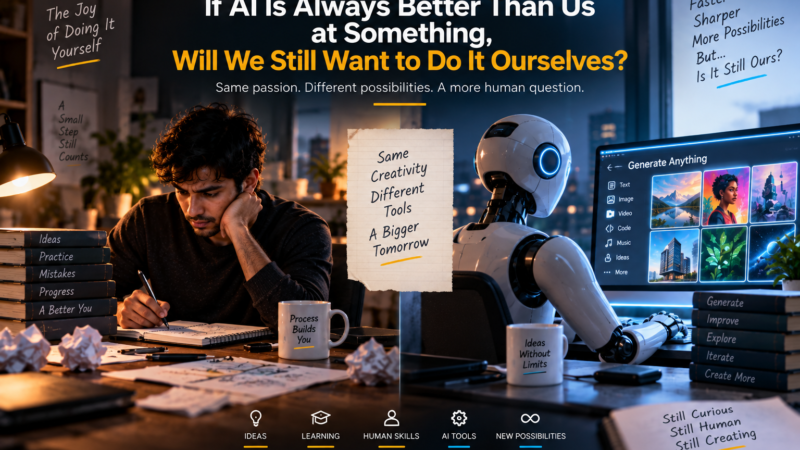
There may also be moments when deliberately doing something ourselves remains worthwhile. We might write the first draft before asking for assistance because forming our own thoughts is part of understanding what we actually want to say. We might attempt a programming problem before asking AI for the solution because struggling with it helps us understand how the code works. We might sketch an idea ourselves before generating alternatives because the imperfect sketch forces us to decide what we are imagining. The purpose wouldn’t be to make life unnecessarily difficult or to prove that we can work without technology. It would simply be recognising that sometimes the process itself is part of what we are trying to gain.
This may eventually become a personal choice rather than a universal rule. Different people will use AI differently depending on what they want from an activity. If the goal is simply to get something done, using as much assistance as possible may make perfect sense. If the goal is to learn a skill, understand a subject, develop confidence, or experience the satisfaction of doing something ourselves, taking the fastest possible route may not always give us what we actually wanted. AI can make the destination easier to reach, but we still have to decide whether reaching the destination was the entire point of the journey.
Accomplishment May Move Somewhere Else
If AI removes some of the effort traditionally involved in creating, our sense of accomplishment may not disappear; it may simply move to different parts of the process. Instead of feeling proud because we manually performed every technical step, we might feel proud because we had the idea in the first place, recognised an opportunity others missed, made good decisions while developing it, kept improving the result, or turned something vague in our imagination into something useful for other people.
Consider someone who uses AI to help build a small business. The AI might assist with the website, branding, emails, research, spreadsheets, marketing material, and even parts of the product itself. That doesn’t mean building the business suddenly becomes effortless. The person still has to decide what to build, understand customers, deal with uncertainty, make mistakes, spend time improving things, and continue when an idea doesn’t work as expected. The technical struggle may decrease while other forms of difficulty remain. Accomplishment could become less connected to how many individual tasks we personally performed and more connected to whether we managed to turn an idea into something that actually mattered.
The Result and the Journey Can Both Matter
There is sometimes a tendency to treat this discussion as though we must choose between valuing the finished result and valuing the effort behind it. In reality, both can matter. A creation can be valuable because it solves a problem, entertains someone, communicates an idea, or makes another person’s life easier regardless of how difficult it was to produce. At the same time, the person who created it may value the experience differently depending on what they learned and how much of themselves they invested in the process.
This means two identical-looking results could carry completely different meanings for the people who created them. One might represent months of learning, while another represents someone finally being able to express an idea they had carried for years but lacked the technical ability to realise. Measuring accomplishment only by effort would miss the second person’s achievement, while measuring it only by the final result would miss everything the first person gained through the process. AI makes this distinction more visible because it separates technical effort from creative possibility in ways that previous tools could not always do.
Maybe the Question Will Become “What Did You Bring to It?”
As AI becomes involved in more creative work, asking whether something was “made with AI” may eventually tell us very little. Almost everything could involve AI at some stage, just as almost every modern piece of writing involves a computer and many photographs involve software processing. The more interesting question may become what the person brought to the creation.
Perhaps they brought an unusual idea, years of experience, a personal story, a particular sense of humour, knowledge of a problem, strong taste, careful judgement, or simply the determination to keep refining something after the first version wasn’t good enough. AI can participate in execution, but it doesn’t automatically make those contributions identical between people. Give the same powerful tool to a thousand people and they won’t necessarily create the same things because they don’t care about the same problems, notice the same details, or imagine the same possibilities.
This could actually make the human part of creation more visible. When technical capability becomes easier to access, the difference between people may increasingly come from intention, perspective, judgement, and the choices they make with that capability. The accomplishment may no longer be entirely about proving that we could perform every step ourselves. It may also be about proving that we knew what was worth making and had enough involvement in the process to make it our own.
Final Thoughts
AI is going to make many forms of creation easier, and that is not something we should automatically fear. There are countless people with ideas they cannot currently express because they don’t have the right technical skills, resources, time, or opportunities. If AI allows more of those people to create, experiment, build, write, design, and explore things that previously felt inaccessible, that could be one of the most exciting things about this technology. Creativity has never belonged only to people who mastered particular tools, and reducing the barrier between imagination and creation could allow ideas to come from far more places.
At the same time, we shouldn’t assume that removing effort has no effect on how achievement feels. Some of our proudest accomplishments matter because of what we had to become in order to reach them. The mistakes taught us something, the frustration developed patience, the repetition created skill, and eventually the finished result reminded us of everything we had learned along the way. If AI removes every difficult step before we have a chance to experience it, we may sometimes receive a better result while missing part of the personal growth that used to come with creating it.
The answer may therefore depend on what we want from the process. Sometimes we simply need the result, and there is little reason to make the journey harder than necessary. At other times, the journey is part of the reason we started. Learning an instrument, writing something ourselves, understanding how a program works, developing an artistic skill, or solving a difficult problem can be valuable even when technology could help us reach the final result faster. AI gives us the option to remove more of the struggle, but having that option doesn’t mean we always have to use it.
Accomplishment in the age of AI may eventually become less about how much difficulty we endured and more about what we contributed, what we learned, why we cared, and what we managed to turn into reality. We may still feel proud of creating something with AI, but the source of that pride could change. Instead of saying that every individual piece was made entirely by our own hands, we may feel accomplished because the idea was ours, the decisions were ours, the direction was ours, and the final result exists because we cared enough to keep shaping it.
If creating becomes easier, accomplishment probably won’t disappear. It may simply become more personal, because each of us will have to decide how much of the process we want technology to handle and how much we still want to experience ourselves. The most meaningful creation may not always be the one that required the greatest amount of effort, nor will it necessarily be the one produced with the least. It may be the one where, after all the tools have done what they can, we can still look at the finished result and recognise something of ourselves in it.