If AI Is Always Better Than Us at Something, Will We Still Want to Do It Ourselves?
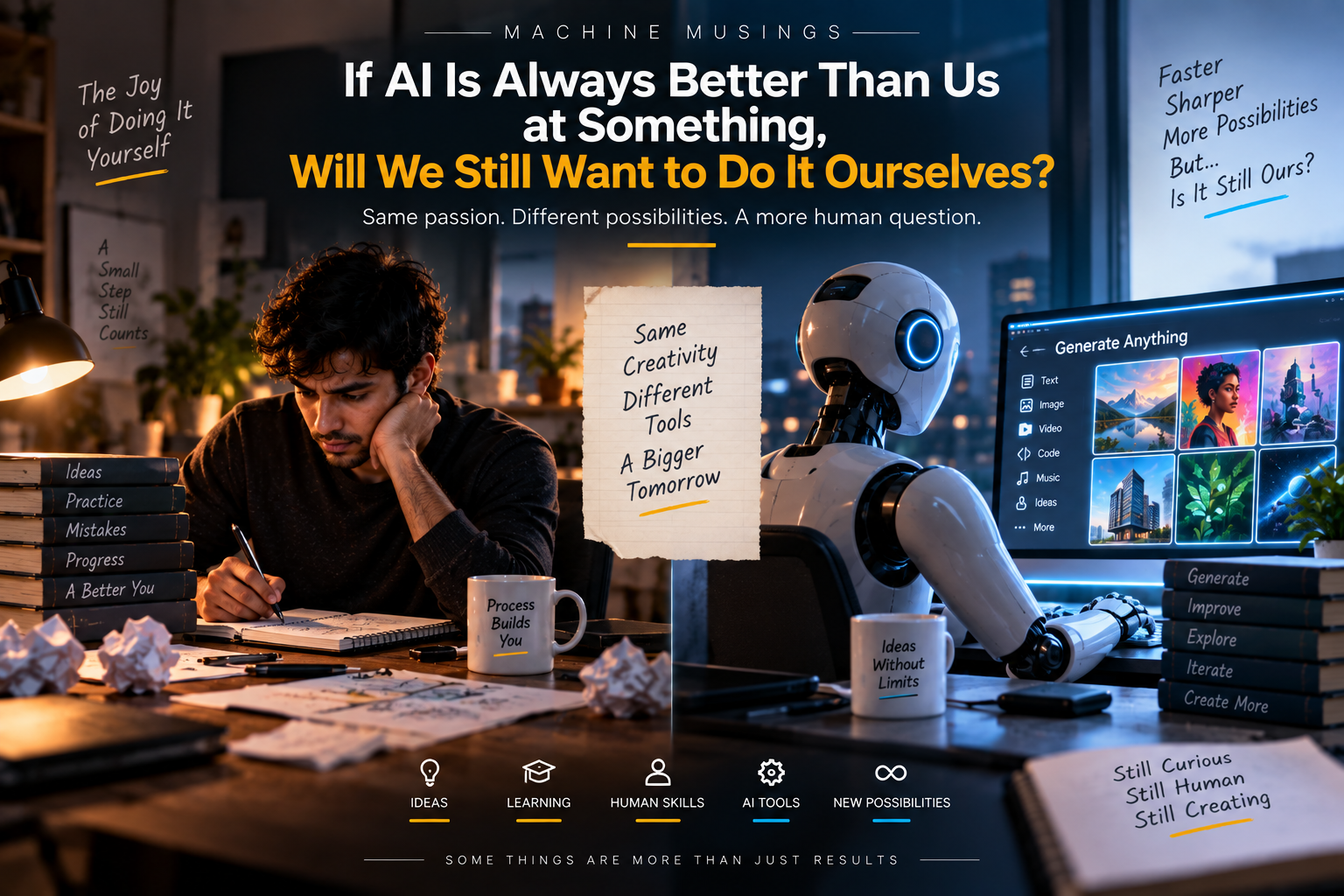
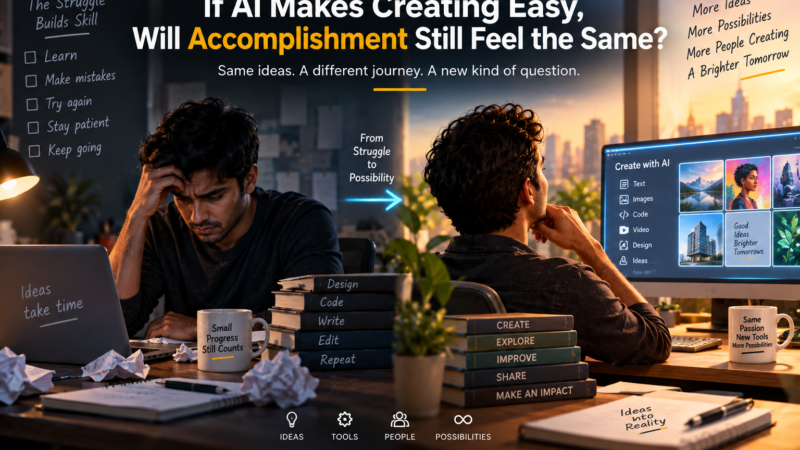
Imagine spending an entire evening trying to create something. Maybe you’re designing a poster, writing a piece of code, editing a photograph, composing music, or simply trying to write something that sounds exactly the way you want. You make mistakes, change things, delete them, start again, and eventually reach a version that makes you feel proud. Then, almost out of curiosity, you ask an AI to attempt the same task. Within seconds, it produces something cleaner, faster, and perhaps even better than what took you several hours to make.
For a moment, you might be impressed. Then another feeling could appear. If AI can already do this better than me, what exactly am I trying to prove by continuing to do it myself?
That question could become much more common as Artificial Intelligence improves. Today, AI can already write, generate images, compose music, help create videos, analyse information, solve programming problems, translate languages, assist with research, and perform many other tasks that once required considerable human skill. It doesn’t perform every one of these tasks better than every human, and quality can vary enormously depending on the task, but the direction is interesting. There may increasingly be activities where an ordinary person knows that a machine can produce a technically stronger result much faster than they can.
We often discuss this in terms of jobs and productivity. If AI can perform a task better, what happens to the person who was paid to perform it? But there is another question that is less economic and much more personal. If AI becomes better than us at something we enjoy doing, will we still want to do it ourselves?
We Don’t Only Do Things Because We Are the Best at Them
Fortunately, human behaviour already gives us part of the answer. Most people who run aren’t faster than a car, yet millions of people run every day. People play chess even though computers can play at a level far beyond almost every human being. Someone might spend an afternoon baking bread even though a bakery can produce it more efficiently. Amateur photographers continue taking photographs even though professional photographers have better equipment and greater skill. People sing despite knowing that countless professional singers sound better, and millions play sports they will never perform professionally.
Clearly, being the best has never been the only reason we do something. Sometimes we do things because the activity itself gives us something. Running can provide physical challenge and a sense of progress. Cooking can be relaxing or meaningful when we prepare something for people we care about. Playing an instrument can feel satisfying even if nobody else ever hears us. Drawing can be enjoyable even when the picture is imperfect. The value of an activity can exist separately from whether the final result is objectively better than something another person or machine could produce.
AI may force us to remember this distinction because it could make comparison unavoidable. When a better result is available almost instantly, we may have to decide whether we were doing something because we wanted the result or because we valued the experience of producing it.
The Beginner May Face a New Kind of Problem
Being a beginner has never been particularly comfortable. Your first drawings don’t look like the pictures you imagined. Your first attempts at programming produce errors you don’t understand. Your first photographs don’t resemble professional photography. Your first few weeks learning an instrument can sound frustratingly different from the music that inspired you to begin.
Traditionally, however, there was an understandable distance between a beginner and an expert. You could look at someone’s impressive work and recognise that they had spent years developing the skill. Their ability could even become motivation because it showed what practice might eventually make possible.
AI changes that comparison because extraordinary-looking results can appear immediately. Someone learning illustration could spend hours working on a drawing and then watch an AI generate a polished image in seconds. A beginner learning programming might struggle with a relatively simple application while an AI assistant generates much of it almost instantly. Someone learning to write might carefully construct a paragraph and then see several polished alternatives appear with a single request.
The danger isn’t simply that AI is better. It is that the beginner may start comparing the earliest stage of their own development with the immediate output of a system trained on enormous amounts of existing material. That is an unfair comparison, but emotionally it may not always feel unfair. If the machine can already produce the result you wanted, tolerating the awkward period of being a beginner may become harder.
Will We Still Have the Patience to Be Bad at Something?
Almost every meaningful skill requires a period when we aren’t particularly good at it. Learning involves making mistakes, receiving feedback, trying again, and slowly developing an understanding that wasn’t there before. The problem is that being bad at something isn’t always enjoyable, especially when a much better result is available instantly.
Imagine a teenager learning digital art. They spend an hour creating something that doesn’t look quite right. Beside them is an AI tool capable of generating twenty impressive alternatives in less than a minute. Continuing to practise requires accepting that their own work may look worse for quite some time. The reward of improvement exists somewhere in the future, while the reward of generation is available immediately.
This may become one of the quieter challenges of growing up with highly capable AI. Previous generations had shortcuts too, but future generations may have access to something capable of skipping much larger parts of the learning process. The question won’t necessarily be whether they are able to learn difficult skills. It may be whether they can see enough reason to remain uncomfortable long enough to develop them.
Learning Something Gives Us More Than the Final Result
The strongest reason to continue learning may be that skills change more than what we can produce. Learning photography doesn’t only allow someone to take better photographs. Over time, they begin noticing light, shadows, composition, expressions, colours, and moments they might previously have ignored. Learning music can change the way someone listens to songs. Learning programming can change the way someone thinks about problems and systems. Learning another language can introduce ways of expressing ideas that don’t translate perfectly into one’s first language.
The final output is only one part of what learning gives us. The process develops judgement, patience, understanding, attention, confidence, and sometimes an entirely new way of looking at the world.
AI might be able to produce a beautiful photograph without giving us a photographer’s eye. It might generate working code without giving us the understanding required to recognise why the code works. It can translate a sentence without giving us the experience of understanding another language when somebody speaks it. It can create music without giving us the feeling of gradually becoming capable of playing an instrument.
If we judge skills only by their outputs, AI may make many forms of learning appear unnecessary. If we judge them by what learning does to the person, the calculation becomes very different.
There Is Satisfaction in Knowing “I Can Do This”
There is also a particular kind of confidence that comes from developing an ability ourselves. Knowing that a tool can solve a problem is useful, but knowing that we understand the problem creates a different feeling. The difference becomes especially obvious when the tool isn’t available or when something goes wrong.
Someone who understands photography can still make creative decisions regardless of which camera they are holding. Someone who understands programming can recognise when generated code behaves incorrectly. Someone who understands writing can identify when an AI-generated paragraph sounds convincing but says very little. Knowledge gives us the ability to evaluate tools rather than simply accepting their output.
This means expertise may remain valuable even when AI can perform much of the execution. In fact, highly capable AI could make understanding more important in certain situations because someone still needs to recognise whether the machine produced something good, appropriate, accurate, safe, or useful. The ability to generate something and the ability to judge it aren’t necessarily the same skill.
Perhaps AI Will Change What Mastery Means
For a long time, mastery has often meant becoming extremely good at performing a particular task. A skilled programmer could write complex software, an illustrator could produce detailed artwork, a musician could perform difficult compositions, and a writer could turn ideas into carefully structured language.
AI could change where some of that mastery sits. Instead of manually performing every step, people may increasingly work with intelligent tools while remaining responsible for direction, judgement, refinement, and the final result. A programmer may write less routine code but spend more time designing systems and understanding difficult problems. A designer may manually create fewer initial variations but spend more time deciding which direction communicates an idea effectively. A filmmaker might use AI for parts of production while focusing more heavily on storytelling and creative decisions.
That doesn’t necessarily mean traditional skills disappear. There will probably continue to be people who value doing things manually, just as there are still photographers who shoot film, musicians who prefer analogue instruments, and craftspeople who make things by hand. But the definition of being “good” at something may expand. Knowing when to use AI, when not to use it, how to recognise weak output, and how to add something the machine cannot easily provide may become part of expertise itself.
The Result Isn’t Always the Point
Consider cooking dinner. If the only objective is obtaining food, ordering a meal is often easier than cooking it yourself. Yet people still cook. Some enjoy experimenting with ingredients, some find the process relaxing, some want control over what they eat, and others enjoy preparing something for their family or friends. The meal matters, but the experience surrounding it matters too.
The same can be true for many creative and intellectual activities. Someone might write in a journal even though AI could produce more polished prose because the purpose is to understand their own thoughts. A person might sketch something while travelling even though their phone can capture the scene more accurately because drawing forces them to observe it differently. Someone might solve a puzzle without asking AI for the answer because the satisfaction exists precisely in not knowing the solution at the beginning.
AI can produce an outcome, but not every activity is simply a problem waiting for the fastest possible outcome. Sometimes the time, effort, uncertainty, mistakes, and gradual improvement are part of what makes the activity worth doing.
We Already Accept Being Worse Than Machines
There is something reassuring about the fact that this isn’t entirely new. Humans have spent a long time creating machines that outperform us physically and computationally. A crane can lift more than a person, a calculator can perform arithmetic faster, a vehicle can travel faster, and a computer can search enormous amounts of information more quickly than any human being.
We generally don’t experience these machines as personal insults because we stopped measuring our value against them. Nobody feels embarrassed because they cannot outrun a motorcycle. We understand that the machine was built specifically to perform certain tasks more efficiently.
AI feels different because it is entering areas we have traditionally associated with intelligence and creativity. Writing, drawing, reasoning, composing music, and solving problems feel closer to our identity than lifting heavy objects. When a machine becomes capable in those areas, comparison can feel more personal.
Perhaps that feeling will change over time. Future generations may find the idea of competing directly with AI as strange as competing with a calculator at arithmetic speed. They may simply treat AI capability as part of the environment and focus on what they want to accomplish with it.
Competition With AI May Be the Wrong Competition
If a person can create an illustration in three hours and AI can generate one in ten seconds, trying to defeat AI purely on speed probably doesn’t make much sense. The same could eventually be true in writing, coding, analysis, translation, and many other areas.
The more useful question may be what the person can contribute that makes the activity meaningful. That could be lived experience, cultural understanding, personal taste, emotional context, responsibility, curiosity, humour, or simply the reason something was created in the first place.
AI can generate thousands of possible outputs, but abundance doesn’t automatically create significance. If everyone can generate impressive things, deciding what deserves to exist may become more important than simply demonstrating that something can be generated. Human contribution may gradually shift from proving that we can outperform machines toward deciding what is worth doing with the capabilities machines give us.
AI Could Actually Help More People Discover Skills
There is another side to this discussion that shouldn’t be ignored. AI might discourage some people from learning certain skills, but it could also help many others begin.
Someone interested in programming may have previously quit because the first errors felt impossible to understand. An AI tutor capable of explaining those errors patiently could help them continue. Someone learning a language could practise conversation whenever they wanted without feeling embarrassed about making mistakes. A beginner photographer could receive immediate explanations about composition. Someone learning music could ask questions that they might have been afraid to ask a teacher.
Used this way, AI doesn’t replace the process of learning. It reduces the frustration that prevents someone from staying with the process long enough to improve.
The difference may depend on how we use it. Asking AI to do everything for us and asking AI to help us understand how to do something ourselves can look similar from the outside, but they create very different experiences.
“Help Me” and “Do It for Me” May Lead to Different Places
Perhaps one of the most important choices we will make with AI is deciding when we want assistance and when we want replacement. If I’m trying to learn programming, there is a difference between asking AI to explain why my code doesn’t work and asking it to rewrite the entire program. If I’m learning to write, there is a difference between asking for feedback on my argument and asking AI to create the argument for me.
Neither approach is automatically wrong. Sometimes we don’t want to learn the underlying skill; we simply need something completed. There is no reason everyone should learn graphic design before creating a simple invitation or become a programmer before building a small personal tool. AI can remove barriers that previously prevented people from turning ideas into reality.
But when the goal is learning, using AI only to reach the answer may remove exactly the experience we were trying to gain. The useful question could therefore become not simply “Can AI do this for me?” but “What do I want to get from doing this?”
Hobbies May Become More Important, Not Less
A world filled with highly capable AI might actually increase the importance of hobbies. If machines perform more economically useful tasks, activities that we do simply because we enjoy them could become a stronger part of how we define ourselves.
Someone may paint without caring whether AI produces better images. Another person may learn guitar without expecting to become a professional musician. People may garden despite automated systems being able to grow food more efficiently, cook despite machines being capable of preparing meals, and write stories that only a few friends ever read.
The absence of economic necessity doesn’t make an activity meaningless. In some cases, it may make the motivation more personal. We aren’t doing it because somebody needs the output. We are doing it because the process gives something back to us.
If AI becomes better at more tasks, we may eventually rediscover the difference between doing something because we have to and doing something because we want to.
Human Imperfection May Become Part of the Appeal
There could also be a cultural shift in how we value imperfection. If AI-generated work becomes increasingly polished, technically correct, and abundant, imperfections that reveal a human process may become more noticeable.
A slightly uneven handmade object tells us something about how it was made. A live musical performance can contain tiny variations that wouldn’t appear in a perfectly generated recording. A handwritten note contains details that a perfectly formatted message doesn’t. A photograph taken at exactly the wrong moment can sometimes become more meaningful than a flawless image.
This doesn’t mean we should deliberately produce bad work to prove that we are human. It simply means that perfection isn’t the only thing people value. Personality, history, effort, context, and imperfection can all contribute to why something matters.
When perfect-looking output becomes cheap, evidence that someone genuinely cared enough to make something may become valuable in a different way.
Children May Need a Reason to Learn Beyond “You’ll Need This Someday”
For generations, adults have encouraged children to learn skills by explaining that they will need them later in life. Learn mathematics because you will use it. Learn to write because your career will require it. Learn another language because it will create opportunities. Learn computer skills because technology will become important.
AI may make some of those explanations harder. A child could reasonably ask why they need to learn something when a machine available in their pocket can already do it.
The answer may need to become deeper. We learn mathematics not only to perform calculations but to understand relationships and reason about problems. We learn writing not simply to produce paragraphs but to organise our thoughts and communicate clearly. We learn languages not only to translate sentences but to understand people and cultures differently. We learn art not because society desperately needs more drawings but because creating teaches us to observe and express.
If AI makes the practical justification for some skills weaker, perhaps education will have to become better at explaining the human reasons for learning them.
We May Need Spaces Where AI Isn’t the Point
As AI becomes integrated into almost every application, there may also be value in preserving activities where optimisation isn’t the goal. A person might deliberately write without assistance, draw on paper, play a physical instrument, solve a puzzle without looking up the answer, or take a walk without asking an algorithm to choose the perfect route.
This doesn’t need to become a rejection of technology. We already move between automated and manual experiences depending on what we want. Someone can drive to work during the week and still enjoy cycling on the weekend. A person can stream music while also enjoying a live concert. Convenience and deliberate effort can coexist.
The important thing may be preserving the choice. If AI becomes available everywhere, we should still be able to decide when we want the fastest result and when we want the experience of getting there ourselves.
Being Better Isn’t the Same as Being Meaningful
Machines may eventually outperform us in an extraordinary range of tasks, but performance is only one way of measuring value. A chess computer can play better than almost every human being, yet two friends playing chess together can still have an enjoyable evening. A professional photograph may be technically better than a picture taken by a parent, but the family photograph may matter far more to the people in it.
Meaning often comes from context rather than performance. Who made something, why they made it, what they experienced while doing it, and who they shared it with can matter as much as technical quality.
AI might therefore force us to separate two questions that we often treat as the same: “Who can do this best?” and “Why do I want to do this?”
The first question may increasingly have a machine as the answer. The second remains much more personal.
Final Thoughts
If AI becomes better than us at more things, there will probably be moments when doing those things ourselves feels unnecessary. When a machine can produce something faster, cheaper, and more accurately, choosing the slower human route may occasionally look inefficient. For tasks where we only care about the result, that may be perfectly fine. There is no reason to spend hours doing something manually simply because previous generations had no alternative.
But not everything we do is about efficiency. We learn, practise, create, experiment, and struggle because those experiences change us. Becoming capable of doing something can build confidence even when we rarely need to use the skill. Understanding how something works can help us judge the machines doing it for us. Creating something imperfectly can feel more satisfying than receiving something perfect instantly because the imperfect version contains our effort, decisions, and progress.
Perhaps AI will eventually make us think more carefully about why we develop skills at all. For a long time, usefulness and learning were closely connected because knowing how to do something was often necessary if we wanted the result. AI could separate those two things. We may no longer need to learn a skill simply to access what that skill produces, which means choosing to learn it could become more deliberate.
That doesn’t necessarily make human skills less valuable. In some ways, it could make them more personal. We might learn because we enjoy understanding something, create because we want to express ourselves, practise because improvement feels satisfying, and continue doing things even when machines can outperform us because being better was never the only reason those activities mattered.
AI may eventually be able to write better, calculate faster, generate more possibilities, and solve certain problems more efficiently than most of us. The challenge won’t always be finding something the machine cannot do. It may be recognising which things are still worth doing ourselves even when the machine can do them better, because sometimes the value of an activity isn’t found only in what we produce at the end. It is also found in what happens to us while we are doing it.