If AI Can Make Everything Personal, Will We Lose the Things We Share?
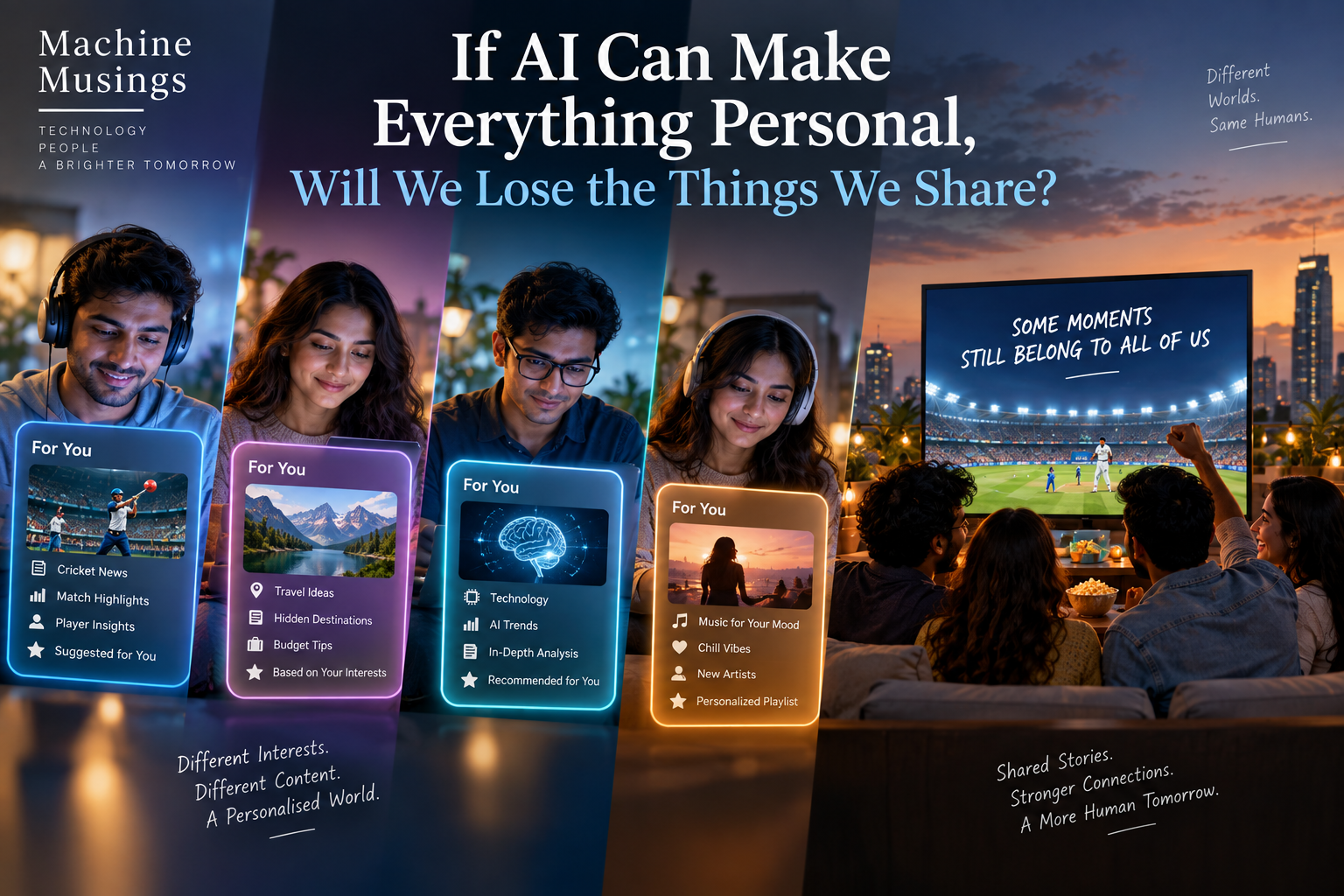
Imagine two people sitting next to each other and asking AI exactly the same question. One receives a short explanation filled with examples from cricket because the AI knows that is how they understand things best. The other receives a detailed explanation connected to business because that matches their interests and previous conversations. Both people understand the subject better, both receive an answer designed specifically for them, and both walk away satisfied. Now take that same idea beyond explanations. Imagine news presented differently for every reader, lessons individually created for every student, advertisements generated for one person at a time, music adapted to your mood and television shows whose characters, humour or even endings change according to whoever is watching. The internet has already been moving towards personalization for years, but AI could take it much further. Instead of simply recommending different things to different people, it could eventually create different things for different people. That sounds incredibly useful, but it also raises an interesting question: if technology becomes capable of creating a world perfectly suited to each of us, what happens to the parts of the world we used to experience together?
We Already Live in Personalized Worlds
Personalization is not something AI suddenly invented. Social media feeds already decide which posts appear first based on what we watch, like, share and ignore. Streaming platforms recommend different films and shows to different people, online stores rearrange recommendations around our shopping behaviour, music apps learn what we enjoy and search engines sometimes adjust results using context such as location and previous activity. Two people can open the same platform at exactly the same time and see completely different versions of it. We have gradually become accustomed to the idea that technology should understand what we like and remove the effort of searching through everything else.
There is a good reason personalization became so popular. The internet contains far more information, entertainment and products than any person could realistically explore. Without some kind of filtering, finding something relevant would become exhausting. Personalization helps turn an overwhelming amount of choice into something manageable, and AI could make that process far more sophisticated. Instead of knowing only that you usually watch science-fiction films, an AI system might understand what kind of stories you enjoy, which themes interest you, how much time you have available and even what kind of mood you are in. Instead of giving every student the same explanation, it could recognise where one student is struggling and explain the idea differently. Personalization at that level could make technology feel less like a system designed for millions of people and more like something that genuinely understands the individual using it.
AI Could Move From Recommending to Creating
The bigger change may come when personalization moves beyond choosing existing content and begins creating the content itself. Today, a streaming service might recommend one film to you and another to someone else. In the future, AI could potentially change parts of the film itself. The pace could be different, the humour could reflect your preferences, supporting characters might receive more or less attention and perhaps even the ending could change depending on what the system believes you would enjoy most. Music could be generated around your current mood rather than selected from a catalogue. Games could continuously create environments and stories based on the way you play. Educational material could be rewritten instantly according to how each student learns.
Information could become equally personal. An AI assistant might explain a complicated news story using the amount of background knowledge it knows you already have. Someone unfamiliar with the subject might receive a simple introduction, while someone who follows it closely receives a deeper analysis. Medical, financial or technical information could be translated into language appropriate for the person reading it. There are enormous advantages to this because information becomes easier to understand without forcing everyone into the same format. The question is not whether personalization can be useful. It clearly can. The more interesting question is what changes when personalization becomes the default way we experience almost everything.
Shared Experiences Give Us Something to Talk About
Think about how often conversations begin because two people experienced the same thing. A major cricket match ends and people discuss the final over the next morning. A popular film releases and friends argue about whether the ending worked. A song becomes popular and suddenly it is playing at weddings, shops, parties and inside cars. A television series reaches its finale and millions of people already know what someone means when they mention a particular scene. Even people who disagree completely about what they watched are still starting from a common experience.
These shared moments may seem like a small part of culture, but they create connections between people who might otherwise have little in common. You do not need to know someone personally to ask whether they watched last night’s match. You do not need to have the same background as someone to recognise a song both of you heard growing up. Shared culture gives strangers common reference points, families memories they can return to and generations experiences they associate with a particular period of their lives. If entertainment eventually becomes individually generated, those common reference points could become less common. You might love a series that technically nobody else has watched because the version you experienced was created specifically for you.
What Happens When We No Longer See the Same Story?
Personalization becomes even more complicated when it involves information rather than entertainment. It is helpful when AI explains something in a way that makes sense to us, but there is a difference between personalizing how information is explained and personalizing the information itself. If two people ask about the same event, they might receive answers emphasising completely different details because the system knows what each person usually cares about. Neither response necessarily has to be false for the two people to leave with noticeably different impressions of what happened.
This matters because understanding the world has always required some degree of shared reality. People can disagree about what an event means, what should happen next or which argument is stronger, but productive disagreement becomes much harder when everyone begins from a completely different collection of facts and context. AI could help solve this by making complex information easier to understand and by exposing people to multiple perspectives, but personalization could also work in the opposite direction if systems become too focused on giving us the version of information we are most likely to engage with. A world where information understands us perfectly is useful, but it becomes less useful if it rarely shows us anything outside what it already knows about us.
Personalization Can Quietly Become a Comfort Zone
One of the attractive things about personalized technology is that it reduces friction. We see more things we like, hear more opinions that interest us and spend less time sorting through things that feel irrelevant. AI could make this comfort incredibly precise. It might know which writing style keeps our attention, which arguments we find convincing, which topics make us uncomfortable and what kind of explanation makes us most likely to continue reading. That knowledge could be used to make technology genuinely helpful, but it could also create environments that become increasingly difficult to leave.
Sometimes encountering something that was not designed for us is valuable. We watch a film chosen by a friend and discover a genre we never would have selected ourselves. We hear a song because someone else played it rather than because an algorithm predicted we would enjoy it. We read an argument we initially disagree with and discover that one part of it makes us reconsider our position. We travel somewhere unfamiliar and realise that the experience is interesting precisely because it was not adapted around our preferences. If everything constantly adjusts itself to fit us, we might become less accustomed to adjusting ourselves to things that do not.
The Same World Can Look Different to Everyone
There is another possibility that becomes more interesting as AI-generated interfaces develop. Websites, apps and digital services may eventually stop having one fixed appearance. An AI system could rearrange an interface according to what each person needs. Someone who prefers simplicity might see only a few options, while an experienced user sees advanced controls. A shopping site could present products differently based on what matters most to each customer. News sites could organise stories according to individual interests, and educational platforms could build completely different learning paths for every student.
This could make digital experiences far more accessible and useful, but it also means that the idea of everyone using the same internet begins to disappear. Two people could visit the same service and experience something substantially different. In many situations that would be an improvement, but it also makes transparency more important. If a system is changing itself around us, we should have some understanding of what is being changed and why. Personalization is easiest to trust when we know that it is helping us navigate the world rather than quietly deciding which parts of the world we should see.
Maybe Shared Culture Will Not Disappear, but Change
It would be easy to assume that extreme personalization automatically means the end of shared experiences, but humans have a habit of creating common culture even when technology changes. The internet fragmented television audiences, yet global shows still become cultural events. Streaming gave everyone access to enormous music libraries, yet particular songs still spread across millions of people. Social media created personalized feeds, yet memes, moments and conversations still escape those feeds and become widely recognised.
AI may create something similar. Perhaps people will deliberately share personalized experiences with one another. Someone might generate a song and send it to friends, who then create their own versions. A story originally made for one person could become popular enough that others ask their AI systems to recreate or adapt it. Communities may form around ideas rather than identical pieces of media. Shared culture might become less about everyone consuming exactly the same thing and more about people continuously remixing experiences together. That could create forms of culture that are difficult to imagine from where we are today.
There May Be Value in Things That Are Not Made for Us
As personalization becomes more powerful, experiences that are intentionally the same for everyone may become more meaningful. A film that refuses to change its ending based on what viewers prefer, a book that asks readers to enter the author’s world rather than adapting itself to theirs, a classroom discussion where everyone begins with the same material or a public event experienced together could feel different in a world where most digital experiences are individually generated.
There is something valuable about encountering another person’s perspective without having it automatically translated into the version most comfortable for us. Art sometimes challenges us precisely because the creator did not know who we were when they made it. A conversation can surprise us because another person does not behave according to our preferences. Shared experiences require a small amount of compromise because the experience belongs to everyone rather than being perfectly designed for any one person. That imperfection may be part of why those experiences connect us.
Personalization Should Expand Our World, Not Shrink It
The most useful version of personalized AI may not be one that continuously gives us more of what we already like. It could be one that understands us well enough to occasionally show us something we would never have chosen ourselves. If an AI knows that we normally read about technology, perhaps it can recognise when a story about history, science, art or another culture might genuinely interest us. If it understands our opinions, perhaps it can introduce a thoughtful opposing argument instead of simply reinforcing what we already believe. Personalization does not have to mean creating a smaller world around each person. Used differently, it could become a way of helping people explore a larger one.
That may require us to think differently about what we want from intelligent systems. The easiest measure of success is whether the AI keeps us satisfied, engaged and comfortable. A more meaningful measure might be whether it occasionally makes us curious about something outside ourselves. Technology that knows us extremely well should perhaps do more than reflect our existing preferences back at us. It could help us discover preferences we did not know we had, ideas we had never considered and people whose experiences are different from our own.
We Still Need a World That Belongs to Everyone
AI could make the digital world more personal than anything we have experienced before. Our entertainment could understand our taste, our education could adapt to the way we learn, our information could arrive in exactly the form we understand best and our digital environments could reorganise themselves around our needs. Much of that would be genuinely useful, and rejecting personalization simply because it changes familiar habits would mean ignoring many of its benefits.
The challenge is making sure that a world designed increasingly around individuals still leaves enough room for things we experience together. We need moments where everyone sees the same match, hears the same song, reads the same story, encounters the same facts or simply experiences something that was not created specifically to satisfy them. Those moments remind us that we are not only individuals surrounded by technology that understands us. We are also part of families, communities, societies and cultures that depend on having something in common.
Perhaps the future question will not be whether AI knows us well enough to create a world for each of us. It probably will. The more important question may be whether, among millions of perfectly personalized worlds, we remember to keep enough places where we can still meet each other.