If AI Can Speak for Us, Will We Get Worse at Difficult Conversations?
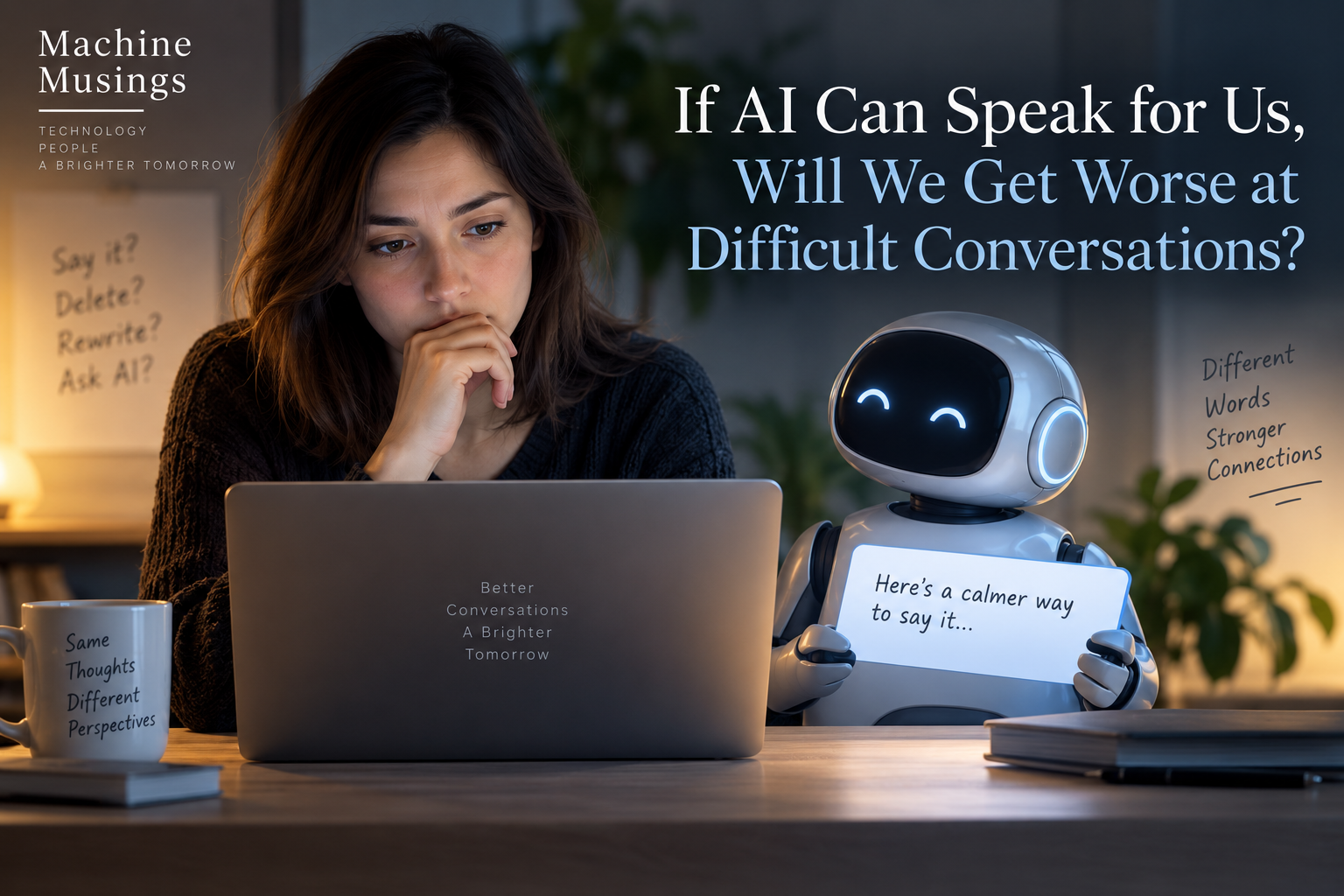
Imagine you need to tell someone something you know they probably won’t like. Maybe you need to apologise after an argument, tell a friend that something they did bothered you, give difficult feedback to a colleague, decline an invitation without hurting someone’s feelings, or explain why you no longer want something to continue. You type a message, read it, delete half of it and rewrite it, but it still doesn’t sound right. Eventually, you open an AI assistant and type, “Can you say this politely for me?” Within seconds, you have a message that sounds calm, thoughtful and carefully worded. It says what you wanted to say without sounding rude, and perhaps it even expresses your feelings better than you could have done in that moment. You make a few changes, press send, and the difficult part seems to be over. But that convenience raises an interesting question: if AI becomes increasingly good at finding the right words for us whenever communication becomes uncomfortable, could we slowly become worse at finding those words ourselves?
This is one of the more ordinary ways Artificial Intelligence is entering our lives. We often talk about AI helping us write reports, create images, analyse information, write code or complete work faster, but communication may become one of its most personal uses. There are already moments when we know what we want to say but cannot figure out how to say it. We might be angry and worry that our message sounds too harsh, nervous about saying no, unsure how to apologise properly or afraid that an honest conversation could damage a relationship. In situations like these, having something that can calmly help us organise our thoughts can be genuinely useful. The interesting part is that communication is not simply about arranging words correctly. The struggle to find those words has always been part of understanding what we actually think and feel.
AI Could Actually Help Us Communicate Better
There is a positive side to this that shouldn’t be ignored. People sometimes hurt each other not because they intended to, but because they communicated badly in the moment. Someone sends a message while angry, chooses the wrong words and creates an argument that becomes much bigger than the original problem. Someone else may genuinely want to apologise but phrase the apology in a way that sounds defensive. Another person may avoid saying something important for weeks because they simply don’t know how to begin the conversation. AI can create a little distance between the emotion we are feeling and the words we eventually send. We can write what we are thinking, ask AI how it might sound to someone else and then decide whether there is a calmer or clearer way to express the same thought.
Used in this way, AI could make communication more thoughtful rather than less human. Someone who struggles with writing may finally be able to express something they have wanted to say for a long time. Someone communicating in a language they are less comfortable with may be able to explain themselves more accurately. A person preparing for a difficult workplace conversation might use AI to think through how their words could be interpreted before speaking to a colleague. The important distinction is whether AI is helping us communicate something we already mean or whether it is beginning to decide what we should say on our behalf. In the first situation, the thought still belongs to us. AI is simply helping us express it more clearly.
But What Happens When AI Always Writes the First Draft?
The situation becomes more complicated when we stop trying to find the words ourselves. Imagine that every uncomfortable message begins with the same habit: we give AI a few sentences explaining what happened and ask it to write the response. The result is good, so we copy it, make a small change and send it. The next time something uncomfortable happens, we do the same thing because it worked before. Over time, we might become extremely good at sending thoughtful messages without necessarily becoming better at having thoughtful conversations.
Writing something difficult forces us to organise what is happening inside our own minds. We have to decide what we are actually angry about, what we want the other person to understand, whether we have contributed to the problem, what we are willing to compromise on and what matters enough that it needs to be said. Sometimes we begin writing a message believing one thing and realise halfway through that the real problem is something completely different. That messy process is not always wasted effort. It can be part of understanding ourselves. If AI immediately turns a few rough thoughts into a polished message, we may gain clarity in the final result while skipping some of the thinking that would normally happen while trying to create it.
Difficult Conversations Are Also a Form of Practice
Nobody particularly enjoys uncomfortable conversations, but they teach skills that easier conversations rarely require. We learn how to listen when our instinct is to defend ourselves, how to disagree without attacking someone, how to explain why something hurt us without turning the conversation into a list of accusations and how to apologise without immediately following the apology with an excuse. We also learn something that no perfectly generated message can completely prepare us for: people are unpredictable. You can spend half an hour creating the perfect opening message, but the person receiving it might respond with something you never expected. They may become upset, disagree with your version of events, ask a difficult question or reveal something that completely changes how you understand the situation.
At that point, the prepared script ends and the actual conversation begins. You have to listen, understand what the other person is saying and respond in real time. Those moments can be awkward and uncomfortable, but that is also where communication becomes a skill rather than a piece of polished writing. If we repeatedly allow AI to handle the beginning, middle and end of difficult exchanges, we may get better outcomes in some situations while getting less practice at dealing with the unpredictability that comes with real human relationships.
When the Words Are Perfect, Does Sincerity Change?
There may also be a strange new question around sincerity. Imagine receiving a long apology from someone after an argument. It acknowledges what happened, recognises how you felt, accepts responsibility and explains what the person wants to do differently. It is exactly the kind of apology you hoped to receive. Later, you discover that most of it was generated by AI after the person entered a short description of the argument. Would knowing that change how the apology feels?
The answer probably depends on the situation. The person may genuinely agree with every word. Perhaps they knew they were wrong but had difficulty expressing it, and AI simply helped them communicate something sincere. In that case, dismissing the apology simply because AI helped write it might be unfair. At the same time, part of what makes personal communication meaningful is the effort involved in reaching another person. When someone sits down, thinks carefully about what happened and struggles to find the words to repair a relationship, that effort can itself communicate something. If beautifully written apologies, expressions of gratitude, condolences and emotional messages can be generated within seconds, we may eventually start caring not only about what a message says but also about how much of the thought behind it actually came from the person who sent it.
AI Could Become an Emotional Middleman
Today we mostly think of AI as something that helps us write a message, but future systems could become much more involved. An AI assistant that has access to our conversations might notice patterns in how we communicate, warn us that a message sounds unnecessarily aggressive, suggest when someone appears upset or remind us that we have been avoiding an important conversation. It might analyse an argument and suggest what each person appears to be misunderstanding. Some of these possibilities could be genuinely helpful. There are situations where an outside perspective helps us see something we were too emotional to notice ourselves.
The concern begins when the assistant becomes a permanent middleman between people. If AI repeatedly tells us how to respond to criticism, when to apologise, how to comfort someone, what tone to use and how to express affection, we could slowly outsource parts of emotional judgement that previously developed through experience. The change would probably not feel dramatic. It would simply become convenient to ask for help whenever something becomes uncomfortable. Eventually, the question may not be whether AI can communicate better than we can, but whether we still feel confident communicating without it.
Maybe AI Should Help Us Prepare Rather Than Speak for Us
There is a useful difference between asking AI to replace a difficult conversation and asking it to help us prepare for one. Instead of saying, “Write an apology I can send,” we could write our own apology and ask whether any part sounds defensive or unclear. Instead of asking AI what to say during a disagreement, we could explain the situation and ask what perspective we might be overlooking. Before sending an emotional message, we could ask how someone else might interpret it. AI can then act more like a mirror that helps us examine our communication rather than a spokesperson that communicates on our behalf.
That approach also keeps something important in our hands: judgement. AI can suggest ten different ways to say something, but we still need to decide which one actually represents what we believe. Sometimes the most polished version may not sound like us at all. A slightly imperfect sentence written in our own voice might communicate more honestly than a flawless paragraph that feels disconnected from the way we normally speak. The goal does not have to be avoiding AI assistance. It can be learning to use that assistance without giving away the responsibility of deciding what we mean.
Not Every Human Conversation Needs to Be Perfect
As AI becomes better at writing, we may also develop unrealistic expectations about how polished communication should be. Real conversations contain pauses, awkward sentences, misunderstandings and moments when someone has to stop and say, “That isn’t what I meant.” We sometimes choose the wrong word and have to explain ourselves again. Those imperfections are not always evidence of bad communication. They can simply be part of two people trying to understand each other.
Human relationships have never depended on everyone saying the perfect thing at the perfect moment. They depend just as much on what happens after someone says the wrong thing: whether they listen, clarify, apologise, forgive or try again. AI may help us reduce unnecessary misunderstandings, which is valuable, but there is a difference between improving communication and trying to remove every imperfect moment from it. If every personal message eventually sounds carefully edited and emotionally precise, the imperfect ones may even begin to feel more human because we can recognise the person behind them.
The Human Part May Become More Valuable
If polished communication becomes effortless, the ability to communicate genuinely may become more noticeable rather than less important. Sitting across from someone and explaining something difficult with empathy is different from generating a thoughtful message. Listening carefully while another person speaks, instead of preparing a response before they have finished, is different too. So is admitting that you were wrong when there is no text box suggesting the appropriate words. These abilities come from experience, attention and the willingness to remain present when a conversation becomes uncomfortable.
AI can certainly help us become better at some of these things. It can show us alternative perspectives, point out language that may sound unnecessarily harsh and help us organise thoughts that feel impossible to explain. But relationships still depend on what happens behind the words. A perfectly written apology means little if our behaviour never changes. A beautifully expressed message of appreciation means less if we never show appreciation in our actions. The words matter, but they have always been only one part of communication.
The Conversation Still Has to Belong to Us
AI will probably become much better at understanding how humans communicate. It may learn our writing style, recognise our relationships and suggest responses that sound almost exactly like something we would have written ourselves. Used thoughtfully, that could be incredibly useful. It could help people express feelings they struggle to put into words, prevent avoidable arguments and encourage us to consider perspectives we might otherwise miss. The goal does not need to be rejecting that help simply because communication has traditionally been difficult.
But perhaps we should also remember that some conversations are difficult because something important is happening. We may be admitting that we were wrong, setting a boundary, telling someone how we really feel, confronting a problem we have avoided or trying to understand someone whose experience is different from ours. The discomfort in those moments is not always something technology needs to eliminate. Sometimes it is part of learning how to communicate, how to understand another person and even how to understand ourselves. AI can help us find better words, but when a conversation truly matters, the person on the other side should still be able to hear something recognisably ours in them.