If AI Becomes Invisible, Will We Notice How Much It Shapes Our Lives?
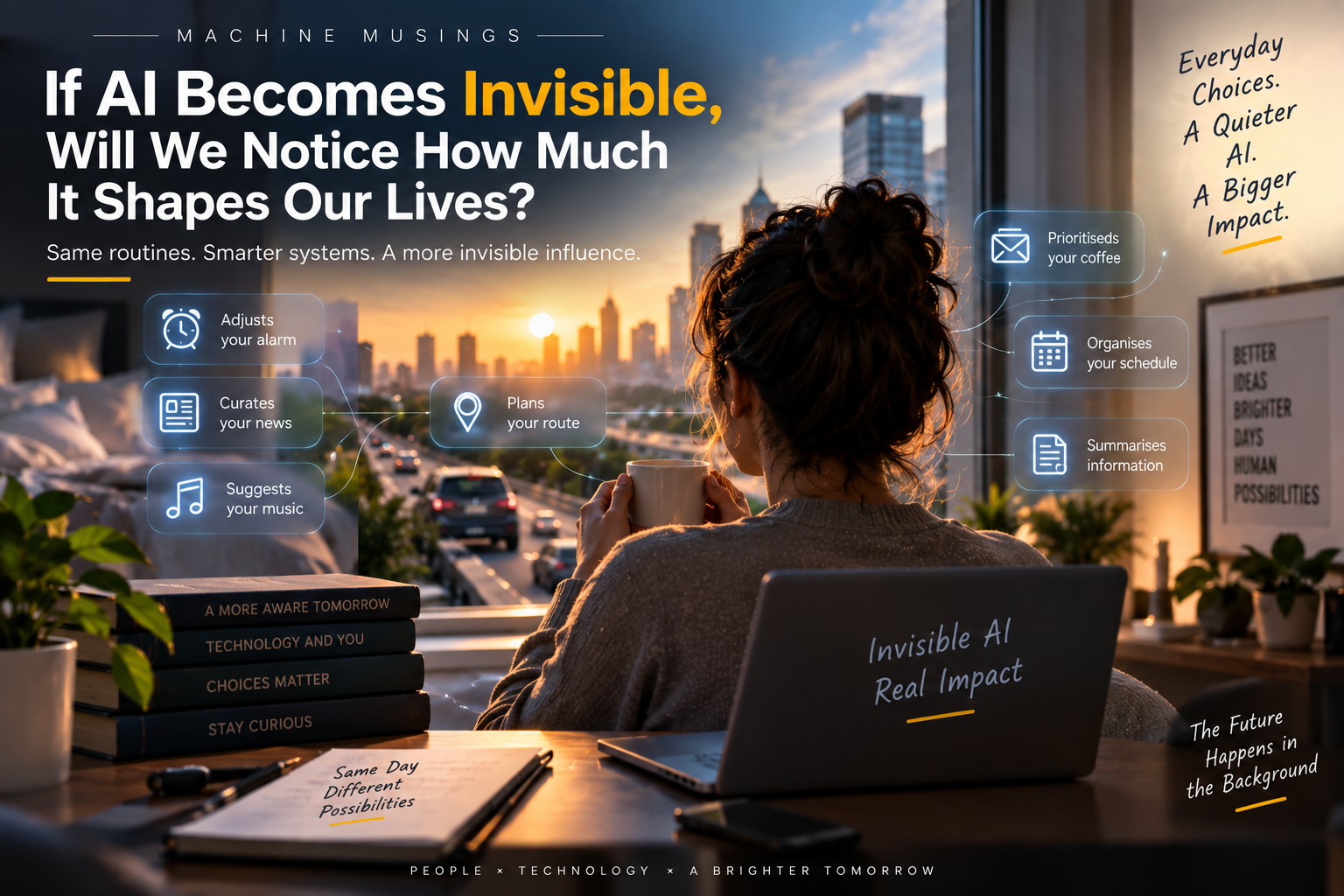
Imagine waking up on an ordinary Monday morning a few years from now. Before you even get out of bed, your phone has already decided which notifications are important enough to show you. Your alarm went off slightly earlier because traffic is heavier than usual. The news on your screen has been selected according to what you normally read. Your music changes to match the kind of songs you usually play in the morning, your navigation system chooses a route before you think about traffic, and when you stop for coffee, an application quietly suggests something based on what you have ordered before. By the time you reach work, your inbox has been prioritised, several emails have been summarised, your calendar has moved a meeting to avoid a conflict, and the software you use has already prepared suggestions for what you should work on first.
Nothing about that morning would necessarily feel futuristic. There may be no robot walking around your home, no holographic assistant waiting beside your bed, and no moment when you deliberately say, “I am going to use Artificial Intelligence now.” You might simply feel that your devices are working the way they are supposed to. Yet before the working day has properly begun, AI may already have influenced what you saw, what you ignored, when you left home, which route you travelled, what you listened to, what you considered important, and what you decided to do first.
That may be one of the most interesting ways AI enters our lives. Not with a dramatic moment when machines suddenly take over everyday decisions, but through hundreds of small conveniences that gradually become so normal that we stop noticing the technology behind them. Right now, Artificial Intelligence still feels like something we consciously use. We open an AI assistant, type a question, ask it to write something, generate an image, analyse information, or help us solve a problem. Even when AI appears inside other applications, there is often a button, label, or feature reminding us that AI is involved. There is a clear moment when we decide to use it, and because of that, we are usually aware that a machine is participating in whatever we are doing.
But technology has a strange habit of disappearing once it becomes normal. Most of us don’t think about the complicated systems working behind the screen every time our phone corrects a spelling mistake, adjusts a photograph, filters a spam message, predicts traffic, recommends a video, or decides which notification appears first. We don’t experience these things as remarkable technologies anymore. We simply expect them to work.
AI may eventually follow the same path, except its role could become much larger. Instead of being something we deliberately open when we need help, AI could quietly exist inside almost everything around us. It might organise our schedules, prioritise messages, control energy use in our homes, personalise what we learn, recommend what we watch, help plan journeys, filter information, assist with purchases, organise finances, and make countless small adjustments throughout the day. We could end up interacting with AI hundreds of times without consciously thinking, “I’m using AI right now.”
That future could be incredibly convenient, but it raises an interesting question: If AI becomes invisible, will we notice how much it shapes our lives?
The Most Successful Technologies Often Disappear
Think about how many technologies you use every day without really thinking about them. Electricity is everywhere around us, yet most of us don’t walk into a room and feel amazed that pressing a switch produces light. GPS satellites help us navigate unfamiliar cities, but when a map tells us to turn left, we usually think about the destination rather than the network of satellites and computers making the instruction possible. The internet itself has become so integrated into ordinary life that many activities no longer feel like “going online.” Sending a message, watching television, paying for something, ordering food, or listening to music can all involve the internet without us consciously thinking about the infrastructure behind them.
In many ways, this is what good technology is supposed to do. The tool gradually stops demanding our attention and allows us to focus on what we actually want to accomplish. Nobody wants to understand every technical process happening inside a smartphone before making a call, and we shouldn’t need to study machine learning before benefiting from an AI feature. If AI can quietly remove repetitive tasks, make services more useful, and reduce unnecessary friction, its invisibility could be a sign that the technology has matured.
The difference is that AI may not only perform tasks in the background. Increasingly, it may also participate in decisions about what information reaches us, which options receive attention, and what actions are suggested next. That makes its invisibility more complicated.
Invisible Doesn’t Mean Inactive
Something doesn’t stop influencing us simply because we stop noticing it. In fact, sometimes the things we notice least become the easiest to accept without questioning.
Imagine opening a shopping application and seeing ten products. You might feel that you are freely choosing among them, and in one sense you are. But some system decided which ten products appeared, which one appeared first, which received a recommendation label, and which hundreds of other possibilities were never shown to you. The same thing can happen with music, videos, news, restaurants, travel options, search results, and social media posts. Our choices are real, but the environment in which we make those choices has already been organised for us.
AI could make that organisation much more sophisticated. Instead of simply knowing what is popular, a system might understand what you usually choose, what time you are most likely to make a purchase, which style of explanation persuades you, what price range you normally accept, what topics hold your attention, and which recommendations you tend to ignore. The experience could feel wonderfully personalised because unnecessary options disappear, but the more personalised the environment becomes, the harder it may be to see what has been filtered out.
Convenience Can Slowly Become Expectation
One of the interesting things about convenience is how quickly it stops feeling like convenience. Something that initially feels extraordinary can become something we expect within a surprisingly short period of time. Navigation apps once seemed remarkable because they could guide us through unfamiliar places. Today, a wrong route or delayed traffic update can feel frustrating because the assistance has become part of what we consider normal.
AI could create similar expectations across many areas of life. We may become accustomed to emails being summarised before we read them, calendars arranging themselves, applications predicting what we want to do next, photographs automatically improving themselves, and information being condensed into exactly the form we prefer. Eventually, doing these things manually could begin to feel unnecessarily slow.
There is nothing automatically wrong with that. Human progress has always involved finding easier ways to do things. The interesting change happens when convenience becomes so expected that we stop noticing the decisions required to create it. If an AI assistant automatically decides which emails are important enough to show us first, for example, it has saved us time, but it has also made a judgement about what deserves our attention. Most of the time that judgement may be useful. Occasionally, it may be wrong. If the system works well enough for long enough, we may stop remembering that a judgement was being made at all.
Our Attention May Be Shaped Before We Use It
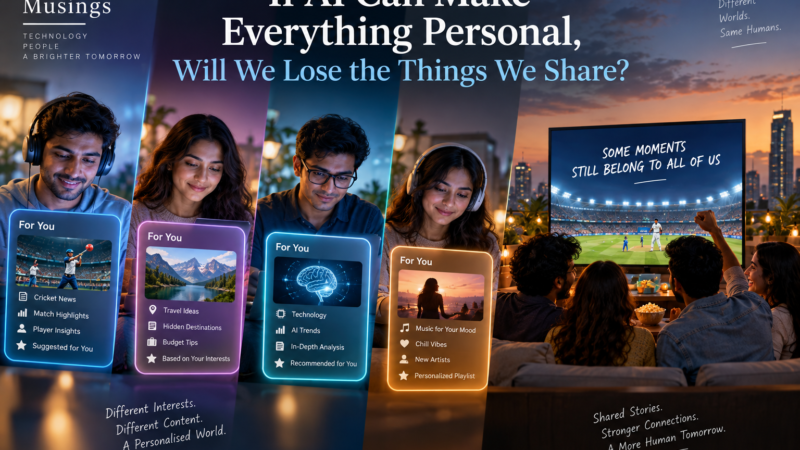
Attention is one of the areas where invisible AI could have enormous influence. There is far more information available than any person could possibly consume, which means something has to decide what reaches us. Historically, that filtering came from editors, broadcasters, publishers, teachers, communities, friends, and our own deliberate searches. Algorithms already perform a large part of that role online, and more capable AI could make the filtering increasingly individual.
Two people could open the same platform and experience completely different versions of it. One person’s feed might emphasise technology, another’s sport, another’s entertainment, and another’s finance. AI could go further by deciding not only what topics interest us but what format, length, tone, timing, and presentation are most likely to hold our attention.
The danger isn’t necessarily that an AI deliberately tries to control what we think. The more subtle possibility is that optimisation itself changes what we encounter. If a system is designed to show us what we are most likely to engage with, then surprising, uncomfortable, unfamiliar, or initially boring ideas may appear less frequently. Over time, the world presented to us could become increasingly compatible with the person the system already believes us to be.
Personalisation Can Be Helpful Without Being Neutral
Personalisation is easy to appreciate because much of it is genuinely useful. If I search for a restaurant, I would rather see options near me than restaurants thousands of kilometres away. If I regularly listen to a particular kind of music, recommendations based on that preference can help me discover artists I might enjoy. If a learning system understands that I am struggling with a particular concept, adapting the explanation to my level can make education more effective.
The complication is that personalisation always involves assumptions. A system has to create some model of who we are, what we like, and what we are likely to want next. The better AI becomes at doing this, the more accurate those assumptions may feel. But people aren’t fixed profiles. We change our minds, develop new interests, become tired of things we once loved, and occasionally enjoy something completely outside our usual preferences.
If invisible AI continuously adapts the world around our existing behaviour, we may have to think about how much space remains for unexpected discovery. Sometimes we don’t know that we like something until we encounter it accidentally. Sometimes the book, song, person, place, idea, or hobby that becomes important to us begins with something we never would have asked an algorithm to recommend.
There Is a Difference Between Helping Us Choose and Choosing for Us
The boundary between assistance and decision-making may become increasingly difficult to see. Imagine asking AI to find the fastest route to work. The goal is clear, and allowing the system to make the decision seems sensible. Now imagine AI deciding which messages deserve your immediate attention. That is still useful, but the system is making a more personal judgement. Move further and imagine AI suggesting which job you should apply for, what course you should study, which financial decision appears sensible, or how you should respond during a disagreement. The assistance is becoming more closely connected to choices that can shape our lives.
The important point isn’t that AI should never help with important decisions. Having access to better information and analysis can improve decision-making. The challenge is remembering when we are receiving assistance and when we have quietly allowed the assistance to become the default decision.
Defaults are powerful because accepting them requires almost no effort. If an AI system repeatedly makes sensible suggestions, following the suggestion becomes easier than considering every alternative from the beginning. Over time, we may trust the system precisely because we rarely have a reason not to. That trust could be deserved, but it could also make the moments when independent judgement matters most harder to recognise.
What Happens When AI Knows Our Habits Better Than We Do?
Many of us probably couldn’t accurately describe every pattern in our own behaviour. We might not know exactly what time we usually become distracted, how often certain kinds of headlines make us click, which colours influence our purchases, how our music preferences change throughout the day, or what combination of factors makes us abandon one product and choose another.
A sufficiently capable AI system working across enough data might notice patterns that we don’t consciously recognise ourselves. That could be extremely useful. It might identify wasteful spending, notice inefficient routines, recommend healthier habits, or help us organise time more effectively. A system capable of noticing patterns we overlook could become a powerful tool for understanding ourselves.
But the same capability raises another question. If a system knows which suggestion we are most likely to accept, then the way that suggestion is presented becomes important. There is a meaningful difference between using knowledge about someone to help them accomplish a goal they chose and using the same knowledge to influence them toward a goal chosen by somebody else. When AI is visible, we may be more likely to ask who built it and why it is recommending something. When AI disappears into ordinary interfaces, that question may become easier to forget.
We May Stop Asking Why Something Appeared
Imagine a future where your digital environment is constantly rearranged around you. Your phone knows which notifications to delay, your television knows which programmes to highlight, your car knows which route you normally prefer, your shopping applications know which products to display, and your AI assistant knows which information to summarise before you see it.
Most of the time, this could feel effortless. But occasionally it might be worth asking a very simple question: Why am I seeing this?
That question becomes increasingly important when the systems organising our attention are complicated enough that their decisions aren’t obvious. Why was this article recommended instead of another one? Why did this product appear first? Why was this message marked important? Why was this particular route suggested? Why did the assistant mention one option but not another?
We don’t need to investigate every recommendation we receive. That would make technology exhausting to use. But maintaining the habit of occasionally questioning how our digital environment is being organised may become an important form of awareness.
Invisible AI Could Change Work Without Workers Noticing Every Change
The same transition could happen in workplaces. AI may not always arrive as a dramatic replacement for an entire job. It could appear gradually inside the software people already use. An email application begins suggesting responses. A spreadsheet starts analysing information automatically. A design program generates alternatives. A customer-service platform drafts answers. A project-management tool predicts delays. A recruitment system helps organise applications.
Each individual change might appear small, but together they could gradually change what a person’s job actually involves. Someone may spend less time producing first drafts and more time reviewing them, less time searching for information and more time evaluating summaries, or less time performing repetitive tasks and more time making decisions.
This could be positive if people gain time for more meaningful work, but it also means the effect of AI on employment may sometimes be difficult to recognise because there isn’t one clear moment when everything changes. The job title could remain the same while the skills required to perform the job slowly become different. By the time we notice how much the role has changed, AI may already have been part of the workflow for years.
Children May Grow Up Without Thinking of AI as AI
Perhaps the biggest difference will be generational. Adults today can remember a world before modern generative AI, which gives us something to compare it with. We remember writing without an AI assistant available, searching through pages of results instead of asking for a direct explanation, and editing photographs without systems capable of generating entire parts of an image.
Children growing up with AI may not experience that contrast. To them, asking a device questions conversationally, receiving personalised explanations, generating media, and having software anticipate their needs may simply be how computers work. They may no more think of these experiences as “using AI” than younger generations today think of streaming a video as “using the internet.”
That doesn’t automatically make them less capable or less independent. Every generation grows up surrounded by technologies previous generations had to learn later. But it does mean that understanding AI may eventually require deliberately teaching something that everyday experience no longer makes obvious: that the systems around us make choices, operate according to objectives, contain limitations, and sometimes make mistakes.
Transparency May Matter More When AI Becomes Less Visible
Today, many discussions about AI transparency focus on whether users should know when they are interacting with an AI-generated image, chatbot, recommendation, or automated system. As AI becomes more deeply integrated into everyday technology, transparency may become harder to define.
It might not be practical for every small AI-assisted action to announce itself constantly. Imagine dozens of notifications every day explaining that AI adjusted your photograph, filtered a message, optimised battery usage, predicted traffic, or rearranged an application. That would quickly become meaningless noise.
A more useful form of transparency may be giving people the ability to understand AI involvement when it matters. Users might need clear ways to see why significant recommendations were made, what information influenced them, what alternatives were considered, and whether personalisation can be adjusted or disabled. The goal wouldn’t necessarily be making AI constantly visible. It would be ensuring that invisible AI doesn’t become impossible to examine.
The Ability to Override AI Could Become Important
Convenience works best when it remains optional. If an AI system suggests a route, we should still be able to choose another one. If it organises information, we may sometimes want to see the unfiltered version. If it recommends what to watch, buy, read, or listen to, we should still be able to explore outside those recommendations.
The ability to override a system might seem unimportant when the system is usually correct, but that is precisely when we are most likely to stop thinking about it. A tool that succeeds ninety-nine times can make us less prepared for the hundredth situation when its recommendation doesn’t fit what we actually want.
Remaining in control doesn’t necessarily mean manually checking everything AI does. That would defeat much of the reason for using automation. It may simply mean preserving the ability to question, change, or ignore the system when something doesn’t feel right.
Sometimes We May Need to Turn Personalisation Off
There could even be value in occasionally experiencing a less personalised digital world. Imagine opening a music service and deliberately asking it not to use your listening history, browsing articles without recommendations based on previous behaviour, or exploring products without an algorithm deciding what best matches your profile.
The experience might initially feel worse because irrelevant things would appear. But among those irrelevant things could also be something unexpected. Removing personalisation temporarily could become a way of escaping the version of ourselves that algorithms have constructed from our past behaviour.
This doesn’t require treating algorithms as enemies. Personalisation can save enormous amounts of time. The point is simply that sometimes discovery comes from encountering things that don’t fit neatly into what we already like.
We Shouldn’t Have to Reject Convenience to Keep Our Awareness
The answer to invisible AI probably isn’t to make every interaction difficult again. There is little value in manually performing repetitive tasks simply to prove that we remain independent from technology. If AI can save time, reduce frustration, improve accessibility, or help people make better use of information, those benefits are worth having.
What may matter is maintaining some awareness of where AI is participating in our lives, particularly when its role moves beyond executing instructions and begins shaping the choices available to us. We can enjoy recommendations while occasionally exploring beyond them, use AI summaries while sometimes reading the original material, accept automated suggestions while remembering that alternatives exist, and allow technology to simplify our routines without assuming that every default deserves to become permanent.
The challenge is finding that balance without turning everyday technology into something we constantly distrust. AI doesn’t have to be suspicious simply because it operates in the background. We already rely on countless invisible systems every day. The difference is that AI may increasingly influence not only how things work but what we see, what receives our attention, and which possibilities appear most relevant to us.
The Future of AI May Not Look Like AI
When people imagine a world filled with Artificial Intelligence, they often picture robots, holographic assistants, futuristic screens, or machines we deliberately speak to. The reality may be much less dramatic. The future of AI could look almost exactly like ordinary life.
We may wake up and our schedule has already adjusted itself. Messages have been prioritised. Traffic has been considered. Our devices have decided which information deserves attention. Music follows our mood. Applications rearrange themselves around what we are likely to need. Work software quietly handles tasks that once required manual effort. Recommendations appear at exactly the right moment, and hundreds of tiny decisions happen in the background without interrupting us.
If all of this works well, we may barely notice it, and perhaps that is exactly what will make the technology feel natural. The important thing is that becoming comfortable with AI doesn’t have to mean becoming unaware of it. We can allow technology to disappear from our attention without allowing its influence to disappear from our understanding.
Final Thoughts
AI becoming invisible could be one of the clearest signs that it has truly become part of everyday life. We probably won’t always talk about “using AI” because eventually AI may simply become one of the layers through which technology works. Just as we rarely think about the internet connection behind every digital service or the software processing every photograph we take, future generations may interact with intelligent systems constantly without treating each interaction as something special.
There is a lot to welcome in that possibility. Technology that understands context, removes repetitive work, improves accessibility, and helps us navigate an increasingly complicated world could make everyday life considerably easier. Not every automated decision needs our attention, and not every recommendation needs to become a philosophical debate. Sometimes we simply want the map to find the fastest route or the spam filter to remove an unwanted message.
The part worth paying attention to is what happens when AI moves from quietly doing things for us to quietly deciding what deserves to reach us. The difference can be subtle because both experiences may feel like convenience. An assistant that removes unnecessary work gives us more freedom, while a system that invisibly narrows our options could influence how that freedom is used. In everyday life, those two roles may increasingly exist inside the same technologies.
Perhaps living well with invisible AI will therefore require something surprisingly simple: occasionally noticing it again. We may need to ask why something was recommended, explore beyond what was personalised for us, read beyond a summary when the subject matters, make a different choice simply because we want to, and remember that an intelligent suggestion is still a suggestion rather than an instruction.
AI doesn’t necessarily become more powerful only when it becomes more intelligent. In some ways, it becomes more influential when we stop noticing that it is there. If that happens, the challenge won’t be keeping AI out of our lives. It will be making sure that as AI becomes better at understanding our habits, anticipating our needs, and organising the world around us, we don’t gradually lose the habit of looking beyond what it has organised for us.