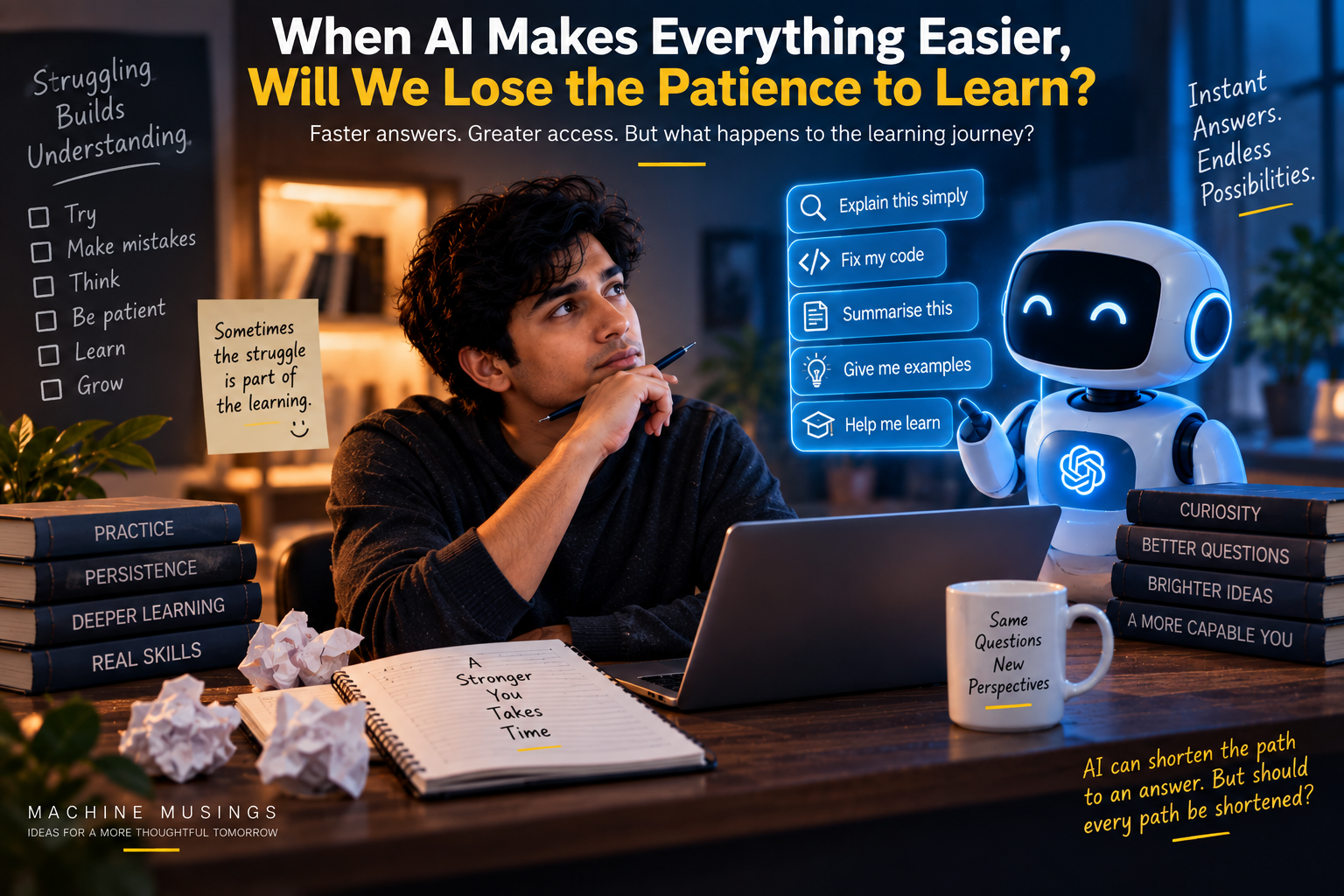
When AI Makes Everything Easier, Will We Lose the Patience to Learn?
Think about the last time you tried to learn something genuinely difficult. Maybe you were learning to code, trying to understand a complicated mathematical problem, improving your writing, learning a new language or simply figuring out how something worked. You probably didn’t understand everything immediately. You made mistakes, searched for explanations, tried again, became frustrated and perhaps even thought about giving up. Eventually, however, something clicked, and the thing that once seemed impossible started making sense.
Artificial Intelligence is beginning to change that experience. Today, when we don’t understand something, we can ask AI to explain it within seconds. If the explanation is too difficult, we can ask for a simpler version. If our code doesn’t work, AI can identify the problem. If we can’t solve an equation, it can show us the steps. If we’re struggling to write a paragraph, it can help improve it, and if a chapter feels too long or complicated, it can summarise the main ideas for us. All of this can make learning faster and more accessible, which is an incredible advantage. But it also creates an interesting question: When AI makes everything easier, will we slowly lose the patience required to learn difficult things?
Learning Has Never Been Completely Comfortable
We often imagine learning as a smooth process in which someone explains something, we understand it and then move on to the next topic. In reality, learning is usually much messier. We misunderstand things, forget what we learned yesterday, make the same mistake several times and sometimes spend an hour trying to understand something that eventually turns out to be surprisingly simple. That frustration can feel like wasted time, but it isn’t always useless. When we struggle with a problem, our mind is forced to try different approaches. We ask why something isn’t working, compare possibilities and gradually build an understanding of the subject. The final answer matters, but so does the process that led us there.
Imagine trying to solve a difficult mathematics problem. You attempt one method and it doesn’t work. You try another, realise where you went wrong and eventually reach the correct answer. The next time you encounter a similar problem, you don’t only remember the answer; you remember something about how to approach the problem. That ability develops partly because you were allowed to struggle.
AI Can Remove the Frustration Almost Instantly
Now imagine encountering the same difficult problem with an AI assistant sitting beside you. You look at the question for thirty seconds, don’t immediately understand it and ask AI to solve it. Within moments, you receive the answer along with a neat explanation. You may read the explanation and think, “Oh, that makes sense,” but there is an important question hiding underneath that moment: Would you be able to solve a similar problem tomorrow without the AI?
Understanding an explanation after seeing it is not always the same as being able to produce the solution yourself. Something can look obvious once somebody has shown us exactly what to do. This isn’t an argument against asking AI for help because a good explanation can save hours of unnecessary confusion. The problem appears when we never give ourselves enough time to attempt the problem before asking for the solution. If the answer is always one prompt away, the temptation to skip the struggle becomes incredibly strong.
We Are Becoming Used to Instant Everything
AI isn’t creating our desire for speed. Technology has been moving in that direction for years. We expect messages to arrive instantly, websites to load immediately, food to arrive quickly and entertainment to begin the moment we press a button. If a video takes too long to get interesting, we skip it. If a webpage loads slowly, we leave. If a movie isn’t engaging enough, another one is waiting. Convenience has gradually changed our expectations about how quickly things should happen.
AI brings that expectation of immediacy into something different: thinking and learning. If we become accustomed to receiving explanations, ideas and solutions within seconds, spending an hour trying to understand something may begin to feel unnecessarily slow. We might start assuming that difficulty means the method is inefficient rather than recognising that difficulty can sometimes be part of the process.
But some skills simply take time. You cannot become fluent in a language after reading one excellent explanation. You cannot become a great programmer by copying generated code without understanding it, and you cannot become a strong writer simply by asking AI to improve every sentence you create. AI can accelerate learning, but it cannot completely replace practice.
The Difference Between Help and Escape
Suppose you’re learning programming and spend twenty minutes trying to understand why your code isn’t working. Eventually, you ask AI for help. Instead of simply fixing the code, you ask it to explain the error and show you why your approach failed. That is AI being used as a teacher. Now imagine encountering an error and immediately pasting the entire program into AI with the instruction, “Fix this.” The corrected code appears, you copy it into your project, it works and you continue. That is useful if your only goal is getting the program running, but if your goal is learning how to program, something important may have been skipped.
The difference isn’t necessarily the AI tool. The difference is why we used it. Sometimes we use AI because we want help understanding a problem, while other times we use it because we want to escape the uncomfortable process of figuring the problem out. Those two behaviours can look almost identical from the outside, but their effect on learning may be completely different.
Mistakes Are Information Too
One of the strange things about learning is that being wrong can be incredibly useful. A mistake tells us that our understanding of something isn’t quite right yet. When a child learns to ride a bicycle, nobody expects them to read instructions and immediately ride perfectly. They lose balance, put their feet down, try again and gradually develop the skill. The mistakes aren’t interruptions to learning; they are part of the learning.
The same principle applies to many intellectual skills. When we write something badly and later recognise why it doesn’t work, our writing improves. When we make a programming mistake and spend time debugging it, we learn how the system behaves. When we pronounce a word incorrectly and someone corrects us, we may remember it differently the next time. AI can help us identify mistakes much faster, which is useful, but if AI always corrects the mistake before we understand why it happened, we may lose some of the lesson hidden inside it. Perhaps the goal shouldn’t be to eliminate mistakes from learning. It should be to learn from them faster.
Students Could Face a Very Different Kind of Education
This question becomes especially important for students. A student today can ask AI to summarise a chapter, explain a concept, solve a problem, create revision notes, generate practice questions and even produce an entire assignment. Used carefully, that could make AI one of the most powerful educational tools ever created. A student who doesn’t understand their teacher’s explanation can ask AI to explain the same idea differently. Someone who is embarrassed to ask a basic question in class can ask it privately, while another student can practise repeatedly without worrying about wasting another person’s time.
But the same technology can also make it extremely easy to avoid learning altogether. If an assignment is difficult, AI can write it. If a problem requires thought, AI can solve it. If reading a chapter takes too long, AI can summarise it. The student may still submit excellent work, but the finished assignment doesn’t necessarily tell us what happened inside the student’s mind. Perhaps education will increasingly need to focus not only on whether students can produce the right answer, but whether they can explain, defend and apply what they supposedly learned.
There Is Value in Being Bored With Something
Patience isn’t only about struggling with difficult problems. Sometimes learning requires doing things that are simply repetitive or boring. Learning a language involves practising vocabulary repeatedly. Learning music requires playing the same movements again and again. Learning mathematics means solving many similar problems, while becoming better at writing requires writing things that won’t always be good.
AI naturally makes us want to skip repetitive work because machines are extremely good at repetition, and sometimes we absolutely should. There is little value in manually performing repetitive tasks when technology can handle them safely and accurately. But repetition in learning can serve a different purpose. The goal isn’t always the output. Sometimes the repetition itself is what develops the skill. If someone wants to become physically stronger, watching a machine lift weights doesn’t make their muscles stronger because the resistance is the point. Learning can sometimes work in a similar way. The mental resistance we experience while practising may be part of what develops our ability.
When Should We Ask AI for Help?
Perhaps the solution isn’t deciding whether we should or shouldn’t use AI while learning. That question is too simple. A better question might be: At what point should we ask AI for help? Maybe we should attempt the problem first, spend five or ten minutes thinking, write the first version ourselves, try to remember the answer before asking or make a prediction about what might happen. Then we can bring AI into the process.
If we’re stuck, we could ask for a hint rather than the complete solution. If we still don’t understand, we could ask for an explanation. After seeing the solution, we could close it and try the problem again without help. This turns AI into something closer to a tutor rather than an answer machine. A good tutor doesn’t immediately solve every problem for a student. Sometimes they deliberately allow the student to struggle for a little while because they know that solving the problem independently creates a stronger understanding. Perhaps good AI-assisted learning should work the same way.
Faster Learning Doesn’t Have to Mean Shallower Learning
It would be unfair to assume that making learning easier automatically makes learning worse. Many difficulties in education don’t contribute anything useful. A badly written textbook doesn’t make you smarter because it is difficult to understand. Spending three hours searching for a simple piece of information isn’t necessarily valuable, and being unable to access a teacher when you’re confused doesn’t improve learning.
AI can remove a huge amount of this unnecessary friction. It can translate complicated explanations into simpler language, provide examples instantly, adapt explanations to different levels of understanding and allow people to explore subjects at their own pace. That could make learning both faster and deeper.
The challenge is distinguishing between two kinds of difficulty: difficulty that exists because information is inaccessible or badly explained, and difficulty that exists because mastering something genuinely requires effort. AI should probably remove as much of the first kind as possible. We may want to be more careful about removing the second.
Expertise Is More Than Having Information
AI can give beginners access to knowledge that once took years to collect, but expertise is more than information. An experienced doctor, engineer, programmer, designer, teacher or musician doesn’t simply know more facts than a beginner. They have encountered thousands of situations, recognise patterns, notice details beginners overlook and have made mistakes that taught them which problems actually matter.
AI can help people reach competence faster, but some understanding develops only through experience. Imagine reading every book about swimming without ever entering the water. You might understand the physics perfectly, but the first time you jump into a pool, your body still has something to learn. Knowing and doing remain different things. AI can explain, but we still have to practise.
What Happens When AI Isn’t Available?
There is another simple test of whether we’ve learned something: Can we still do it when the tool isn’t there? If someone uses AI to improve every email they write, can they still write a clear email without it? If a programmer relies on AI for every function, can they understand the code when something unexpected happens? If a student uses AI to solve every equation, can they solve one during an exam?
Using tools isn’t a weakness. Professionals use tools constantly. Pilots use instruments, engineers use calculators, writers use spell-checkers and programmers use documentation. The important thing is knowing enough to recognise when the tool gives you something that doesn’t make sense. Dependence becomes risky when we lose the ability to evaluate the assistance we’re receiving.
Patience May Become a Competitive Advantage
There is an interesting possibility here. If technology makes everyone accustomed to instant results, people who retain the ability to stay with difficult problems may actually become more valuable. Some problems don’t have immediate answers. Scientific discoveries can take years, building a successful business can involve repeated failures, learning a complicated skill can take thousands of hours, relationships require patience and creative work sometimes involves staring at something for days before figuring out what is wrong.
AI may help with all of these things, but it cannot guarantee that every meaningful problem becomes easy. Perhaps one of the most valuable skills in an AI-powered world will be the ability to recognise, “This is difficult, and that’s okay. I haven’t understood it yet,” and then continue anyway.
AI Can Shorten the Path — But Should Every Path Be Shortened?
Technology has always helped humans take shortcuts, and many of those shortcuts are wonderful. Nobody needs to perform long calculations manually simply to prove they can. Nobody should spend hours searching through books for a simple fact that can be found instantly. But not every shortcut leads to the same destination.
If your destination is simply completing a task, AI may help you reach it much faster. If your destination is becoming capable of doing the task yourself, however, the journey matters too. A person who asks AI to translate every sentence may communicate successfully while never learning the language. Someone who generates code may build something without becoming a programmer. Someone who asks AI to write may publish words without necessarily becoming a better writer. There is nothing inherently wrong with any of those outcomes if learning wasn’t the goal. But when learning is the goal, taking the shortest possible path may sometimes defeat the purpose.
Final Thoughts
Artificial Intelligence could become one of the greatest learning tools we have ever created. It can make education more accessible, explain difficult ideas in countless ways, provide immediate feedback and give people the ability to explore subjects far beyond what they previously had access to. The danger isn’t that AI makes learning easier because making unnecessary difficulty disappear is a good thing. The more interesting danger is that we may begin treating all difficulty as unnecessary.
Some struggles should absolutely disappear. Confusing instructions, inaccessible information and unnecessary obstacles don’t deserve to survive simply because previous generations had to tolerate them. But other struggles are different. Trying, failing, thinking, practising and trying again are often how skills become ours. Perhaps we shouldn’t measure AI-assisted learning only by how quickly we reach the correct answer. We should also ask whether we could reach that answer again when the AI isn’t there.
AI can explain something to us in seconds, correct our mistakes, show us the shortcut and even walk us through every step. But there is still one thing we have to do ourselves: learn.
Maybe the question we should carry into an AI-powered future isn’t whether technology can make learning easier. It is whether we can become better learners without becoming people who expect learning to always be easy.