If AI Can Give Us Answers Instantly, Will We Stop Asking Better Questions?
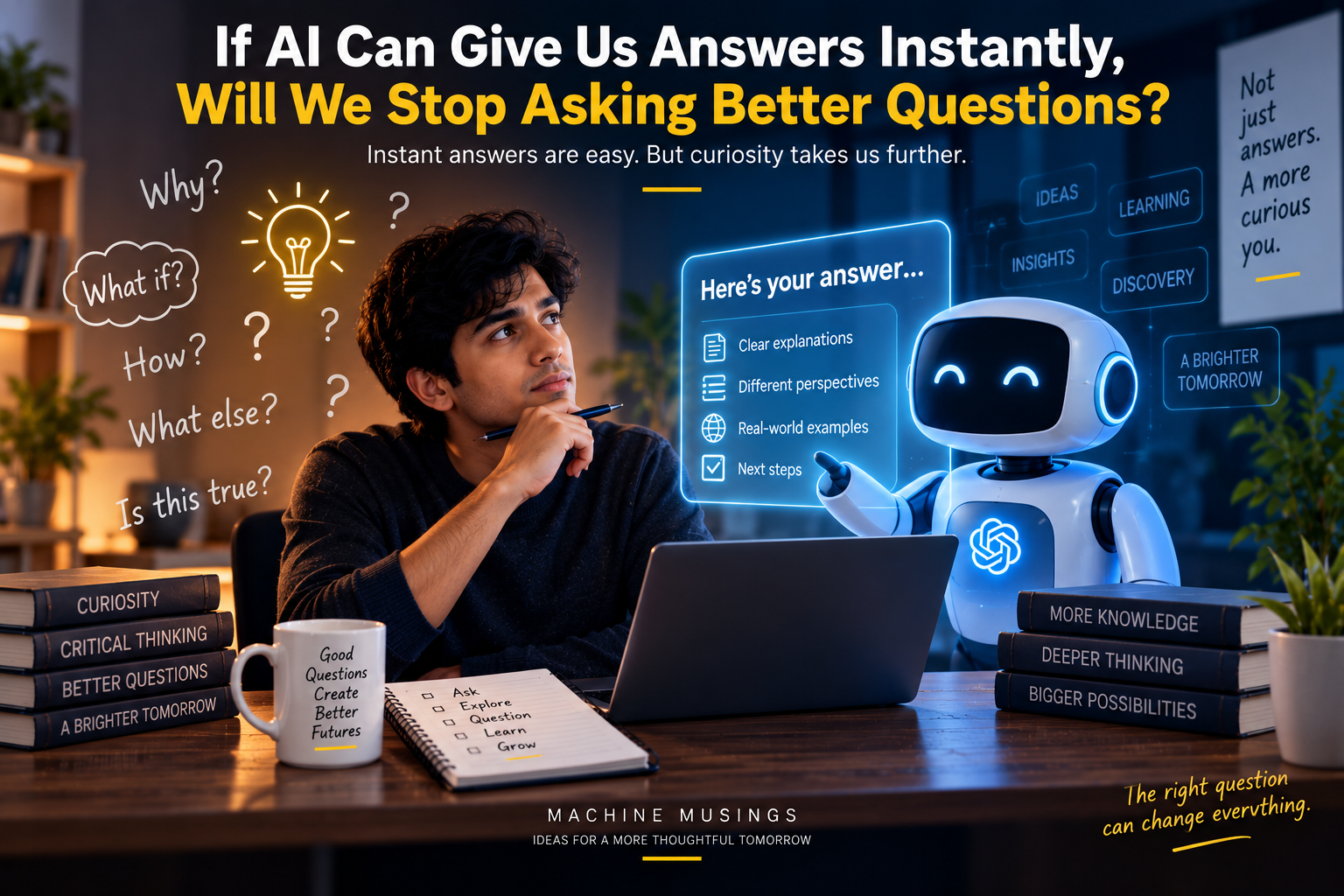
There was a time when not knowing something meant you had to make an effort to find the answer. You might ask a teacher, call a friend, search through a book, visit a library or spend time experimenting until something finally made sense. Then came search engines, putting an enormous amount of information just a few clicks away. Now Artificial Intelligence is taking that convenience one step further. Instead of searching through ten different websites and putting the information together ourselves, we can ask one question and receive a detailed, organised answer within seconds.
That is an extraordinary capability. Whether you want to understand a scientific concept, learn how something works, compare two products, solve a coding problem, plan a trip or simply satisfy a random curiosity at midnight, AI can often help almost immediately. But as getting answers becomes easier than ever, another question becomes worth considering: If AI can give us answers instantly, will we stop asking better questions?
We Have Never Had So Many Answers
Think about how much information is available to an ordinary person today. A student sitting at home can learn mathematics from professors on the other side of the world. Someone starting a business can study marketing, finance and management without entering a business school. A person interested in programming can access tutorials, documentation and examples for almost any technology imaginable.
AI makes accessing all of this even easier because we no longer always need to know exactly where to look. We can simply explain what we are trying to understand and ask for help. If the explanation is too complicated, we can ask for a simpler one. If we need an example, we can request one. If something still doesn’t make sense, we can ask again from a completely different angle.
In many ways, this is one of the most exciting things about AI. Knowledge can become more approachable because people are able to interact with information rather than merely search for it. However, having access to answers and knowing what to do with those answers are two very different things.
The First Answer Is Not Always the Best Answer
Suppose you ask an AI, “Is working from home better than working from an office?” It might give you a balanced explanation about productivity, flexibility, collaboration and work-life balance. That could be useful, but the conversation becomes much more interesting when you continue asking questions.
Better for whom? A new employee or an experienced professional? Someone living alone or someone with a family? A software developer or a salesperson? Does working remotely affect learning from senior colleagues? Does commuting time change the answer? What about people who don’t have a comfortable place to work at home?
Suddenly, one simple question has become several deeper questions, and those questions reveal that the original answer was never as straightforward as it first appeared.
AI can give us a starting point incredibly quickly. But perhaps one of the biggest mistakes we can make is treating that starting point as the end of our thinking.
Good Questions Have Always Been Valuable
We often admire people who seem to know a lot of answers, but some of the most interesting people are actually those who know how to ask good questions. A scientist looks at something ordinary and asks why it happens. An entrepreneur notices an inconvenience and asks whether there is a better way to solve it. A journalist hears a claim and asks what evidence supports it. A child sees something adults have stopped noticing and simply asks, “Why?”
Questions move thinking forward.
The first question is often obvious. The better question usually appears after we begin understanding the subject. Someone might initially ask, “How can AI improve education?” After learning more, they may begin asking, “Which parts of education should AI not make easier?” That second question opens an entirely different conversation.
Perhaps the value of knowledge isn’t only that it gives us answers. Sometimes an answer is valuable because it gives us a better question to ask next.
Students May Feel This Change the Most
Imagine a student receiving an assignment about climate change, economics, history or Artificial Intelligence. Today, they can enter the question into an AI assistant and receive a structured response almost immediately. The answer may contain an introduction, arguments, examples and a conclusion. With a little editing, the assignment might even look complete.
But completing an assignment and learning from an assignment aren’t necessarily the same thing.
The purpose of many assignments isn’t simply to produce 1,500 words. The process forces students to research, compare sources, organise information, decide what matters and form an argument. When AI performs all of those steps immediately, students may receive the finished product without experiencing the process that was supposed to develop their understanding.
This doesn’t mean students shouldn’t use AI. In fact, they can use it in a much more interesting way. Instead of saying, “Write my assignment,” a student could ask, “What are the main disagreements around this subject?” They could then ask which evidence supports each position, where the evidence is weak, what questions remain unanswered and whether there are perspectives they haven’t considered.
The same AI can either shorten the learning process or deepen it. The difference often comes down to the questions the student chooses to ask.
Curiosity Begins With Not Knowing
There is something uncomfortable but valuable about not knowing an answer. You encounter a question, don’t immediately understand it and begin thinking. Maybe you form a theory. Maybe you discuss it with someone. Maybe your first explanation turns out to be completely wrong, but discovering why it was wrong teaches you something.
Instant answers reduce that period of uncertainty.
Usually, that’s wonderful. Nobody needs to spend an entire afternoon wondering about a simple fact that can be checked in seconds. But not every question benefits from being answered immediately. Sometimes sitting with uncertainty gives us time to notice things we wouldn’t otherwise notice.
If every moment of curiosity immediately becomes a request to AI, we may gradually become less comfortable saying, “I don’t know yet. Let me think about it.”
And perhaps “I don’t know” is not always a problem that needs to be fixed instantly. Sometimes it is the beginning of learning.
AI Can Sound More Certain Than the Answer Deserves
Another reason good questions matter is that AI responses can sound remarkably confident. A neatly organised answer with clear paragraphs can feel authoritative even when the subject is complicated, uncertain or dependent on assumptions.
This creates an important habit for anyone using AI: don’t only ask “What is the answer?” Ask “Why should I believe this answer?”
What evidence supports it? Are there credible arguments against it? What assumptions are being made? Is the information current? Is this a fact, an interpretation or a prediction? What would make the conclusion wrong?
These questions become particularly important when dealing with serious subjects. The smoother AI becomes at explaining things, the easier it may be to confuse a well-written answer with a correct one.
Critical thinking therefore doesn’t become less important because AI exists. It may become more important precisely because AI is so good at sounding helpful.
The Best AI Conversation Might Begin After the First Answer
Many people interact with AI almost like a search engine. They ask one question, receive one response and leave. But conversational AI becomes much more interesting when the first answer is treated as the beginning rather than the conclusion.
Suppose you ask for five business ideas. Instead of choosing one immediately, ask why each idea might fail. Then ask which assumptions the ideas depend upon. Ask which type of customer would actually pay for them. Ask what existing businesses already solve the same problem. Ask what would make one idea difficult to copy.
The AI didn’t suddenly become more intelligent between the first and fifth question. Your questioning improved the conversation.
This applies to almost everything. When writing, ask what is weak about your argument. When studying, ask for an example that contradicts the general rule. When programming, ask why one solution might fail at scale. When planning something, ask what you have forgotten to consider.
AI can provide answers, but questions determine which parts of its capabilities we actually reach.
When Answers Become Cheap, Questions May Become Expensive
For most of history, obtaining information was difficult. Books were expensive, experts were difficult to reach and specialised knowledge could take years to access. The internet dramatically reduced that barrier, and AI may reduce it even further.
When something becomes abundant, its value often shifts elsewhere.
If everyone can generate a reasonable answer, perhaps having an answer is no longer particularly impressive. The valuable skill becomes knowing which question deserves to be answered.
Imagine two businesses with access to the same powerful AI. One asks, “How can we sell more products?” The other asks, “Why do customers who buy once rarely come back?” The second question may reveal a much more important problem.
Two researchers might have access to the same information, but one notices a contradiction the other overlooks. Two students may use the same AI, but one keeps asking “why” until they actually understand the subject.
The technology is identical. The curiosity isn’t.
Better Questions Require Some Knowledge
There is a small contradiction here. People sometimes assume that because AI can answer almost anything, we no longer need to know as much ourselves. But knowing something about a subject is often exactly what allows us to ask better questions about it.
A beginner learning photography might ask, “How do I take better photos?” An experienced photographer might ask how a particular focal length changes perspective, how lighting affects skin tones or why a certain composition creates tension. Their existing knowledge allows them to recognise more specific questions.
The same applies to programming, finance, medicine, history, design and almost every other field. The more you understand, the more clearly you can see what you don’t understand.
AI can help us gain that foundational knowledge faster, but if we completely outsource understanding to the machine, we may never develop the knowledge required to question its answers properly.
AI Should Make Us More Curious, Not Less
There is another way this future could develop, and it is much more exciting. Instead of reducing curiosity, AI could dramatically increase it.
Imagine reading about black holes and immediately being able to ask every strange question that comes into your mind. What would happen if you approached one? Why can’t light escape? How do scientists know they exist? Could one eventually disappear? What would time feel like near one?
Previously, some of those questions might have required searching through several sources or finding someone with specialised knowledge. Now the barrier between curiosity and exploration can be extremely small.
That means AI doesn’t necessarily have to make us intellectually lazy. It can allow us to follow curiosity further than before.
The danger isn’t having instant answers. The danger is stopping after the first one.
Perhaps We Need to Learn How to Question AI
Schools teach us how to read, write and calculate. Increasingly, perhaps another skill will matter: learning how to question intelligent systems.
Not merely how to write complicated prompts, but how to recognise when an answer needs challenging. How to ask for evidence. How to distinguish fact from interpretation. How to request another perspective. How to identify assumptions. How to recognise uncertainty.
These aren’t really “AI skills.” They are thinking skills.
And they were valuable long before Artificial Intelligence existed.
AI simply gives us a new reason to practise them.
The Question You Ask Shapes the Answer You Receive
There is something worth remembering whenever we interact with AI: the machine usually doesn’t know exactly what we actually need. It knows what we asked.
If the question is vague, the answer may be vague. If the question contains a wrong assumption, the response may begin from that assumption unless it is challenged. If we ask only for arguments supporting what we already believe, we may never encounter the strongest arguments against us.
In that sense, asking AI questions can reveal something about our own thinking.
Are we trying to understand something, or are we trying to confirm what we already believe? Are we looking for the truth, or simply the fastest answer? Are we asking because we’re curious, or because we want someone else to do the thinking?
The quality of the answer matters, but so does the intention behind the question.
Final Thoughts
Artificial Intelligence is making answers faster, easier and more accessible than at almost any other point in human history. That is something worth celebrating. A person can learn about subjects outside their education, explore ideas they previously couldn’t access and receive explanations adapted to their level of understanding.
But access to answers doesn’t automatically create understanding.
If we become satisfied with the first response to every question, AI could make us extremely informed while leaving us surprisingly uncurious. On the other hand, if we use each answer as a doorway to another question, AI could become one of the greatest tools for curiosity we have ever created.
Perhaps the future won’t belong to the people who know the most answers. After all, when everyone carries an AI capable of producing answers within seconds, simply knowing an answer may become less remarkable.
The advantage may belong to people who notice what everyone else overlooked, challenge the obvious explanation and continue asking “Why?”, “What if?”, “How do we know?” and “What are we missing?”
Because AI may eventually make answers available to almost everyone.
But it cannot automatically make everyone curious.
And in a world overflowing with answers, knowing which question to ask next may become one of the most human skills we have left.