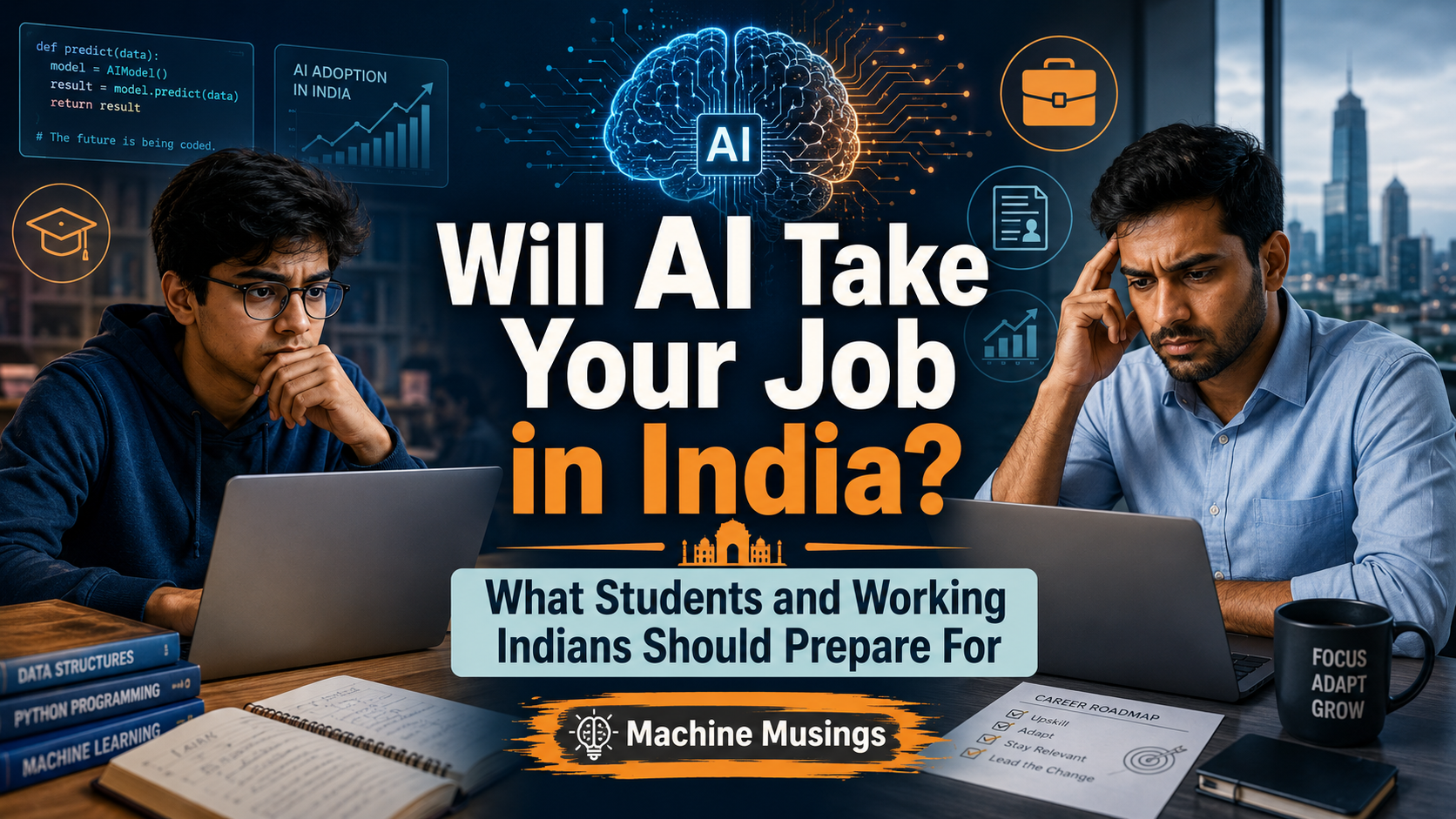
Will AI Take Your Job in India? What Students and Working Indians Should Prepare For
There was a time when Artificial Intelligence sounded like something that belonged to science-fiction movies. We imagined robots, talking computers and machines smarter than humans. Today, however, AI is quietly sitting inside our phones, laptops, classrooms and offices. A student uses ChatGPT to understand a difficult chapter, a software developer asks AI to debug code, a marketing professional generates ideas for an advertisement, a graphic designer creates concepts in seconds, a customer-support employee uses an AI assistant to respond faster, and an accountant automates repetitive Excel work.
Somewhere between all of this convenience, one uncomfortable question keeps appearing: Will AI take my job? For millions of Indians, especially college students, fresh graduates and working professionals, this is no longer just a futuristic question. It is becoming a career question. But perhaps we are asking the wrong question. Instead of asking, “Will AI take my job?”, maybe we should be asking, “How will AI change my job, and am I preparing for that change?” Because those are two very different things.
The Fear Is Understandable
India has an enormous young population competing for limited opportunities. Every year, lakhs of students graduate from colleges hoping to enter engineering, IT, banking, consulting, marketing, government services and countless other professions. Competition was already intense, and then AI entered the room.
Suddenly, a tool can write an email in five seconds. It can generate computer code, summarise a 50-page document, create images, analyse spreadsheets, answer customers, translate languages and even prepare presentations. So naturally, an employee looks at all of this and thinks, “If the computer can do so much of my work, why would the company need me?”
It is a reasonable fear. But there is an important difference between automating a task and eliminating an entire job.
AI May Replace Tasks Before It Replaces Jobs
Think about a teacher. A teacher prepares lessons, creates questions, checks assignments, explains concepts, understands students, manages a classroom, motivates someone who is struggling, talks to parents and makes decisions based on individual behaviour. AI might help that teacher prepare a worksheet within seconds, but does that mean the teacher disappears? Probably not. It simply means that one part of the teacher’s workload becomes easier.
The same logic applies to many professions. An accountant may use AI to analyse transactions, a lawyer may use it to summarise documents, a programmer may use it to generate basic code, a writer may use it for research or brainstorming, and a doctor may use AI-assisted systems to interpret certain information. The profession remains, but the way the profession works changes. And this distinction is extremely important.
The Employee Who Uses AI May Replace the Employee Who Doesn’t
You may have heard a version of this statement online: “AI may not replace you, but someone using AI might.” It sounds like another motivational quote designed for LinkedIn, but there is some truth hidden inside it.
Imagine two digital marketers with similar experience. The first employee spends three hours researching competitors, preparing campaign ideas and creating a basic report. The second employee understands how to use AI tools properly. They use AI to organise the research, analyse patterns and generate initial ideas. Instead of spending three hours on repetitive preparation, they spend one hour reviewing the AI’s work and another two hours improving the actual strategy.
Who becomes more productive? Probably the second employee. The important point is that AI didn’t replace the marketer. It changed what being a good marketer looks like.
This Is Already Happening in India
India’s AI transition isn’t restricted to software engineers. Businesses are increasingly looking at how AI can be used in areas such as marketing, graphic design, business development, education and many other professions. At the same time, organisations need people who can actually implement AI to solve real problems rather than merely talk about it.
That means we are slowly moving from the era of “Have you heard about AI?” to “Can you actually use AI to solve a problem?” That shift matters enormously for Indian students. Knowing the definition of Artificial Intelligence will not automatically make someone employable. Knowing how to work with it might make a much bigger difference.
Which Jobs Could Be Most Affected?
There is no perfect list because AI technology is changing quickly. Still, jobs containing large amounts of predictable and repetitive digital work are likely to experience some of the biggest changes.
Data Entry and Basic Administrative Work
Imagine a job where most of your day involves copying information, organising documents, entering numbers, preparing standard reports and converting information from one format to another. These are exactly the kinds of tasks automation handles well.
This doesn’t mean every administrative position will disappear. However, jobs built almost entirely around repetitive information processing may become increasingly difficult to depend upon as long-term careers.
Customer Support and BPO Jobs
India has one of the world’s largest business-process outsourcing industries, and customer-support jobs have provided employment to thousands of young Indians. AI chatbots and voice assistants can already answer many repetitive questions such as “Where is my order?”, “How can I reset my password?”, “What is my account balance?” or “When will my refund arrive?”
Machines are becoming increasingly capable of handling these simpler interactions, but complicated customers still exist. Angry customers still exist. Unusual situations still exist. Human judgement still matters. Rather than disappearing completely, support jobs may increasingly move towards complex cases where human communication and decision-making are valuable.
Content Writing
Yes, even this profession has to talk about the elephant — or perhaps the chatbot — in the room. AI can produce hundreds of words within seconds. Businesses that previously paid someone to produce very basic product descriptions, social-media captions or generic articles may increasingly use AI instead.
But there is another side to this. AI-generated content can suffer from sameness. It can sound polished without saying anything particularly memorable. Original experiences, personality, humour, investigation, opinion and genuine expertise still matter. The internet may actually become so crowded with AI-generated writing that distinctly human writing becomes more valuable. Funny how technology works.
Graphic Design
AI image-generation tools have improved dramatically. Someone without professional design experience can describe an idea and receive an image within seconds, and that clearly affects certain types of basic design work.
But professional design is not simply about asking someone to “make me a nice picture.” Brand identity, typography, visual hierarchy, user psychology, consistency, creative direction and understanding the client’s actual problem still require judgement. A designer who understands both design fundamentals and AI tools could become considerably faster than someone relying entirely on traditional workflows.
Software Development
This one scares a lot of Indian engineering students. AI can write code, so does that mean studying computer science is becoming pointless? No.
Writing ten lines of code was never the entire purpose of being a software engineer. Architecture, debugging complicated systems, security, performance, databases, user requirements, system design and decision-making remain important. AI may make coding easier, and that could actually mean companies build more software, not less. However, developers who only know how to reproduce basic code without understanding what it does may face greater competition.
What About Commerce Students?
AI isn’t an engineering-only conversation. Students studying B.Com, BBA, MBA, finance, accounting, economics or marketing are also likely to work in AI-enabled environments.
A future financial analyst might ask AI to examine thousands of transactions before personally analysing unusual patterns. An HR professional might use AI to organise applications. A marketing manager might use it to analyse customer behaviour, while a consultant might use it to summarise market research.
You don’t necessarily need to become an AI engineer. You need to understand how AI affects your profession. That is a much more realistic goal.
What About Arts and Humanities Students?
There is another misconception that AI is only important for technical students. That is no longer true. As AI becomes easier to operate, technical barriers can decrease while communication, creativity, critical thinking and subject expertise become even more important.
Someone who understands psychology and knows how to use AI may conduct interesting consumer research. Someone who understands history could create new educational experiences. Someone who understands languages could work on localisation and multilingual AI. Someone who understands journalism could use AI for research while applying human judgement to verification.
Your degree and AI don’t necessarily have to compete. They can complement one another.
What Should Indian Students Actually Learn?
This is where things become practical. You do not need to panic and enrol in seventeen AI courses tomorrow. Start with the fundamentals.
Typing “Write this assignment” into an AI tool is not an AI skill. Learn how to explain problems clearly, provide useful context, ask better questions, evaluate responses, iterate, compare outputs and understand limitations. The quality of what AI gives you often depends on the quality of thinking you bring to it.
Then learn one skill that AI can amplify. It could be AI combined with programming, finance, marketing, design, law, research, education or business. That combination is much more powerful than simply putting “AI enthusiast” in your LinkedIn bio. The world already has enough AI enthusiasts. It needs people who can solve actual problems.
Don’t Stop Learning the Fundamentals
This is perhaps one of the biggest traps AI creates. Why learn grammar when AI can correct sentences? Why learn coding when AI writes code? Why learn mathematics when AI can calculate? Why learn Excel when AI can analyse spreadsheets?
Because you need enough knowledge to recognise when the machine is wrong.
Machines can sometimes be very confidently wrong. If you have no understanding of the subject, you cannot properly evaluate the answer. AI should become a tool sitting on top of your knowledge, not a replacement for having knowledge.
Communication Will Become More Valuable
Suppose everyone in your office has access to the same AI tool. What separates employees then? Judgement, communication, leadership, creativity, negotiation, empathy, understanding customers, understanding business and making difficult decisions.
These abilities are surprisingly difficult to automate completely. Ironically, the rise of Artificial Intelligence might make distinctly human skills more important.
Working Professionals Shouldn’t Ignore This Either
It is easy to assume AI is something younger employees need to learn, but that would be a mistake. Imagine someone with fifteen years of experience in banking. They understand customers, regulations, internal systems and real-world problems. Now imagine that same person learns how to use modern AI tools.
They have something a fresh graduate may not possess: experience + AI capability. That combination can be incredibly valuable. Experienced professionals don’t necessarily need to compete with AI. They should learn how to make AI work with their experience.
Don’t Learn Every AI Tool
Every week, the internet announces, “10 AI tools you MUST learn!” Then next week there are fifteen more. Trying to master every AI application is exhausting and mostly pointless.
Tools will disappear. Companies will change. Features will merge and interfaces will evolve. Instead, understand the concepts behind them. Learn how AI can automate repetitive work, analyse information, assist research, generate first drafts and integrate with other software. If you understand the principles, learning a new tool becomes much easier.
One Dangerous Habit: Letting AI Think for You
There is one part of the AI revolution we should probably worry about more. Not jobs — thinking.
When every difficult question immediately goes into ChatGPT, Gemini or another AI system, we risk outsourcing something important: struggle. Sometimes struggling with a problem is exactly how we learn. Writing your own first paragraph, trying to solve an equation, debugging the code yourself or thinking through an argument develops abilities that simply receiving an answer does not.
Use AI to accelerate thinking. Don’t use it to avoid thinking. There is a huge difference.
So, Will AI Take Your Job?
For some people, unfortunately, automation may remove certain roles. Technology has always done this. ATMs changed banking jobs, computers changed office work, the internet changed travel agencies, smartphones changed photography and e-commerce changed retail.
But technology also creates professions that barely existed before: app developers, digital marketers, YouTubers, cloud engineers, cybersecurity professionals, social-media managers and UX designers are obvious examples. AI itself is already creating and changing categories of work.
The uncomfortable truth is that nobody can guarantee exactly which jobs will exist twenty years from now. But one pattern appears repeatedly throughout history: people who adapt to technological change usually have more opportunities than people who ignore it.
The Indian Opportunity
India should not look at Artificial Intelligence only as a threat. We have millions of young people, a massive technology sector, a growing startup ecosystem, strong engineering talent, an enormous multilingual population and businesses across nearly every imaginable industry.
If Indian students learn to use AI creatively — not merely consume it — we could benefit enormously. And this opportunity isn’t limited to Bengaluru, Hyderabad, Mumbai, Pune or Delhi. AI tools can be accessed by someone sitting in Jaipur, Patna, Lucknow, Indore, Nagpur, Guwahati, Kochi, Chandigarh or a small town that most startup founders have never visited.
Access to sophisticated technology has become remarkably widespread. In many cases, someone needs little more than a decent device and an internet connection to begin experimenting with powerful tools. What they eventually build with that access is another question entirely.
Final Thoughts
If you’re a student worried that AI will make your degree useless, don’t panic. If you’re already working and wondering whether younger AI-skilled employees will replace you, don’t panic either. But don’t ignore what is happening.
Experiment, learn and adapt. Understand where AI fits into your profession. Build skills that machines can amplify rather than depending entirely on repetitive work.
Because the future probably won’t simply be humans vs AI. It may increasingly become humans who know how to work with AI vs humans who don’t.
And perhaps that is the real Machine Musing here.
The biggest question isn’t whether Artificial Intelligence is becoming capable enough to do our work. It is whether we are becoming adaptable enough to change the way we work.