If AI Does Our Thinking for Us, What Happens to Our Decisions?
Think about how many decisions you make in an ordinary day. You decide what to wear, what to eat, which route to take, what music to listen to, what product to buy, which message deserves an immediate reply and what you should do after work. Most of these decisions are so small that we barely notice ourselves making them. Then there are bigger decisions: which career to pursue, where to invest our money, whether to accept a job, where to travel, what skills to learn and sometimes even whether we should continue with something or leave it behind.
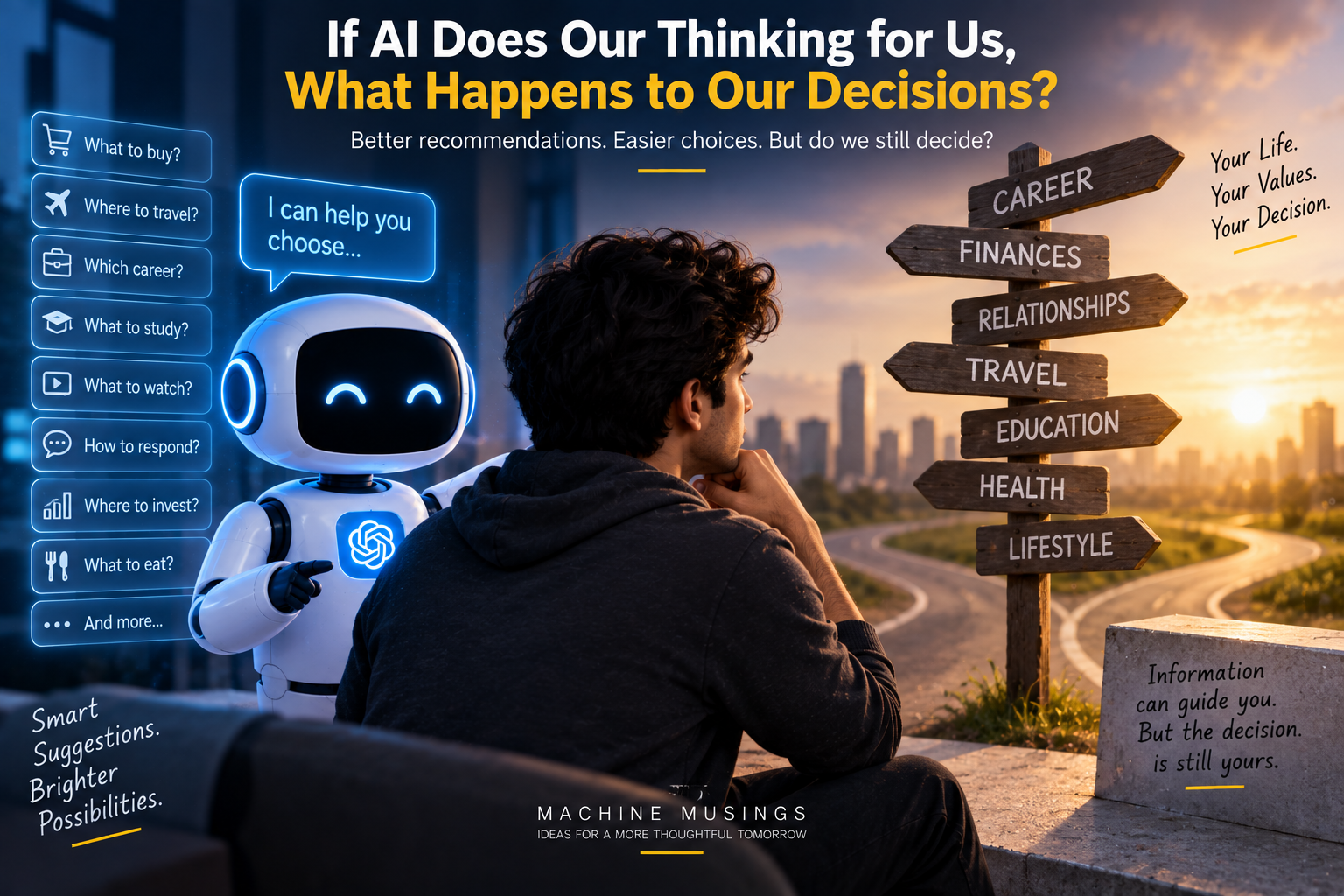
Technology has always helped us make these choices. Maps suggest faster routes, streaming platforms recommend what to watch, shopping websites show products we might like and search engines help us compare options. Artificial Intelligence, however, could take this much further. Instead of simply giving us information, an AI assistant can potentially understand the situation, compare alternatives, consider our preferences and recommend what it thinks we should do. That sounds incredibly convenient, but it creates an interesting question: If AI increasingly helps us think through our choices, at what point does helping us make decisions become making those decisions for us?
We Already Let Algorithms Influence Our Choices
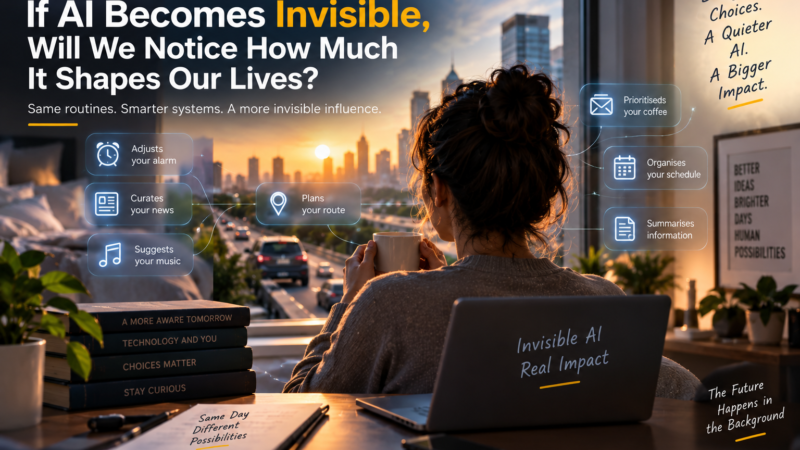
The idea of technology influencing our decisions isn’t new. Every time a streaming service recommends a movie, a shopping platform suggests a product or a social-media feed decides which posts appear first, algorithms are already influencing what we encounter. We still make the final choice, but that choice is often made from a selection that technology has already organised for us. Imagine opening a streaming service on Friday evening. Thousands of movies may be available, but you probably don’t examine every one of them. You look at the recommendations displayed on the homepage and choose from those. Technically, you selected the movie, but the platform influenced which options entered your consideration in the first place.
AI could make this influence much more personal. Instead of simply recommending popular choices based on previous behaviour, an AI assistant might understand that you’re tired, have only ninety minutes available and usually prefer something light after a stressful week. It could then say, “Based on what you usually enjoy, I think you should watch this.” That recommendation may be excellent. After enough good recommendations, however, we may gradually stop asking ourselves what we want and simply ask the machine.
Advice Becomes Powerful When It Is Usually Right
We ask people for advice because we value their judgement. If a friend consistently gives terrible recommendations, eventually we stop asking them. But if someone repeatedly gives useful advice, we begin trusting them more, and AI could develop the same kind of relationship with our decisions. Imagine asking an AI which laptop you should buy. It considers your budget, work requirements, previous preferences and available options before recommending one. You buy it and love it. A few months later, you ask where you should stay during a trip, follow its recommendation and have a great experience. Later, you ask which course would be best for developing a particular skill, and once again the suggestion works well.
Eventually, something changes. You no longer carefully examine every recommendation because the AI has developed a good track record. That isn’t necessarily irrational because trusting reliable advice saves time. We already do this with people, brands and services we trust. But the better AI becomes at recommending things, the easier it becomes to move from “What do you think?” to “Just tell me what I should do.” Those two questions may sound similar, but there is an important difference between asking for advice and handing over the decision itself.
Decision Fatigue Is Real — and AI Could Help
Not every decision deserves twenty minutes of careful thinking. Modern life gives us an enormous number of choices, many of which aren’t particularly meaningful. Open a food-delivery application and you may find hundreds of restaurants. Search for headphones and you’ll see thousands of products. Try choosing a hotel and you can spend hours comparing locations, prices, photographs and reviews. Sometimes we don’t want more options; we want fewer.
AI could be extremely useful here. Instead of spending an hour comparing twenty nearly identical products, you might tell an assistant what matters to you and ask it to shortlist three. Instead of reading hundreds of hotel reviews, AI could identify the options that best fit your priorities. Instead of manually planning every part of a journey, it could create an itinerary around your available time and budget. There is little reason to romanticise unnecessary decision fatigue. If AI can save us from spending forty minutes deciding which phone charger to buy, perhaps that is simply a good use of technology. The challenge is recognising that not all decisions are equally disposable.
Choosing a Restaurant Is Not the Same as Choosing a Career
Imagine asking AI, “Where should I eat tonight?” If the recommendation isn’t perfect, the consequences are probably small. You eat an average meal and try somewhere else next time. Now imagine asking, “Should I leave my job?” Suddenly, the situation is very different. An AI can help us think about salary, career growth, workplace satisfaction, financial stability and alternative opportunities. It can ask useful questions and help organise our thoughts. But a career decision involves things that may be difficult to reduce to a neat comparison. There may be family responsibilities, personal ambitions, fear, relationships with colleagues and feelings about the future that cannot be perfectly represented by a list of advantages and disadvantages.
The same applies to decisions about relationships, education, moving to another city or changing the direction of our lives. AI may become extremely good at analysing information surrounding these decisions, but analysis and living with the consequences are different things. The machine can recommend, but we are still the ones who have to wake up the next morning and live with what happens.
Sometimes We Don’t Actually Want the “Best” Decision
This may sound strange, but human beings don’t always choose the option that appears objectively best. Suppose two jobs are available. One pays significantly more, offers better benefits and provides greater career stability. The other pays less but involves work you genuinely enjoy. A system optimising for financial security might strongly favour the first option, but you might still choose the second. Was that the wrong decision? Not necessarily.
Human decisions are shaped by values, emotions, ambitions and experiences that don’t always fit neatly into optimisation. Someone may choose a smaller home because they love the neighbourhood. They may travel somewhere more expensive because the place has personal meaning. They may pursue a risky creative career instead of a secure profession because they simply cannot imagine doing anything else. AI can help us understand trade-offs, but perhaps it shouldn’t always try to eliminate them. Sometimes the “best” decision depends entirely on what kind of life we actually want to live.
Bad Decisions Teach Us Things Too
Nobody wants to make terrible decisions deliberately, but some of our most useful lessons come from choices that didn’t work out. You buy something you regret and learn what matters to you next time. You accept an opportunity that turns out differently from what you expected and discover what kind of work you dislike. You trust someone’s advice and later realise that you should have listened to your own judgement. These experiences gradually build intuition.
If AI becomes excellent at protecting us from bad decisions, that could obviously be beneficial. Nobody needs to lose money simply for the educational experience. But there is an interesting question about what happens when we outsource so many choices that we stop developing confidence in our own judgement. Decision-making is partly a skill. We become better at it by making decisions, seeing what happens and adjusting. If the machine always chooses for us, we may become extremely good at following recommendations while becoming less comfortable when no recommendation is available.
“What Would AI Do?” Could Become Our Default Question
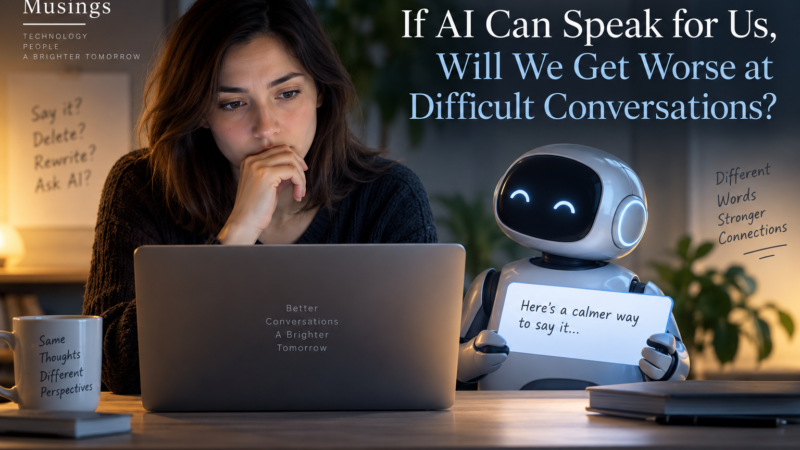
Imagine having an AI assistant available throughout the day. You’re writing an email and ask how you should respond. You’re buying something and ask which option to choose. You’re planning your weekend and ask what you should do. Someone sends you a difficult message and you immediately ask AI how you should reply. Each individual use seems perfectly reasonable, but together they create an interesting possibility. Instead of AI being a tool we occasionally consult, it could become the first place we turn whenever uncertainty appears.
We might begin asking AI before asking ourselves, and that could happen gradually enough that we barely notice it. Nobody wakes up one morning and decides to stop making independent decisions. We simply discover that asking the assistant is faster, easier and often produces good results. Convenience rarely forces us to change our behaviour. It simply makes one behaviour easier than another.
AI Doesn’t Need to Control Our Decisions
When people imagine machines controlling human decisions, the picture is usually dramatic: some powerful AI tells everyone what to do and humans obediently follow. Reality could be much more ordinary. AI doesn’t need authority over us if we voluntarily follow its recommendations because they’re convenient and usually useful. Imagine your navigation app telling you to take a particular road. Most of us don’t feel controlled by the app. We follow the route because we assume it knows something about traffic that we don’t.
Now imagine applying that same relationship to more areas of life. Which product should I buy? Which course should I take? Which investment should I consider? Which candidate should I hire? How should I respond to this person? Which city would suit me best? The more areas in which AI appears to know more than we do, the easier it becomes to defer. Perhaps the future risk isn’t that AI takes control of our choices. It is that we become comfortable enough to hand over control ourselves.
Recommendations Can Quietly Shape What We Want
There is another layer to this problem. Recommendations don’t only help us choose between things we already want; they can influence what we become interested in. Suppose an AI repeatedly recommends a certain kind of music. You begin listening to it more often and eventually develop a genuine interest in that genre. Did the AI discover your taste, or did its recommendations partly shape your taste? The same could happen with products, entertainment, travel destinations, hobbies and even ideas.
This doesn’t mean recommendation systems are secretly controlling us. Human preferences have always been influenced by friends, family, advertising, culture and the people around us. But highly personalised AI could make that influence more precise. A friend recommends things based on what they know about you, while an AI may eventually be able to consider far more information about your previous behaviour than any friend could remember. That makes the question of influence worth paying attention to.
We Should Know Why Something Is Being Recommended
Perhaps one way to preserve our judgement is to ask AI not only what it recommends but why. Instead of asking, “Which laptop should I buy?” we could ask, “Which three laptops best fit my requirements, and what are the trade-offs between them?” Instead of asking, “Which career should I choose?” we could ask, “What factors should I consider before making this decision?” Instead of asking, “Should I accept this job?” we could ask AI to identify the strongest arguments for accepting it and the strongest arguments against it.
That changes the role of AI. The machine stops being the decision-maker and becomes something closer to an adviser. A good adviser doesn’t necessarily tell us what to do; they help us see the situation more clearly so we can decide. Perhaps that is the healthiest relationship we can build with AI decision-making tools.
Sometimes AI Should Disagree With Us
There is another problem with asking for advice: sometimes we aren’t really looking for advice. We are looking for confirmation. Suppose you already want to buy an expensive product and ask AI whether purchasing it is a good idea. You may phrase the question in a way that makes your preferred answer obvious, and the same thing happens when we ask people for advice.
A useful AI shouldn’t simply become a machine that produces sophisticated reasons supporting whatever we already want to do. Sometimes the most valuable response might be, “You seem to be assuming something that may not be true.” If AI becomes part of our decision-making process, its value may come partly from challenging us. That requires us to be willing to hear an answer we don’t like. Otherwise, AI doesn’t improve our judgement; it simply becomes a more advanced way of agreeing with ourselves.
Responsibility Still Has to Belong Somewhere
Suppose AI recommends a decision and the decision goes badly. Who is responsible? For small decisions, the question may not matter much. If an AI recommends a terrible movie, nobody is going to organise an investigation. But the stakes become much higher in areas such as finance, employment, education or healthcare.
If we increasingly rely on AI recommendations, we may be tempted to blame the system whenever something goes wrong by saying, “I only did it because the AI told me to.” But advice doesn’t automatically remove responsibility. At least for many personal decisions, we still need to understand that AI is providing information or recommendations rather than living our lives for us. The final decision may still need to remain ours precisely because the consequences are ours.
Independent Judgement May Become More Valuable
There is an interesting pattern running through many discussions about Artificial Intelligence. The better machines become at performing a particular task, the more valuable certain human abilities surrounding that task may become. If AI can generate information, evaluating information becomes important. If AI can produce creative options, taste and direction become important. If AI can recommend decisions, independent judgement becomes important.
Perhaps the future won’t require us to make every decision alone because that would defeat much of the purpose of having intelligent tools. Instead, we may need to become better at recognising when to delegate and when not to. Let AI compare hundreds of hotel options, organise information, identify things we overlooked and calculate trade-offs that would take us hours. But when a decision touches something deeply connected to our values, identity or future, perhaps we should hesitate before simply asking the machine to choose.
The Best AI Might Help Us Think, Not Think Instead of Us
Imagine two versions of an AI assistant. The first responds to every difficult choice by saying, “Based on everything I know, you should choose Option A.” The second says, “Option A appears stronger financially, while Option B seems more aligned with the priorities you’ve described. Here are the trade-offs and the questions I think you should consider before deciding.” Which one would actually make us better decision-makers?
The first is easier, while the second requires us to think, and perhaps that’s exactly why the second might be more valuable. A powerful AI shouldn’t necessarily remove us from the decision-making process. It could help us participate in that process with better information, clearer reasoning and a broader understanding of the consequences.
Final Thoughts
Artificial Intelligence could make everyday decision-making dramatically easier. It can help us compare options, process enormous amounts of information, notice things we overlooked and reduce the exhaustion created by hundreds of small choices. There is no reason we should reject that help simply to prove that humans can make decisions without machines. But convenience can slowly become dependence if we stop paying attention to where one ends and the other begins.
There is a difference between asking AI to help us understand our choices and asking AI to choose for us. There is a difference between using a recommendation and automatically accepting it, and there is a difference between trusting a useful tool and gradually losing confidence in our own judgement. AI doesn’t need to control our decisions. We only need to become comfortable enough to stop making them ourselves.
Perhaps the smartest way to use AI isn’t to ask it, “What should I do?” every time we encounter uncertainty. Maybe we should ask it to show us what we’re missing, challenge our assumptions, explain the trade-offs and help us understand the decision more clearly. Then, after all of that, there should still be one final step that belongs to us: choosing.
AI may eventually know our preferences, understand our habits and calculate consequences better than we can in many situations. But a good decision isn’t always simply the option with the highest predicted chance of success. Sometimes a decision is also an expression of who we are, what we value and who we want to become. And those may be choices worth continuing to make for ourselves.