What Happens When the Internet Is Filled With More AI Content Than Human Content?
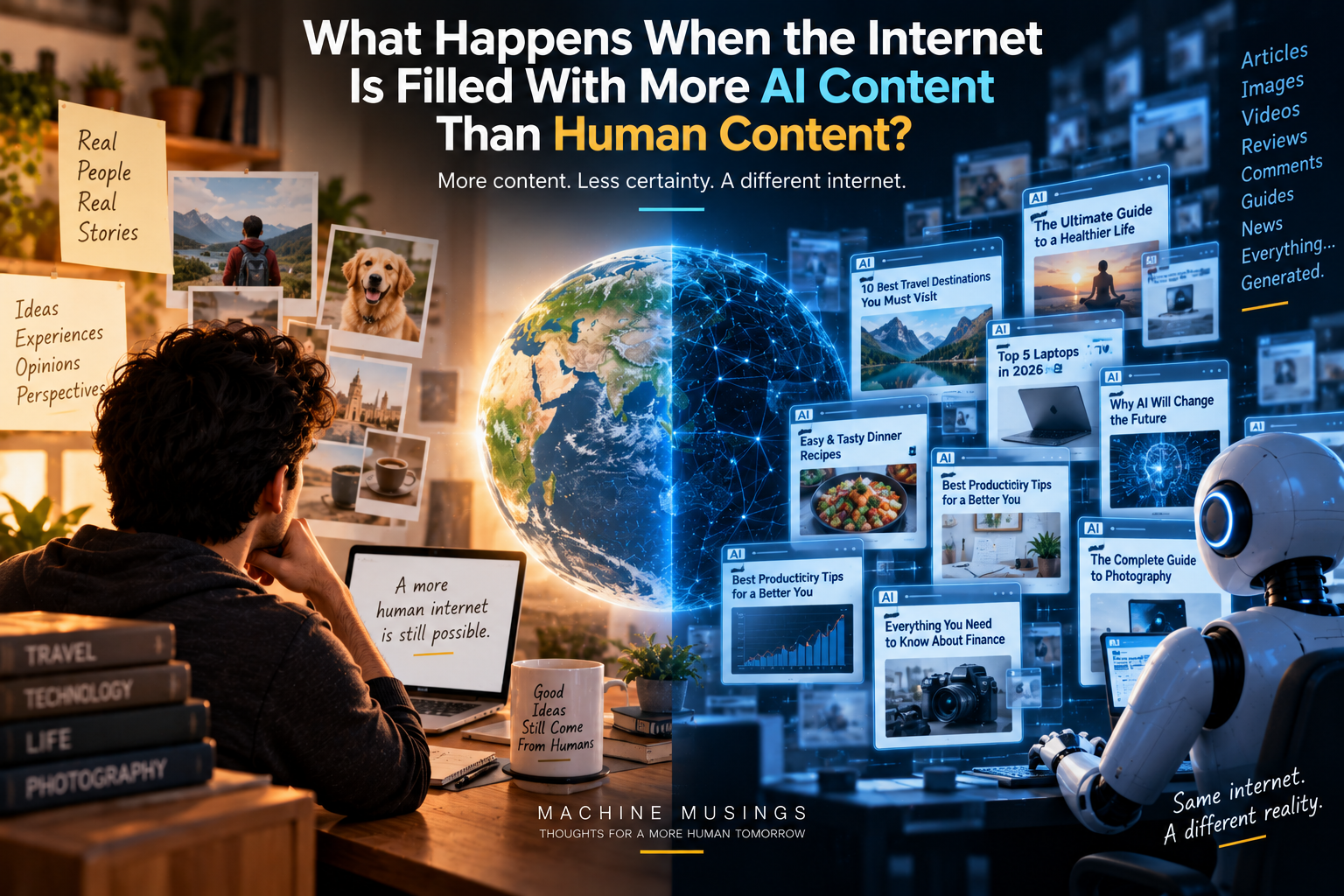
Think about everything you encounter during an ordinary hour on the internet. You might read a news article, scroll through photographs on social media, watch a short video, read comments underneath it, search for a product, look at customer reviews, visit a blog and perhaps listen to music while doing all of this. For most of the internet’s history, we could reasonably assume that somewhere behind almost everything we encountered was another human being. Someone wrote the article, someone took the photograph, someone recorded the video, someone typed the comment and someone shared their opinion.
Artificial Intelligence is beginning to complicate that assumption. AI can already generate articles, photographs, illustrations, music, voices, videos, advertisements, product descriptions, social-media posts and comments. Creating this content can take seconds, and the amount that can be produced is almost unlimited. That leads to a strange possibility for the future of the web: What happens when the internet contains more content created by machines than content created by humans?
The Internet Was Built From Human Contributions
One of the things that made the internet extraordinary was the ability for ordinary people to contribute to it. Someone could create a personal website about a hobby, write a detailed tutorial after solving a difficult problem, upload photographs from a place few people had visited or share an opinion that would never have appeared in a newspaper. Forums became valuable because people answered one another’s questions, blogs became interesting because individuals shared their experiences and perspectives, review websites helped because customers described what happened after actually buying something, and social media became enormous because billions of people continuously shared pieces of their lives.
The quality was never perfect. Humans can be wrong, biased, dishonest and repetitive, but much of the internet still represented something important: human experience being recorded and shared with other humans. When you found a ten-year-old forum discussion explaining an unusual problem with your computer, there was often a real person behind that answer who had experienced the same problem and taken the time to explain how they solved it. Now imagine the same internet when producing another page, comment, article or image costs almost nothing.
AI Can Create More Content Than We Could Ever Consume
A human writer has limitations. Writing a thoughtful article takes time. A photographer has to go somewhere, take photographs and choose which ones to publish. A video creator needs to plan, record and edit. Even someone writing a short social-media post has only twenty-four hours in a day. AI doesn’t face those limitations in quite the same way. A system can potentially generate hundreds or thousands of variations of an article, image or description in the time it would take a person to create one. Connect generation systems with automated publishing tools and the scale becomes difficult to imagine. A website could theoretically publish thousands of pages without thousands of writers sitting behind them.
Some of that could be genuinely useful. AI could help translate information into many languages, make complicated knowledge easier to understand, create accessibility descriptions, summarise long documents and help small creators produce things they previously couldn’t afford to make. But quantity creates its own problem. If creating content becomes almost free, the internet could become unbelievably good at producing things nobody particularly needed. We might have more articles, more images and more videos than ever before without necessarily having more original ideas.
Search Could Become a Battle Against Endless Content
Imagine searching for something surprisingly specific, such as a problem with an old camera you own. Today, you might find a forum discussion where someone encountered the same problem, a repair guide written by an enthusiast and perhaps a video showing how to fix it. Now imagine those useful results surrounded by hundreds of AI-generated articles. Each article has a slightly different title: “How to Fix This Camera Problem,” “7 Easy Ways to Solve This Camera Issue,” or “The Complete Guide to Repairing Your Camera.” They look professional, contain plenty of information and may even be perfectly optimised for the words you searched, but perhaps none of their creators ever owned the camera.
The articles may simply be different versions of information gathered from somewhere else. Suddenly, the challenge isn’t finding information; the challenge is finding the person who actually knows what they’re talking about. Ironically, the more content AI allows us to create, the harder finding genuinely useful information could become if quality, originality and real experience aren’t easy to distinguish.
What Happens to Personal Blogs?
Personal blogs are particularly interesting in this future because they represent almost the opposite of mass-generated content. A personal blog isn’t valuable because its author can produce more words than anyone else. It can be valuable because those words represent one person’s experiences, observations and way of looking at something. Imagine two articles about someone’s first year running a business. One is perfectly structured, contains every important point and was generated almost entirely by AI. The other is slightly less polished but contains the author’s actual mistakes, embarrassing moments, unexpected successes and things they wish someone had told them. Which one would you rather read?
There isn’t necessarily one correct answer. The AI-generated article might still contain useful information, but the second article contains something harder to manufacture: a lived experience. As AI-generated writing becomes increasingly common, perhaps personal perspective will become more important rather than less. Readers may stop being impressed simply because an article is grammatically perfect and well organised. They may increasingly ask, “What does this person actually have to say?”
Perfect Writing Could Become Boring
For years, writers have been encouraged to make their work cleaner. Fix the grammar, improve the structure, remove awkward sentences and make everything sound professional. AI is extremely good at helping with exactly those things. But imagine a future in which millions of articles are perfectly written. Every introduction is engaging, every paragraph flows smoothly, every heading is optimised and every conclusion neatly summarises the argument. At some point, perfection itself might become strangely ordinary.
Human writing has quirks. People use expressions influenced by where they grew up, repeat certain words, tell stories in unusual ways and occasionally write a sentence that isn’t technically perfect but somehow sounds exactly like them. AI can imitate styles, of course, but perhaps readers will increasingly value writing that feels connected to an actual individual. Maybe the future of writing won’t be about proving that AI wasn’t involved anywhere in the process. Writers may use AI for research, editing, brainstorming or correcting mistakes. The more meaningful distinction could be whether there was a real human idea underneath the final piece.
Social Media Could Become Even Stranger
Now think about social media. You see a photograph of a beautiful holiday destination. Was someone actually there? You watch a video of a person explaining something. Is that person real? You read a comment praising a product. Did an actual customer write it? You see thousands of accounts discussing the same topic. How many represent independent people? Synthetic content doesn’t automatically mean deceptive content. A creator might openly use an AI-generated image for entertainment or artistic purposes, or a company might use a virtual character and clearly explain that the character isn’t real. There is nothing inherently wrong with that.
The problem begins when we cannot easily tell the difference. Social media depends heavily on the feeling that we are seeing what other people think, do and experience. If a significant portion of those people, experiences and reactions can be generated automatically, the meaning of engagement itself begins to change. A post with ten thousand comments looks popular, but what if most of those comments were generated by machines? Numbers that once represented human attention could become increasingly difficult to interpret.
AI Talking to AI Could Become Normal
There is an almost funny version of this future. Imagine an AI system generates an article, another automated system publishes it on social media, AI-controlled accounts comment on it, another AI summarises those comments, search engines index the discussion, and a different AI assistant later discovers the page and uses it while answering someone’s question. At some point, you have to ask: Where was the human?
The internet could theoretically develop enormous conversations in which machines are producing, responding to and redistributing content created by other machines. Humans might still be involved in setting goals and consuming the results, but the amount of machine-to-machine content could become enormous. We built the internet partly so humans could communicate with one another across distances. It would be rather strange if we eventually became spectators while our software talked to itself.
What Happens When AI Learns From AI?
This leads to an even more interesting question. AI systems are trained using enormous collections of information, much of which ultimately comes from things humans created: books, websites, articles, images, code and other forms of recorded knowledge. But what happens as an increasing proportion of publicly available material is itself generated by AI? Imagine a future AI system encountering millions of articles written by earlier AI systems. Those articles may themselves have been based partly on other AI-generated material, meaning future models could encounter content that has travelled through several generations of machines before reaching them.
The quality and composition of training data matter, and future AI systems don’t necessarily have to absorb everything they encounter online. Still, the broader question is fascinating. For years, machines learned from an internet largely created by humans. What happens when machines increasingly encounter an internet they helped create themselves? If the original source of an idea becomes harder to identify, distinguishing genuinely new information from endlessly recycled information could become increasingly important.
Original Sources Could Become More Valuable
Perhaps one consequence will be renewed appreciation for original sources. Instead of reading the fiftieth summary of an idea, people may want to find the person who first expressed it. Instead of reading another article describing a scientific study, they may look for the study itself. Instead of trusting hundreds of repeated claims, they may ask where the information originally came from. This could actually be a healthy change.
The internet has already made copying and repeating information incredibly easy, and AI accelerates that process dramatically. One incorrect claim can be rewritten into countless forms and appear to have enormous support simply because many pages repeat it. But repetition isn’t the same as independent evidence. If AI-generated content becomes abundant, knowing the origin of information may become just as important as understanding the information itself.
“Made by a Human” Could Become a Selling Point
Consider what happened to handmade products after mass manufacturing became normal. A handmade table isn’t necessarily objectively better than one produced by a machine, but people sometimes value it because they appreciate the craftsmanship and the knowledge that someone personally created it. Something similar could happen with digital content. Perhaps websites will begin highlighting that an article was written from personal experience, photographers may emphasise that an image was actually captured with a camera, musicians may advertise live recordings, and creators might show more of their process to demonstrate the human work behind what they produce.
Maybe labels such as “Human Written,” “Original Photography,” or “Created From Personal Experience” will eventually carry value. Not because AI-created content is automatically bad, but because human-created content could become relatively scarce. Scarcity changes what we appreciate. For decades, producing digital content was evidence that someone had invested at least some effort. In the future, effort itself may become something creators want to demonstrate.
Imperfection Might Become a Form of Authenticity
This could lead to another strange reversal. Today, we often remove imperfections because they make content look less professional. Tomorrow, some imperfections might actually make content feel more trustworthy. A slightly awkward pause in a video, an unusual sentence in an article, a photograph with imperfect lighting or a person stumbling over a word could remind us that a real human being was involved.
Of course, AI can imitate imperfections too, which makes this much more complicated. Artificial content can deliberately be made to look spontaneous or imperfect, so authenticity cannot simply be judged by appearance. Still, people may become more interested in the process behind content. Who created this? Why did they create it? What experience do they have? Can I see how it was made? The story behind the content may increasingly become part of the content itself.
More Content Doesn’t Mean More Knowledge
One of the most important distinctions in this entire discussion is the difference between information and knowledge. Suppose AI allows the internet to grow ten times larger. Does humanity now know ten times more? Obviously not. We may simply have ten times as many ways of expressing similar information. A thousand articles repeating the same explanation don’t necessarily add more understanding than one excellent article, and ten thousand generated photographs of imaginary places don’t create ten thousand new real-world experiences.
The internet’s value doesn’t come from the number of pages it contains. It comes from whether those pages contain something useful, accurate, interesting or genuinely new. AI makes producing information incredibly easy. The next challenge may be deciding which information deserves our attention.
Human Creativity Doesn’t Have to Compete With AI Quantity
It would be easy to look at the amount of content AI can produce and assume human creators cannot compete. A person cannot write ten thousand articles in a day or create thousands of images every hour, but perhaps competing on quantity is the wrong game. A grandmother writing about a family tradition doesn’t need to outperform an AI at producing articles. A traveller describing something unexpected that happened during a journey doesn’t need to generate five hundred travel guides. A programmer explaining the unusual bug they spent three days fixing doesn’t need to publish thousands of tutorials.
Their advantage is that something actually happened to them. AI can help organise those experiences, improve the writing or make the final presentation better, but the source of the story remains human. In an internet overflowing with generated content, a real experience may become more interesting precisely because it cannot be produced at unlimited scale.
Maybe the Internet Will Split Into Two Layers
Perhaps we will eventually think about online content in two broad categories. One layer will be enormous, fast and generated: summaries, explanations, translations, personalised entertainment, advertisements and countless pieces of temporary content created whenever they are needed. The other layer may be smaller but valued differently: original reporting, personal experiences, research, art, photography, conversations and ideas connected to identifiable people.
Both could be useful. We don’t necessarily need every weather summary or product description to be handcrafted by a person because there are many forms of information where automation makes perfect sense. The important thing may be knowing which kind of content we’re looking at. If I want a quick explanation of a simple concept, generated content might be perfectly adequate. If I’m reading someone’s account of living through an event, I probably care a great deal whether that person actually existed and experienced it.
The Future of the Internet May Be About Trust, Not Content
For years, one of the internet’s biggest problems was scarcity of good information. Then the problem became abundance: there was so much information that search engines and social platforms had to help us decide what to see. AI could push us into another stage entirely. The problem may no longer be finding content because there may be effectively unlimited content. The problem will be deciding what deserves to be trusted, read and remembered.
Who made it? Where did the information come from? Was there original research? Is there a real experience behind it? Has the content simply repeated something generated elsewhere? These questions could become normal parts of digital literacy. Perhaps one of the most valuable internet skills of the future won’t simply be finding information. It will be finding the origin of information.
Final Thoughts
Artificial Intelligence is making digital content easier to create for millions of people. That can be an extraordinary thing. Someone who struggles with writing can communicate an idea more clearly, a small business can create professional material without hiring a large team, and creators can experiment with images, music and video in ways that previously required expensive tools and specialised skills. The problem isn’t simply that AI can create content. The more interesting question is what happens when creating content becomes almost effortless and unlimited.
An internet containing billions of additional articles, images, videos and comments isn’t automatically a better internet. If those things simply repeat one another, imitate experiences nobody actually had or exist mainly to capture our attention, we could end up surrounded by more content while finding less that feels worth consuming. Perhaps that will change what we value. We may care more about original sources, search for genuine expertise and appreciate personal blogs precisely because there is a person behind them. We may value photographs because someone actually stood somewhere and captured a moment, and we may enjoy writing because it contains a perspective shaped by a life that was genuinely lived.
For years, the internet was largely a place where humans created things for other humans. AI doesn’t necessarily have to destroy that. It may simply force us to recognise how valuable it was. Perhaps someday, when almost anything can be generated perfectly within seconds, the most interesting thing we can encounter online won’t be the most polished article, the most beautiful image or the most impressive video. It may simply be something that makes us think: “A real person had something they genuinely wanted to say.”