If AI Makes Everyone More Capable, What Will Make Someone Stand Out?
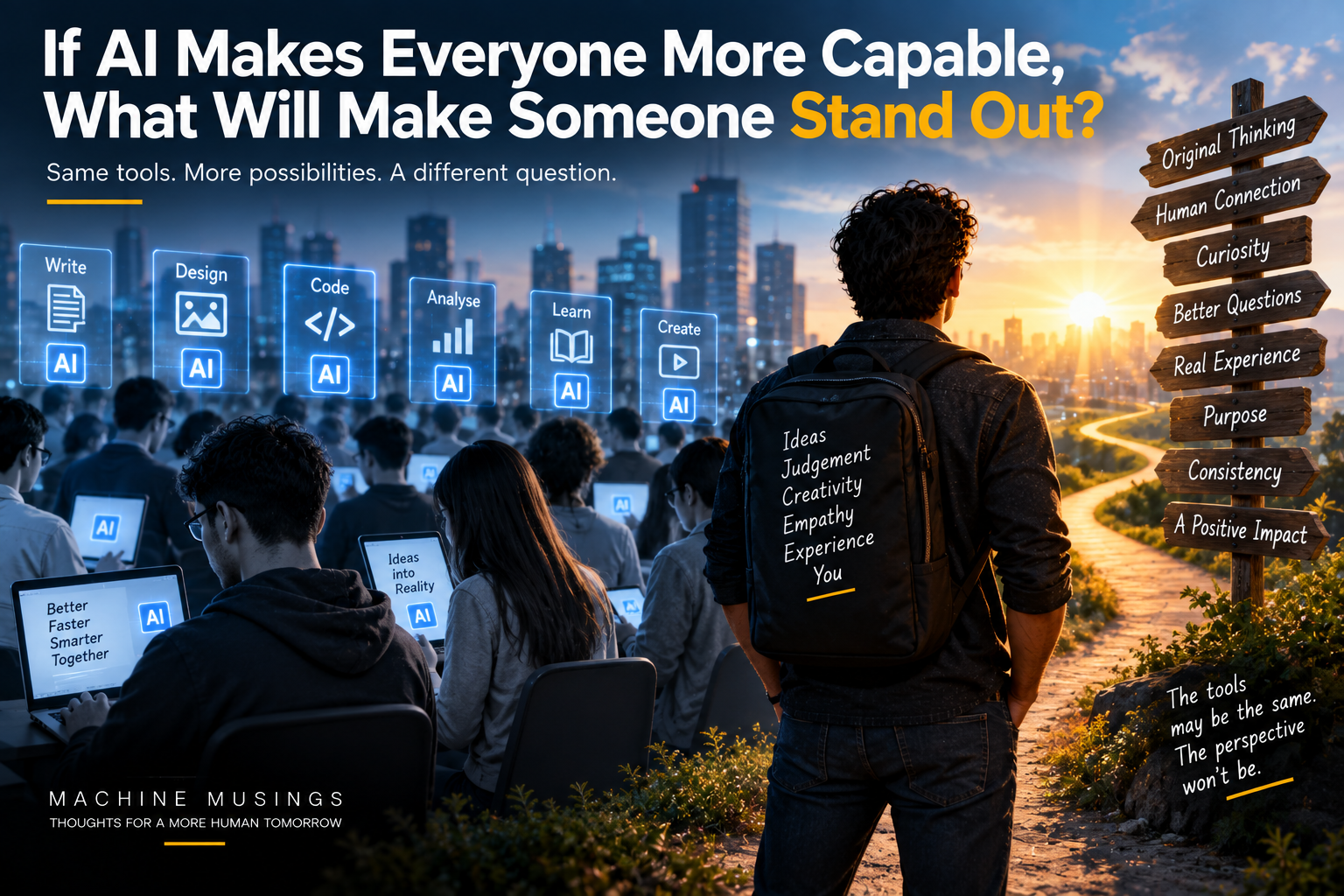
For a long time, being able to do something difficult was enough to make a person stand out. Someone who could write exceptionally well, design beautiful graphics, build software, analyse complicated information, create professional presentations or communicate ideas clearly possessed skills that took considerable time to develop. Those abilities still matter, but Artificial Intelligence is beginning to change how easily some of them can be accessed. A person who isn’t particularly confident about writing can use AI to improve a document. Someone with limited design experience can generate impressive visuals. A beginner can receive help writing code, a student can get complicated ideas explained in simpler language, and a small business can produce work that once might have required several specialised people.
This is one of the most exciting things about AI because powerful capabilities are becoming available to far more people. Someone doesn’t necessarily need a large team, expensive resources or years of specialised experience before they can begin turning an idea into something real. AI can reduce the distance between imagining something and actually creating it. But if these tools continue becoming more capable and more widely available, they also create an interesting question. If AI makes everyone more capable, what will actually make someone stand out?
When Powerful Tools Become Normal
New technology often begins as an advantage for the relatively small number of people who understand how to use it. Eventually, however, useful technology becomes normal. Computers were once unusual workplace tools, while today basic computer skills are simply expected in many professions. Knowing how to search the internet was once a meaningful advantage, but now almost everyone carries access to enormous amounts of information in their pocket. Smartphones gave ordinary people cameras, navigation, communication, editing tools and access to knowledge that previous generations could hardly have imagined, yet simply owning a smartphone doesn’t make someone exceptional today.
AI may follow a similar path. Right now, knowing how to use AI effectively can provide a noticeable advantage. A person may complete research faster, improve writing, automate repetitive tasks, generate ideas or learn unfamiliar subjects more efficiently. But if AI assistants eventually become as common as search engines, email or smartphones, access to AI itself will no longer be unusual. The person competing with you for a job, building a business in the same market or creating content in the same field may have access to tools just as powerful as yours. At that point, the advantage won’t simply come from having AI; it will come from what you choose to do with it.
Good Work Could Become Much Easier to Produce
One possible consequence of widespread AI is that the average quality of many kinds of work could improve. Emails may become clearer, presentations may become more polished, websites may become easier to build, translations may become better, images may become more professional and reports may become more organised. People who previously struggled with certain technical aspects of their work may be able to overcome those limitations with assistance.
That is a positive development, but it also changes expectations. If almost everyone can create a reasonably professional presentation, having a professional-looking presentation becomes less impressive. If AI can help almost anyone write a grammatically correct and well-structured email, correct grammar alone becomes less valuable as a differentiator. If thousands of people can generate attractive graphics within minutes, simply producing an attractive graphic may no longer attract much attention. AI could therefore raise the minimum standard of what people consider acceptable while simultaneously making it harder to stand out by technical quality alone.
The Difference Between Good and Interesting May Become Bigger
AI can help produce something good, but “good” and “interesting” aren’t always the same thing. A perfectly written article can still say nothing memorable. A beautiful presentation can contain an ordinary idea. A technically impressive application can solve a problem nobody particularly cares about. A professionally produced video can still be boring. As tools improve, we may see enormous amounts of content and work that are technically competent but surprisingly similar.
This could make ideas more important. When producing something becomes easier, deciding what should be produced becomes more valuable. Two people might have access to exactly the same AI tools, but one may ask predictable questions while the other notices a problem nobody else has considered. One may use AI to reproduce what already exists, while the other uses it to explore something unusual. The technology available to them could be identical while the results are completely different because the human direction behind the technology is different.
Taste Could Become a Serious Advantage
Taste is difficult to define because it isn’t simply technical knowledge. It is the ability to recognise when something feels right, when an idea is interesting, when a design is unnecessarily complicated, when a sentence should be removed, when an opportunity deserves attention or when something that looks impressive doesn’t actually have much substance. Taste develops through exposure, experience, curiosity and repeated decisions about what we consider valuable.
AI can generate twenty options within seconds, but receiving twenty options creates another problem: someone still has to choose. If AI produces ten designs, which one communicates the idea best? If it suggests fifteen headlines, which one will actually make someone curious? If it proposes several business strategies, which one fits the situation? If it generates hundreds of ideas, which few deserve to become real projects? As generation becomes easier, selection becomes more important, and the ability to recognise quality among an abundance of possibilities may become one of the most valuable human skills.
Judgement Matters When Answers Are Easy to Generate
AI can provide an answer quickly, but having an answer and having the right answer are different things. More importantly, sometimes the real challenge is deciding whether the question itself is worth asking. Someone may use AI to analyse a business idea in enormous detail, but if the original idea is based on a poor understanding of customers, a beautifully organised analysis won’t solve the fundamental problem.
Human judgement involves context. It includes understanding people, consequences, timing, uncertainty and situations where there isn’t a perfectly measurable answer. AI can help us examine those things, but the person using the system still needs to decide what information deserves attention and what should be ignored. In a world where everyone can generate suggestions, explanations and strategies quickly, the person who consistently makes better decisions about those suggestions may have a greater advantage than the person who simply generates the most of them.
Curiosity Could Become More Valuable, Not Less
AI makes asking questions incredibly powerful. Someone curious about economics, programming, astronomy, psychology or almost any other subject can begin exploring it immediately. Concepts that once required hours of searching across different resources can often be explained interactively, and follow-up questions can be asked without worrying about whether they sound basic.
But access to answers doesn’t automatically create curiosity. Two people can have access to exactly the same AI and use it very differently. One might ask it to complete whatever task is immediately necessary and stop there. Another might continue asking why something works, what would happen under different conditions, whether there are alternative explanations and how an idea connects with something completely different. The same tool could therefore make one person faster while making another person genuinely more knowledgeable. If answers become abundant, the ability to keep asking interesting questions may become more valuable.
Original Experience Cannot Simply Be Generated
There is another advantage humans possess that becomes especially important when generated content becomes common: personal experience. AI can write about travelling through a city, but it hasn’t walked through that city as you have. It can describe running a business, but it hasn’t experienced the uncertainty of risking its own money. It can discuss friendship, failure, ambition or disappointment, but it doesn’t possess a personal history of those experiences.
People bring something to their work that cannot be reduced entirely to technical skill. Their families, cultures, mistakes, careers, conversations, places they have visited and problems they have faced influence how they see the world. Two people can be given exactly the same question and notice completely different things because their lives have trained them to pay attention to different details. AI can help someone communicate that perspective more effectively, but the perspective itself still comes from somewhere. In a world filled with generated material, genuine experience may become more noticeable precisely because it is harder to manufacture.
Discipline Still Matters When Work Becomes Easier
There is a temptation to believe that better tools eliminate the need for discipline. If AI can help us write, research, organise and plan, perhaps success becomes much easier. AI certainly can reduce the effort required for many tasks, but completing a task faster doesn’t necessarily create the discipline required to keep doing meaningful work over a long period.
Someone still needs to begin the project, continue when the initial excitement disappears, respond to feedback, correct mistakes and finish what they started. A person can generate a business plan in minutes, but building the business may take years. AI can create a training schedule, but it cannot perform the exercise for you. It can suggest how to learn a language, but you still need to practise. It can help outline a book, but someone must care enough about the book to keep working on it. AI can reduce friction around execution, but consistency remains something people have to develop themselves.
Reliability May Become More Valuable Than Brilliance
When powerful tools become widely available, employers and collaborators may begin caring even more about qualities that technology cannot guarantee. Can this person be trusted to finish something? Do they communicate when there is a problem? Can they work with other people? Do they take responsibility for mistakes? Can they make sensible decisions when instructions are unclear?
These qualities may sound less exciting than creativity or intelligence, but they matter enormously in the real world. A brilliant person who repeatedly misses deadlines can be less useful than someone slightly less talented who consistently delivers good work. AI may help both people become more capable, but it doesn’t automatically make either of them dependable. If technical ability becomes easier to access, qualities such as reliability, communication, responsibility and professionalism may become even stronger ways of distinguishing one person from another.
The Real Competition Won’t Be Humans Against AI
A lot of conversations about the future of work are framed as humans competing against Artificial Intelligence. In many situations, however, the more realistic comparison may be between people who use AI differently. A designer using AI may compete with another designer using AI. A programmer using AI may work alongside another programmer using similar tools. A student with access to an AI tutor may be surrounded by other students who have access to the same kind of assistance.
That changes the question. It is no longer simply, “Can AI do what I do?” It becomes, “What can I do when everyone around me also has AI?” The answer probably won’t be to use AI more frequently than everyone else. It may involve understanding your field more deeply, developing stronger judgement, asking better questions and building enough experience to recognise when an AI-generated suggestion is useful and when it isn’t.
Knowing How to Use AI Will Still Matter
If AI becomes widely available, using it effectively will still be important. There can be a substantial difference between someone who treats AI as a machine for generating finished answers and someone who treats it as a tool for exploration, critique and improvement. One person might ask for a complete solution and accept the first response. Another might provide context, question assumptions, compare alternatives, verify important information and repeatedly refine the result.
The second person isn’t necessarily succeeding because they know some magical prompt. They are succeeding because they understand what they are trying to achieve. Good AI use often depends on good thinking before the prompt is written. The clearer someone is about the problem, constraints and desired outcome, the more useful the tool can become. As AI interfaces improve, complicated prompting techniques may become less important, while subject knowledge and clarity of thought could matter even more.
Expertise Isn’t Going Away
It can sometimes appear that AI makes expertise unnecessary because a beginner can ask an AI system about something they don’t understand and receive an impressive response. But expertise isn’t simply the ability to produce an answer. Experts are often valuable because they can recognise when an answer is wrong, incomplete or inappropriate for a particular situation.
Give the same AI-generated code to an experienced programmer and someone who has never programmed, and they won’t evaluate it in the same way. Give an AI-generated financial analysis to an experienced analyst and a complete beginner, and they may notice very different things. The tool can help both people, but the expert has a larger foundation from which to judge what the tool produces. AI may therefore make beginners more capable while simultaneously making deep expertise more powerful because experts can combine their knowledge with capabilities that previously required much more time.
Doing More Won’t Necessarily Mean Achieving More
One of the easiest ways to use AI is to increase output. We can write more posts, create more images, generate more ideas, produce more reports and start more projects. But more output doesn’t automatically create more value. If everyone begins producing ten times as much, the world may simply contain ten times as many things competing for attention.
The ability to decide what not to produce could become surprisingly important. Instead of asking how many articles we can publish with AI, we might ask which article is actually worth writing. Instead of generating hundreds of product ideas, we might spend more time identifying which problem genuinely deserves to be solved. Instead of using AI to fill every available space with more content, we might use it to improve the few things we genuinely care about. When production becomes cheap, attention becomes expensive, and people who respect other people’s attention may stand out more than people who simply generate the most material.
Being Human Could Become Part of the Difference
As AI-generated work becomes increasingly polished, small signs of personality may become more valuable. People don’t always want the technically perfect answer. Sometimes they want a perspective, a story, humour, emotion or an opinion shaped by an actual person’s experience. This doesn’t mean deliberately making work worse or refusing to use AI. It means recognising that perfection and personality aren’t the same thing.
A person can use AI extensively while still producing something distinctly their own. AI might help organise an article, but the experiences inside it can remain personal. It might help edit a video, but the reason for making that video can still come from the creator. It might help build a product, while the insight about what people actually need comes from someone who understands the problem. The people who stand out may not necessarily be those who hide AI completely, but those who use it without allowing everything they create to become interchangeable with everyone else’s work.
The Value May Move From Execution to Direction
For much of history, turning an idea into reality required significant execution ability. You might have a brilliant idea for software but lack the programming skills to build it. You might imagine a beautiful visual but lack the ability to design it. You might understand a business opportunity but lack the resources to create professional marketing materials. AI can reduce some of these barriers, allowing more people to attempt things they previously couldn’t.
When execution becomes easier, direction becomes more important. What are you building? Why should it exist? Who does it help? What should it feel like? Which details matter? What should be removed? These questions aren’t about whether something can be generated; they are about whether it deserves to exist in the first place. AI can help explore the answers, but someone still needs to care enough to ask the questions.
Standing Out May Become More About Choices
Perhaps the most interesting change is that AI could shift competition away from pure capability and toward choices. If two people can both write well with assistance, what do they choose to write about? If both can create professional designs, what do they choose to communicate? If both can build applications, which problems do they choose to solve? If both can analyse enormous amounts of information, which conclusions do they consider important enough to act upon?
This means opportunity doesn’t necessarily disappear when capabilities become more equal. The nature of opportunity changes. Tools may become widely shared, while curiosity, judgement, experience, ambition and priorities remain different from person to person. AI can give people similar capabilities without giving them identical minds, lives or motivations. Those differences may become the source of what makes their work distinctive.
Final Thoughts
AI making more people capable should be something worth celebrating. Skills and resources that were once available only to specialists, large companies or people with significant time and money may become accessible to almost anyone willing to learn. Someone with an idea may be able to build a prototype without assembling a large team. A student may explore subjects beyond what is available in the classroom. A small business may create work that once required an expensive agency. People who previously felt limited by one particular skill may finally be able to express ideas they already had.
At the same time, greater capability doesn’t automatically make everyone equally successful. If everyone receives better tools, the standard simply moves. The advantage may gradually shift away from being able to produce something and toward knowing what deserves to be produced. Taste will matter because someone needs to choose among endless possibilities. Judgement will matter because someone needs to recognise which answers make sense. Curiosity will matter because powerful answers are useless without interesting questions. Expertise will matter because someone needs to recognise mistakes. Discipline and reliability will matter because tools can make work easier without making people consistent. Personal experience will matter because technology can generate information without having lived a human life.
The future therefore may not be one in which AI makes everyone the same. It could be almost the opposite. When basic capabilities become easier to access, the differences between what people notice, choose, believe, value and pursue may become much more visible. Having AI may eventually become no more unusual than having a smartphone or internet connection, which means simply using AI won’t be enough to make someone exceptional.
In a world where everyone can create more, perhaps the person who stands out will be the one who knows what is worth creating. In a world where everyone can receive answers, perhaps the advantage will belong to the person asking questions other people haven’t considered. In a world where powerful tools make execution easier, the hardest and most valuable part may increasingly become deciding where all that capability should be directed.
AI may make everyone more capable, but capability alone has never guaranteed that someone will do something meaningful with it. As these tools become available to more people, what separates us may increasingly be the parts that cannot simply be handed over by a machine: our judgement, curiosity, experiences, choices and willingness to follow an idea far enough to turn it into something worthwhile.