If AI Becomes Our Second Brain, What Happens to the First One?
Try to remember the phone numbers of five people you regularly talk to. Not their names in your contacts, but their actual numbers. For many of us, that would be surprisingly difficult. Now imagine travelling somewhere in your city without using navigation. Could you remember every turn? What about remembering an appointment without a calendar notification, calculating something without opening a calculator, or recalling a piece of information without immediately searching for it online? None of this necessarily means our brains are becoming weaker. Technology has always allowed us to move certain tasks outside our minds. We write things down because we don’t want to remember everything, use calendars because dates are easy to forget, use calculators because performing every calculation mentally would be unnecessary, and use maps because memorising every road isn’t particularly useful.
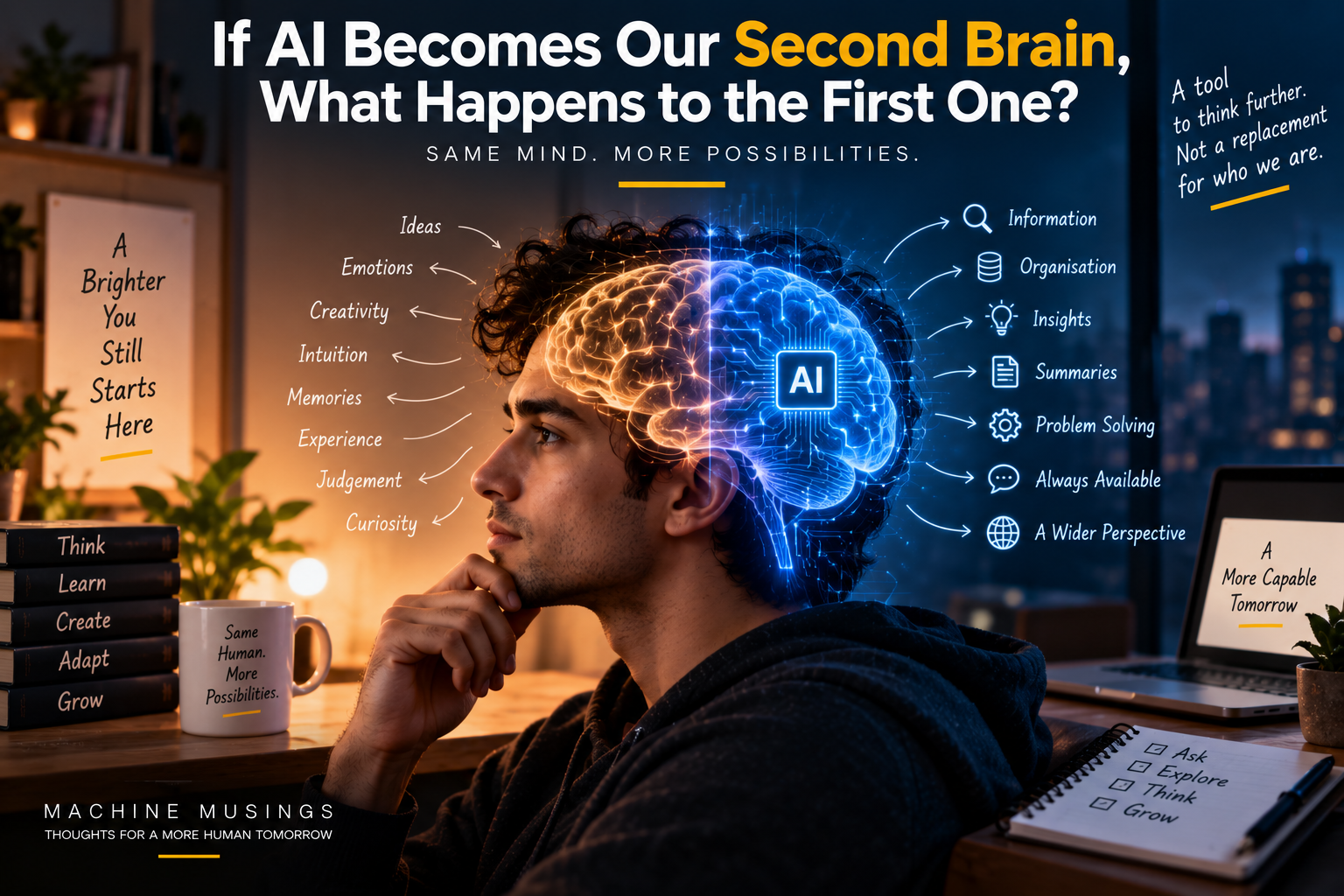
For years, smartphones have gradually become an external memory for our lives. Artificial Intelligence, however, introduces something slightly different. AI doesn’t only store information for us; it can organise it, summarise it, connect it, explain it and increasingly help us think about what to do with it. Instead of simply becoming another place where our information is stored, AI could become something that actively works with that information alongside us. That raises an interesting question: If AI becomes our second brain, what happens to the first one?
We Have Always Stored Our Thoughts Outside Our Heads
The idea of using something outside ourselves to remember information isn’t new at all. Human beings have been doing it for thousands of years. Writing itself is a form of external memory. Instead of remembering every story, agreement, calculation or historical event, we learned to record information so that it could survive beyond the limits of an individual person’s memory. Books expanded this enormously, while libraries allowed generations of knowledge to exist somewhere we could return to whenever we needed it. Computers took the same idea much further because instead of remembering where every document was stored physically, we could search for it digitally.
Smartphones then placed enormous amounts of information in our pockets. We stopped memorising some phone numbers because our contacts remembered them. We stopped remembering every appointment because calendars reminded us. We stopped carrying maps because navigation applications could tell us exactly where to turn. In many ways, this has been wonderful because our brains don’t have unlimited attention, so allowing technology to remember less important details gives us more room to focus on other things. The question isn’t whether we should use external tools to support our memory because we already do that constantly. What makes AI interesting is that the external tool is beginning to do something more than simply remember.
AI Doesn’t Just Store Information — It Works With It
Imagine writing something in a notebook. The notebook remembers exactly what you wrote, but it doesn’t understand your notes. It cannot tell you that an idea you wrote six months ago connects surprisingly well with something you wrote yesterday, summarise twenty pages of your thoughts or reorganise them into a useful plan. AI potentially can. Suppose over several months you use an AI assistant while working on a project. You discuss ideas, ask questions, create plans, compare alternatives and record decisions. Instead of searching manually through hundreds of old notes, you might eventually be able to ask, “What were the main ideas I considered for this project, and why did I reject some of them?” An AI with access to the relevant information could organise that history into something useful.
That feels different from ordinary digital storage because a hard drive stores information, while AI can potentially help us interpret the information we’ve stored. Once a tool can remember, organise, connect and interpret information for us, it starts to feel less like a filing cabinet and more like an extension of how we think. This is where the idea of AI as a “second brain” becomes particularly interesting, because we aren’t simply giving a machine the responsibility of remembering things; we may gradually begin giving it some responsibility for understanding and organising those things too.
Forgetting Isn’t Always a Failure
We often treat forgetting as something negative. If we forget someone’s birthday, an appointment or an important fact, we become frustrated with ourselves. But human memory was never designed to preserve every detail perfectly. We forget constantly, and sometimes that may actually be useful. Think about everything you’ve seen today: faces in the street, advertisements, conversations, notifications, numbers, signs, videos and random thoughts. If your brain stored every detail with equal importance and constantly presented all of it back to you, thinking might become exhausting.
Forgetting helps reduce that noise. Our minds keep some things, lose others and gradually change the way memories feel. An embarrassing moment that seemed enormous ten years ago may barely matter today, while a disagreement that once made us angry may eventually lose its emotional weight. Human memory isn’t simply an archive; it is part of how we process experience over time. An AI memory could work differently because digital information can potentially remain exactly where we left it. This creates a strange possibility in which our second brain may continue remembering things our first brain was naturally ready to forget.
A Perfect Memory Might Not Always Be Helpful
Imagine having an AI assistant that remembers every idea you abandoned, every mistake you discussed, every preference you expressed and every decision you considered. In some situations, that would be incredibly useful because you could retrieve important details without worrying about forgetting them. But there could also be moments when old information no longer represents who you are. Perhaps five years ago you disliked a certain type of food, but your taste changed. Maybe you once wanted a particular career but eventually discovered something completely different. Perhaps you expressed an opinion years ago that you no longer agree with.
Humans change, but a digital record doesn’t automatically understand that change. A useful second brain would therefore need to do more than remember. It would need to understand that some information becomes outdated, some memories matter more than others, and sometimes forgetting—or at least reducing the importance of something—is part of moving forward. The smartest AI memory may therefore not be the one capable of remembering absolutely everything forever, but the one capable of understanding what remains relevant to the person we are today.
What Happens to Our Natural Memory?
There is a simpler concern as well. When we know something is stored somewhere else, do we make less effort to remember it ourselves? Most of us have probably experienced this already. If you know a phone number is saved in your contacts, you have little reason to memorise it. If navigation will guide you somewhere, you may pay less attention to the route. If you know you can search for a fact whenever you need it, remembering the fact itself may feel less important. This isn’t necessarily a problem because memorising every phone number isn’t an important measure of intelligence.
AI, however, could expand this behaviour from simple information into more complicated areas. If an AI remembers what we discussed, do we need to remember the conversation? If it keeps track of our plans, do we need to hold those plans in our minds? If it can summarise what we’ve learned, how much of the detail do we need to retain ourselves? Perhaps the important distinction isn’t simply between remembering and forgetting, but between information we genuinely need to carry inside our minds and information we only need to know how to retrieve when necessary.
Knowing Something and Knowing Where to Find It Are Different
The internet already changed our relationship with knowledge. There is a difference between knowing the capital of a country and knowing that you can find the answer within seconds. Both can get you to the information, but they aren’t exactly the same ability. AI pushes this further because instead of merely retrieving information, it can explain, compare and reorganise it. That could encourage us to rely less on remembering facts and more on knowing how to ask useful questions and evaluate the answers we receive.
There are advantages to that because nobody needs to memorise every fact in existence. What matters more in many situations is understanding concepts, recognising relationships and knowing how to evaluate information. At the same time, some knowledge needs to exist inside us before deeper thinking can happen. A doctor cannot search every basic medical concept while treating someone. A musician cannot stop in the middle of a performance to look up every note. A fluent speaker doesn’t search for every word before speaking. Expertise depends partly on knowledge becoming familiar enough that we can use it almost automatically. External intelligence can expand what we know, but there is still value in having knowledge that is genuinely ours.
Could We Start Outsourcing Our Thoughts Too?
Memory may only be the beginning. AI isn’t simply becoming something we ask to remember information. We increasingly use it to organise ideas, summarise documents, brainstorm possibilities, compare choices, draft writing and solve problems, and all of those activities involve thinking. Suppose you have an idea and immediately ask AI to develop it before you’ve spent much time thinking about it yourself. The AI gives you five directions, identifies possible problems and proposes a structure. That can be extremely useful, but your own thought process has changed because instead of beginning with an empty space and struggling to develop the idea, you begin with several possibilities already placed in front of you.
Again, that isn’t automatically bad because humans have always thought with other humans. We brainstorm with colleagues, ask friends for advice and learn from books written by people who thought about a problem before us. The difference with AI is availability. AI can potentially be there for almost every thought, every question and every moment of uncertainty. When help becomes available for every thought, we may need to become more deliberate about deciding which thoughts deserve some time alone inside our own heads before we ask a machine to participate.
Sometimes Thinking Requires Sitting With a Problem
There is something uncomfortable about not knowing what to do. You encounter a difficult problem, think about it, walk away, return later and perhaps spend days without finding a satisfying answer. AI can dramatically shorten that experience because we can ask a question and receive possibilities almost immediately. That can be wonderful when the problem is practical, but sometimes the period before an answer appears is useful too. Our minds continue working on things even when we’re not consciously trying to solve them. We notice connections, reconsider assumptions and sometimes arrive at ideas precisely because we weren’t given an immediate solution.
If we ask AI the moment uncertainty appears, we may reduce the amount of time we spend sitting with difficult questions. Not every unanswered question is a problem that needs to be solved within thirty seconds, and sometimes uncertainty is where our own thinking begins. AI can help us move forward when we’re stuck, but perhaps we shouldn’t always treat the feeling of being stuck as something that needs to disappear immediately.
A Second Brain Could Make Us More Capable
It would be easy to make this entire discussion sound negative, but that would ignore the enormous possibilities of AI-assisted thinking. A second brain could make people significantly more capable. Imagine never losing a good idea because you forgot to write it down, being able to return to a project after two years and immediately understand where you left off, or having an AI help connect ideas from books you’ve read, conversations you’ve had and notes you’ve written over many years. For people managing complicated work, studying large amounts of information or pursuing several interests, this could be incredibly powerful.
Instead of replacing human thought, AI could provide structure around it. Our first brain could focus more on imagination, judgement, curiosity and experience while the second brain helps with organisation, retrieval and comparison. Seen in this way, AI doesn’t necessarily make human intelligence less important. It could allow us to spend less effort on managing information and more effort deciding what that information means and what we should do with it. That sounds less like replacing intelligence and more like extending it.
Creativity Could Benefit From Remembering More
Creative work often involves connecting things that initially appear unrelated. An idea from a book you read years ago might suddenly become relevant to something you’re writing today. A photograph from a journey could inspire a design, or a conversation with someone might influence an idea months later. Our natural memory makes these connections imperfectly because many potentially useful thoughts disappear from immediate awareness over time.
An AI second brain could potentially surface forgotten material at exactly the right moment. It might remind you that you wrote something similar eight months ago or point out that a new idea connects with a project you abandoned last year. That could be incredibly useful, but even here the human still has an important role because the machine can identify a connection while we decide whether that connection actually means anything. Creativity isn’t simply finding relationships between information; it involves taste, emotion, experience and judgement. AI may expand the number of dots available to connect, while we remain responsible for deciding which dots are worth connecting.
The Second Brain Shouldn’t Become the Boss
There is an important difference between having a tool that remembers our preferences and having a tool that begins defining us through those preferences. Imagine an AI saying, “You usually dislike this kind of movie, so I didn’t recommend it.” That sounds helpful until the day your taste begins to change. Or imagine an assistant saying, “You previously said you weren’t interested in this career, so I removed those opportunities.” Again, it sounds useful until an old preference begins limiting a new possibility.
A second brain built from our past could accidentally become a filter around our future. Human beings are inconsistent. We change our minds, contradict ourselves, discover interests we never expected to have and sometimes deliberately do things that don’t match our previous behaviour. An AI trying to help us based on what it remembers should leave room for that unpredictability. Our history can inform who we are, but it shouldn’t completely determine who we’re allowed to become.
Privacy Becomes Much More Personal
A second brain also creates an obvious question: who controls it? A tool containing a few notes isn’t particularly revealing, but imagine an AI that gradually becomes familiar with your projects, preferences, routines, questions, goals and the things you regularly think about. That collection could become an unusually detailed representation of your life, and the more useful the second brain becomes, the more personal it may become as well.
That makes control important. People need to understand what information is being retained, how it is being used, when it can be deleted and whether particular information should be remembered at all. The ideal second brain shouldn’t simply remember everything because it can; it should remember information in ways that respect what the person actually wants it to retain. Convenience shouldn’t require giving up the ability to decide what remains private, temporary or forgotten.
What Happens If We Lose Access to the Second Brain?
There is also a practical question that becomes more important as dependence increases: what happens if the system isn’t available? If your AI assistant has organised years of information, projects and ideas, losing access to it could feel very different from temporarily losing access to a search engine because part of your external memory would suddenly disappear.
This is another reason our first brain still matters. We don’t need to memorise everything an AI stores, but perhaps we should retain enough understanding of our own work, knowledge and decisions that we aren’t completely helpless without the tool. Technology works best when it increases our capabilities, but the relationship becomes more complicated when losing access to the technology makes us feel incapable of continuing without it.
Maybe Intelligence Has Always Been Shared
There is another way to look at all of this. Perhaps the idea of a completely independent human mind was never entirely accurate. Much of what we know comes from other people. Teachers helped us learn, authors gave us ideas, friends helped us think through decisions, and society stores knowledge in books, institutions, traditions and now digital systems. Human intelligence has always depended partly on access to knowledge outside an individual brain.
AI may simply become another part of that network, but the difference is that this new external intelligence can interact with us directly. It doesn’t merely wait on a bookshelf. It responds, reorganises information and participates in the process. That makes it powerful, and anything powerful enough to shape how we think deserves to be used consciously. The goal doesn’t necessarily have to be keeping AI outside our thought process; it may be learning how to include it without allowing it to replace every part of that process.
Perhaps the First Brain Gets a Different Job
Maybe the arrival of AI doesn’t mean our brains become unnecessary. Perhaps it changes what we should expect them to do. We may spend less mental energy remembering routine details and more time evaluating information. We may memorise fewer isolated facts while becoming better at understanding how ideas connect. We may use AI to generate possibilities while developing stronger judgement about which possibilities deserve attention.
The calculator didn’t eliminate mathematics; it changed which parts of mathematics humans needed to perform manually. Search engines didn’t eliminate knowledge; they changed how we access it. AI may do something similar to thinking. The skills that matter could gradually shift from remembering everything toward understanding, questioning, judging and creating with what we can access. If that happens, the first brain isn’t disappearing; its responsibilities are simply changing.
We Should Occasionally Think Without Assistance
Even if AI becomes an incredibly useful second brain, there may still be value in deliberately doing some things without it. We can try writing the first paragraph before asking AI for suggestions, attempt the problem before requesting the solution, think through a decision before asking for another perspective, or try remembering something before searching for it. None of this is necessary because using AI is somehow cheating or because technology automatically makes us weaker. It is simply because abilities need to be used if we want to maintain them.
We exercise our bodies even though machines can lift heavier things than we can, and perhaps occasionally thinking without assistance will become a kind of mental exercise in an age of abundant artificial intelligence. The goal doesn’t have to be avoiding AI. It can simply be making sure the relationship remains a partnership in which the technology expands what our minds can do without giving us a reason to stop using our minds altogether.
Final Thoughts
Artificial Intelligence becoming our second brain could be one of the most useful developments in personal technology. A system that helps us remember information, organise ideas, connect past thoughts and manage the enormous amount of information surrounding modern life could free us from a great deal of unnecessary mental effort. We shouldn’t assume that outsourcing memory automatically makes us less intelligent because humans have always used tools to extend what our minds can do. Writing, books, calculators, computers and smartphones all moved certain tasks outside our heads, and society became capable of things that would have been impossible without them.
AI continues that story, but it also goes further because it doesn’t merely store what we know; it can participate in how we organise, interpret and use what we know. Perhaps we shouldn’t worry about whether AI remembers more than we do because it almost certainly will. We don’t need to compete with machines over who can store the most information or retrieve it the fastest. Instead, we should protect and continue developing the things our first brain is particularly valuable for: curiosity, judgement, imagination, experience, reflection and the ability to change our minds.
Maybe AI becoming our second brain isn’t the problem; the more important question is what we stop asking the first one to do. If AI remembers everything for us, our minds should still decide what matters. If AI gives us possibilities, our minds should still decide which ones are worth pursuing. If AI organises our past, we should remain free to imagine a future that doesn’t look exactly like it. The best second brain shouldn’t make the first one unnecessary; it should give the first one more room to think.