If AI Can Sound Like Anyone, How Will We Know Who Is Real?
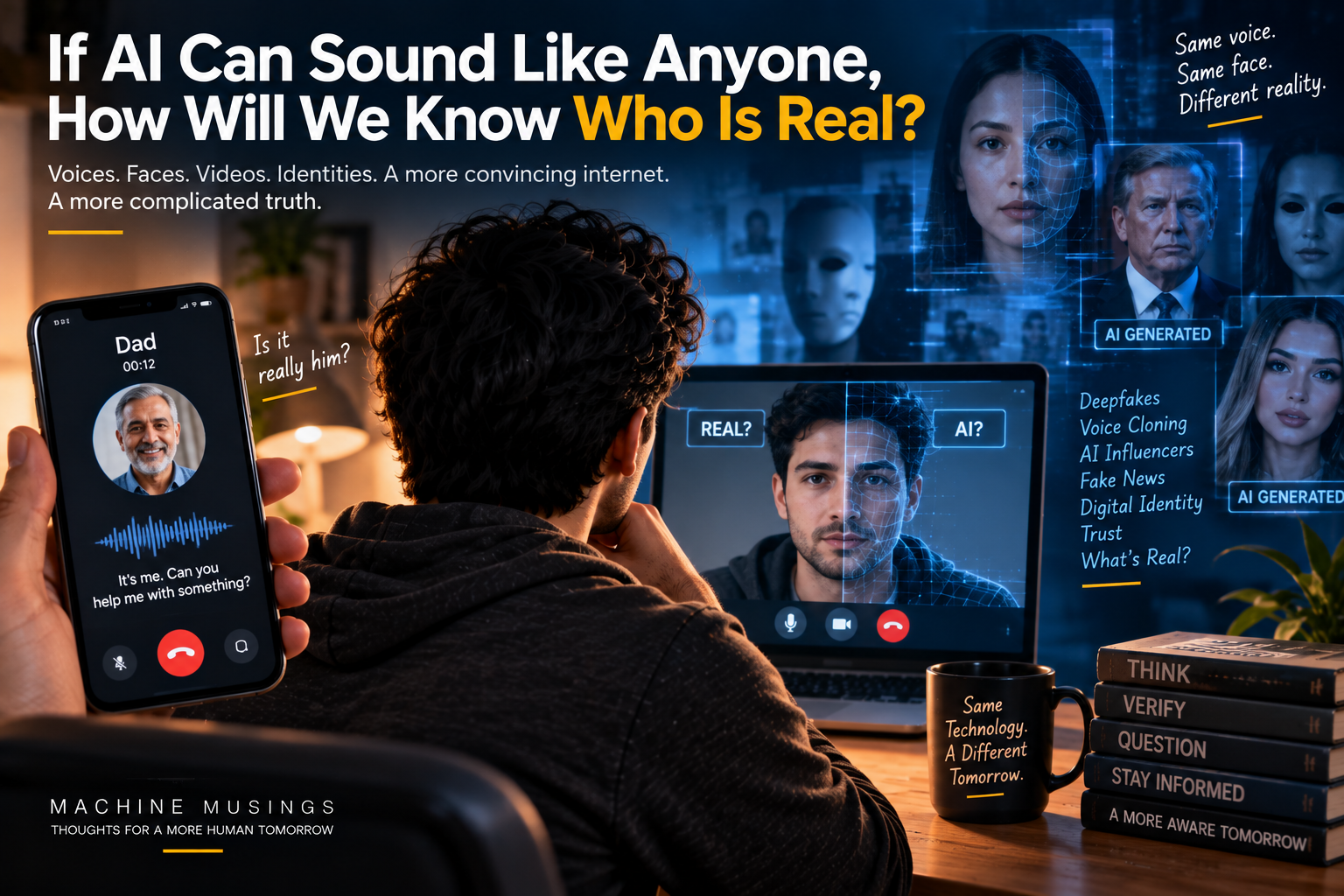
Imagine receiving a phone call from someone you know. You recognise the voice immediately. The way they pronounce your name sounds right, their tone feels familiar and even the little pauses between their words sound exactly like them. They tell you something unexpected and ask you to do something urgently. For most of our lives, recognising someone’s voice would have been a pretty good reason to believe that we were actually speaking to that person. But what if the voice on the other side wasn’t theirs at all?
Artificial Intelligence is making it increasingly possible to generate convincing voices, images and videos. A person’s voice can be imitated, a photograph can show something that never happened, and video can make someone appear to say words they never actually said. At the same time, AI-generated characters and virtual personalities are becoming more realistic. This technology can be fascinating and creative, but it also challenges one of the simplest ways humans have traditionally understood reality: we believed what we could see and hear. If AI can eventually sound and look like almost anyone, how will we know who is real?
Seeing Was Once Believing
There is a reason people say, “I’ll believe it when I see it.” Photographs and videos have historically carried a certain amount of authority because they appeared to capture something that actually happened. Of course, photographs have always been editable and videos can be manipulated, but creating convincing fake media once required significant skill, time and specialised tools.
AI changes the scale and accessibility of that manipulation. Someone doesn’t necessarily need to be an expert in visual effects to create an artificial image or imitate a voice. Generative systems can make sophisticated content much easier to produce, and those capabilities will probably continue improving. The result is that we may gradually enter a world where seeing something with our own eyes on a screen is no longer enough to conclude that it actually happened.
That doesn’t mean every photograph or video suddenly becomes suspicious. Most things people share online will still have perfectly ordinary explanations. But the assumption behind digital media is changing. Instead of automatically asking, “What am I seeing?”, we may increasingly need to ask, “Where did this come from?”
A Familiar Voice Feels Personal
Voice may be even more interesting than images because we have an emotional relationship with familiar voices. You can sometimes recognise a close friend or family member after hearing only a few words. You know their accent, rhythm, expressions and the particular way they laugh. That familiarity creates trust almost automatically.
Now imagine technology becoming good enough to reproduce those details convincingly. A generated voice doesn’t need to fool millions of people. Sometimes it only needs to fool one person for a few minutes.
This changes how we may need to think about identity in digital communication. If someone contacts us unexpectedly and asks for something unusual, recognising the voice may no longer be sufficient evidence by itself. Context becomes important. Does the request make sense? Is the person contacting us in the way they normally would? Can we confirm the situation through another method?
For years, voices helped prove identity. In an AI-powered world, a voice may increasingly become something that can be copied rather than something that proves who is speaking.
Video Calls Could Become an Interesting Test of Trust
Video calls currently feel more trustworthy because we can both hear and see the person. If somebody appears on screen, speaks naturally and responds to us in real time, it feels difficult to imagine that the person might not be exactly who they appear to be.
But AI-generated video and real-time manipulation raise an interesting possibility. What happens when appearance itself can be altered convincingly during live communication? We may eventually reach a point where seeing a face moving naturally and hearing the expected voice still doesn’t provide complete certainty about identity.
That sounds extremely futuristic until we remember how quickly digital media has changed. A few years ago, many obviously AI-generated images had strange hands, distorted faces or unrealistic details. Improvements can happen quickly. We should probably avoid assuming that today’s limitations will remain permanent.
The important issue isn’t whether every video call will become fake. That is unlikely to be how people experience technology. The more important shift is that visual presence may no longer be the strongest possible proof of identity.
The Problem Isn’t Only Fake People
When we talk about AI impersonation, it is easy to imagine celebrities, politicians or famous business leaders. Their voices and images are widely available, which makes them obvious examples. But ordinary people may eventually have to think about the same issue.
Many of us already have photographs, videos and recordings of ourselves online. We appear in social-media posts, family videos, work meetings, interviews and public events. As synthetic-media technology becomes more capable, digital material associated with ordinary individuals could potentially be used to imitate them as well.
That makes this subject personal. The question isn’t simply, “Can AI create a fake video of a famous person?” It is also, “What happens when somebody can create convincing digital media of people we actually know?”
The internet has spent decades encouraging us to share more of ourselves. AI may force us to think more carefully about what happens when pieces of our digital identity can be reconstructed by machines.
Fake Content Is Only Half the Problem
There is another consequence that may be even more complicated. If realistic fake media becomes common, people may begin questioning genuine media as well.
Imagine a real video showing somebody behaving badly. Instead of explaining what happened, the person could simply say, “That’s AI-generated.” If synthetic media is convincing enough, some people may believe them.
This creates a strange situation. AI doesn’t only make fake things easier to believe; it can potentially make real things easier to deny.
Evidence becomes less powerful when everyone knows that evidence can be manufactured.
A genuine recording could be dismissed as fake. A real photograph could be labelled AI-generated. A legitimate voice recording could be questioned because people know voices can be cloned.
The problem therefore isn’t simply that we might believe something false. It is also that we might stop believing something true.
Social Media Could Become Harder to Interpret
Social media already moves faster than verification. A dramatic video can spread across millions of screens before anyone knows where it originally came from. People react, share, comment and form opinions within minutes. By the time additional context appears, the original impression may already have travelled much further.
AI-generated media could intensify this problem because the content doesn’t necessarily need to be perfect. It only needs to look believable for long enough to spread.
Imagine a short video apparently showing a public figure making a controversial statement. Thousands of people repost it immediately. Others create reaction videos. Screenshots appear on different platforms. People begin arguing about it. Hours later, someone discovers that the original clip was generated or manipulated.
The correction may never reach everyone who saw the first version.
In that environment, the speed at which we react becomes part of the problem. Perhaps one of the most valuable habits in the AI era will simply be waiting before deciding what something means.
Virality and Truth Are Not the Same Thing
The internet often rewards content that produces an immediate emotional reaction. Something shocking, funny, frightening or outrageous is more likely to be shared quickly than something ordinary. AI can potentially produce endless variations of exactly that kind of content.
This creates an uncomfortable combination: extremely powerful content-generation tools operating inside platforms where attention is incredibly valuable.
A convincing fake doesn’t necessarily need to survive careful investigation. It may only need to generate millions of views before anyone investigates it.
That means our relationship with viral content may need to change. A video having ten million views doesn’t make it authentic. Thousands of people sharing something doesn’t prove that they independently verified it. A claim appearing repeatedly across different accounts doesn’t necessarily mean those accounts found separate evidence.
Popularity tells us how widely something travelled.
It doesn’t automatically tell us whether it was true.
How Will We Prove That Something Is Real?
If photographs, voices and videos become easier to generate, perhaps digital systems will increasingly need ways of establishing where media came from. Instead of relying only on what something looks like, we may care more about its history.
Who created this file? Which device captured it? Has it been edited? Where was it originally published? Is there a trustworthy source associated with it?
This would represent an interesting change in how we consume media. Today, many people evaluate content mainly by looking at it. In the future, authenticity may depend increasingly on information that exists around the content rather than simply inside it.
That could make digital provenance, verification and trustworthy sources much more important. We may not personally understand every technical system used to verify media, just as most people don’t understand every security technology behind online banking. What matters is that reliable ways of establishing authenticity become available and understandable.
We May Develop New Social Habits
Technology often changes social behaviour in ways that eventually feel completely normal. There was a time when receiving a phone call from an unknown number didn’t automatically make people suspicious. Today, many people hesitate before answering. We adapted because unwanted and deceptive calls became common.
AI-generated impersonation could create similar habits.
Families might develop simple ways of confirming unusual requests. Businesses may use additional verification before approving sensitive actions. People might become more cautious about trusting unexpected voice messages or video calls. If someone suddenly asks for something completely out of character, we may learn to confirm it independently before responding.
These behaviours might initially feel inconvenient, but they could eventually become ordinary digital manners.
Just as we learned not to share passwords simply because an email asks for them, we may learn not to trust identity simply because a face or voice looks familiar.
AI-Generated People Could Become Normal Too
There is another, less threatening side of this future. Not every artificial person will be pretending to be a real individual. We may see more virtual presenters, digital influencers, AI characters and synthetic personalities that openly acknowledge what they are.
That creates a different question: Does a person need to be real for their content to have value?
A fictional character can entertain us. An animated character can make us laugh. A virtual presenter could explain information clearly. An AI-generated musician could potentially produce music people genuinely enjoy. If everyone understands that the identity is artificial, perhaps there is nothing deceptive about it.
The problem isn’t necessarily artificiality.
The problem is artificiality pretending to be authenticity.
A clearly fictional AI character and an AI impersonating a real person are fundamentally different situations. Transparency may therefore become one of the most important boundaries in synthetic media.
What Does “Real” Actually Mean Online?
This entire discussion eventually leads to a surprisingly philosophical question. What does it mean for someone to be “real” on the internet?
Even before AI, online identity was never a perfect reflection of offline life. People choose which photographs to post, edit videos, carefully write captions and present certain parts of themselves while keeping others private. Social media has always contained a mixture of reality and presentation.
AI simply pushes that idea much further.
A virtual personality might have no physical body but interact with millions of people. An AI-generated musician might release songs that produce real emotions in listeners. A synthetic presenter might teach someone something genuinely useful.
The content may be artificial while the human reaction to it is completely real.
Perhaps the future won’t require us to reject everything created by AI. Instead, we may need clearer distinctions between fiction, assistance, simulation and deception.
Knowing what we’re interacting with may matter more than demanding that everything online be entirely human-created.
Trust May Move From Content to Source
For a long time, we could often judge media by examining the media itself. Does the photograph look edited? Does the video appear strange? Does the voice sound unnatural? Those clues may become less useful as generation technology improves.
Trust may therefore move elsewhere.
Instead of asking only, “Does this video look real?”, we may ask, “Who published it?” Instead of asking whether a screenshot looks convincing, we may search for the original statement. Instead of trusting a voice message automatically, we may consider whether the request matches what we know about the person.
This doesn’t mean becoming suspicious of everything online. Constant paranoia would make the internet exhausting.
It means developing a different kind of digital literacy: one based less on appearance and more on context, origin and verification.
Human Trust Has Never Depended Only on Technology
There is something reassuring here. Humans built trust long before photographs, recordings and video calls existed. We learned to understand people through relationships, shared experiences, reputation and context.
Perhaps AI will remind us that technology was never supposed to be the entire foundation of trust.
If someone you’ve known for fifteen years suddenly sends a strange request that completely contradicts their personality, the fact that the message contains their face and voice shouldn’t necessarily override everything else you know about them.
Our knowledge of people still matters.
Context still matters.
Relationships still matter.
Technology can reproduce someone’s appearance, but reproducing the entire history of a relationship is much harder.
We May Become More Careful Before Believing
There is a tendency to look at synthetic media and conclude that nobody will ever know what is real again. I don’t think the future necessarily has to be that hopeless.
People adapt.
We learned that not every email is legitimate. We learned that photographs can be edited. We learned that social-media posts can contain misinformation. We developed verification tools, fact-checking practices and new habits around online security.
AI-generated media will probably require another adaptation.
Perhaps we will become slower to react to extraordinary claims. Maybe we will look for multiple reliable sources before believing a viral video. We may become more interested in where media originated rather than simply where we encountered it.
In a strange way, AI could force us to become more thoughtful consumers of information.
The transition may be messy, but uncertainty doesn’t necessarily mean the end of trust. It may simply mean trust needs stronger foundations.
Final Thoughts
Artificial Intelligence is making it possible to create media that previous generations would have considered extraordinary. Voices can be generated, faces can be created, images can depict events that never happened and videos can increasingly blur the boundary between recording and generation. These technologies will undoubtedly have creative and useful applications, but they also challenge one of our oldest instincts: trusting what we can see and hear.
The biggest problem may not simply be that fake things become convincing. It may be that convincing things stop being enough. A familiar voice may not prove who is speaking. A realistic video may not prove that an event happened. A photograph may not prove that someone stood in front of a camera.
That doesn’t mean reality disappears. It means proving reality may become more complicated.
Perhaps we will rely more on sources, context, provenance and verification. Perhaps we will develop new habits for confirming identity. Perhaps we will become slightly slower before sharing something simply because it shocked us.
And perhaps that isn’t entirely a bad thing.
For years, the internet encouraged us to react quickly: click, like, share, comment and move on. AI may give us a reason to introduce one additional step before all of those actions:
“Is this actually real?”
Because in a world where AI can potentially sound like anyone, look like anyone and create moments that never happened, the ability to generate convincing content may no longer be the most impressive skill.
The more important skill may be knowing what deserves our trust.