When Everyone Has AI, What Makes Your Work Yours?
There was a time when knowing how to use a particular piece of technology could give you a significant advantage. Someone who knew Photoshop could create things most people couldn’t. Someone who understood programming could build websites and applications that seemed almost impossible to a non-programmer. Someone who was particularly good at writing, research or presentation design could produce work that clearly stood apart from everyone else’s.
Artificial Intelligence is beginning to change that equation. Today, someone who has never studied graphic design can describe an idea and generate an impressive image. A person with limited programming knowledge can ask AI to help create code. Someone struggling to write an email can produce a polished version within seconds, while a student can ask AI to explain a difficult subject, prepare notes or suggest ideas for an assignment.
These capabilities are incredibly useful, but they lead to an interesting question. If eventually almost everyone has access to powerful AI tools, what makes the work produced by one person different from the work produced by another?
Having AI May Stop Being an Advantage
Right now, knowing how to use AI effectively can provide an advantage in many situations. A person who understands how to give clear instructions, evaluate AI-generated results and integrate AI into their workflow may complete certain tasks much faster than someone who doesn’t use these tools.
But technological advantages rarely remain exclusive forever. Smartphones were once expensive devices owned by relatively few people. Websites were once difficult to create without technical knowledge. Video editing required specialised equipment, and professional-quality photography demanded expensive cameras and considerable experience. Over time, these technologies became easier and more widely available.
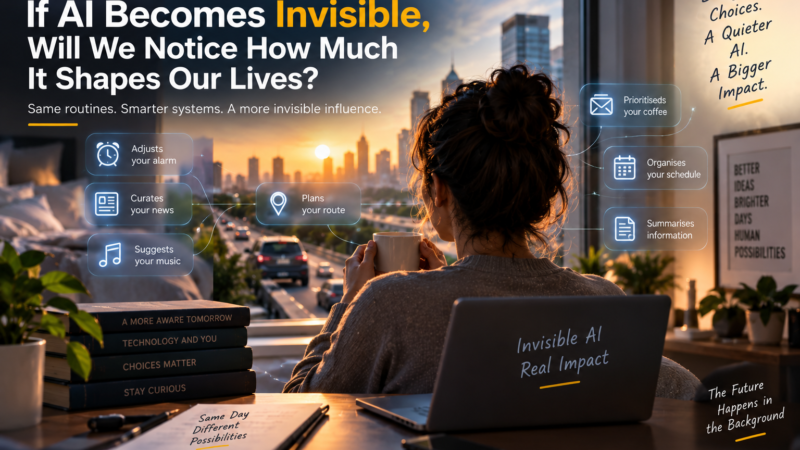
AI could follow a similar path. As AI assistants become integrated into phones, computers, browsers, office software and creative applications, using AI may eventually feel as ordinary as using a search engine or spell-checker does today. At that point, saying “I know how to use AI” may not be particularly impressive because almost everyone will know how to use it at some level.
When everyone has the tool, simply having access to the tool is no longer the advantage. The advantage shifts towards what you actually do with it.
Give Two People the Same AI and See What Happens
Imagine giving two people access to exactly the same AI system and asking them to create an advertisement for a new product. Both have the same technology, the same features and the same amount of time.
The first person might simply ask, “Create an advertisement for this product.” The AI produces something reasonable, the person accepts it and the task is finished.
The second person approaches the problem differently. They think about who the customer is, what problem the product solves, what emotion the advertisement should create and what makes the product different from its competitors. They provide that context to the AI, review what it produces, reject ideas that don’t work, combine the useful ones and add their own perspective.
Both people used AI, but the final results could be completely different.
The difference wasn’t the machine. The difference was the thinking that happened around the machine.
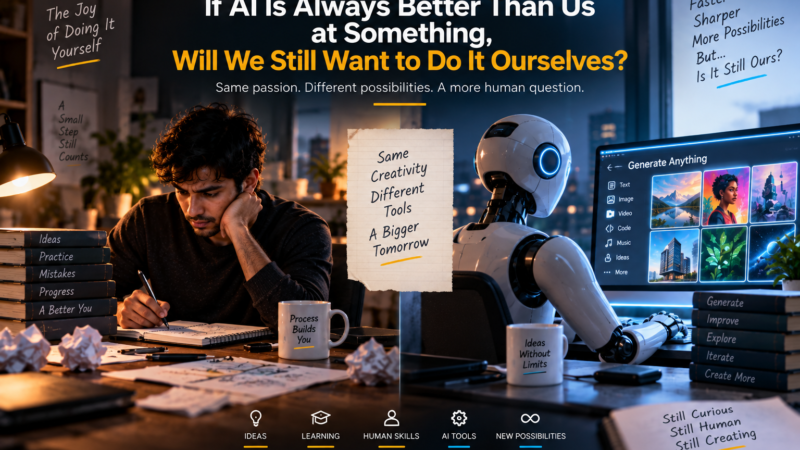
AI Can Generate Ideas, but Which Idea Is Good?
One of AI’s most impressive abilities is generating possibilities. Ask for ten headlines and you can receive them within seconds. Ask for twenty business ideas and you’ll probably get twenty. Ask for several ways to design a webpage, structure an article or approach a presentation, and AI can quickly provide options.
But generating possibilities and recognising a good possibility are not the same skill.
Suppose AI gives you twenty names for a new company. Which one should you choose? Which one sounds memorable? Which one fits the audience? Which one feels too generic? Which one could still make sense five years from now?
AI can help evaluate those questions too, but eventually someone has to make a judgement.
The same applies to writing, design, programming, business and almost every other creative activity. Producing something is only part of the process. Knowing what deserves to remain, what should be changed and what should be completely discarded requires taste and judgement.
Perhaps in an AI-heavy world, choosing well becomes almost as important as creating well.
What Happens When Everyone’s Work Starts Looking Similar?
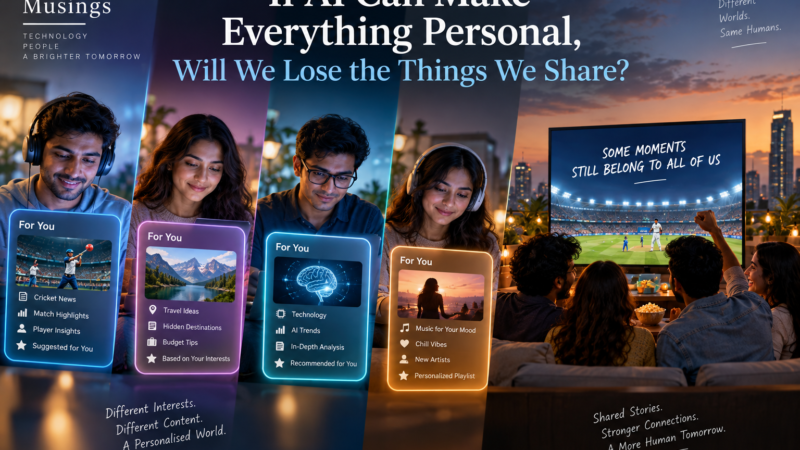
There is another possibility worth considering. If millions of people use similar AI systems for writing, design, presentations, advertisements and social-media content, could some of that work begin to feel increasingly similar?
We may already recognise certain patterns. Some AI-generated writing can be extremely polished but strangely predictable. Certain phrases appear repeatedly, paragraphs follow familiar structures and everything feels professionally written without necessarily feeling personal. AI-generated images can sometimes have a similar problem. They may look impressive, yet after seeing enough of them, certain visual styles begin to feel familiar.
This doesn’t mean AI cannot produce original work. The possibilities are enormous. But when people provide similar instructions and accept the first result they receive, similarity shouldn’t surprise us.
Imagine thousands of people asking, “Write a professional LinkedIn post about leadership.” Even if every response is slightly different, how many of them will express something nobody else has said?
AI may make it easier for everyone to produce competent work. Ironically, that could make distinctive work even more valuable.
Your Experience Is Something AI Doesn’t Automatically Have
Suppose two people decide to write about their first job. AI can help both of them organise the article, improve grammar, suggest headings and make sentences clearer. But their actual experiences will not be identical.
One person may remember being terrified on their first day. Another may have made a funny mistake during their first meeting. Someone may have had an excellent manager who changed the way they thought about work, while another person may have learned from a terrible workplace.
Those experiences give writing something that a generic prompt cannot automatically provide.
The same applies beyond writing. A designer brings years of visual experience. A teacher understands how real students respond when they are confused. A salesperson knows the strange objections customers actually make. A programmer remembers the mistakes that caused systems to fail. A business owner understands problems that never appeared in the original business plan.
AI can contain enormous amounts of information, but your particular combination of experiences belongs to you.
Perhaps the strongest work will come from combining those experiences with what AI can do rather than asking AI to replace them.
Your Mistakes Might Actually Matter
We usually think good work should remove mistakes. In many cases, that’s obviously true. Nobody wants incorrect calculations, broken code or factual errors simply because they look “human.”
But there is another kind of imperfection that can be valuable.
Human creativity often develops through experiments that don’t work. Someone tries an unusual design and discovers something interesting. A writer uses a strange expression that becomes part of their style. A musician experiments with something that technically shouldn’t work but sounds brilliant. A business tries an idea that fails and discovers a completely different opportunity.
AI is often used to make things cleaner, faster and more polished. But if everyone optimises their work towards the same idea of perfection, imperfections may become part of what makes individual work recognisable.
Sometimes originality comes from doing something slightly differently from how it is supposed to be done.
The Prompt Isn’t the Whole Skill
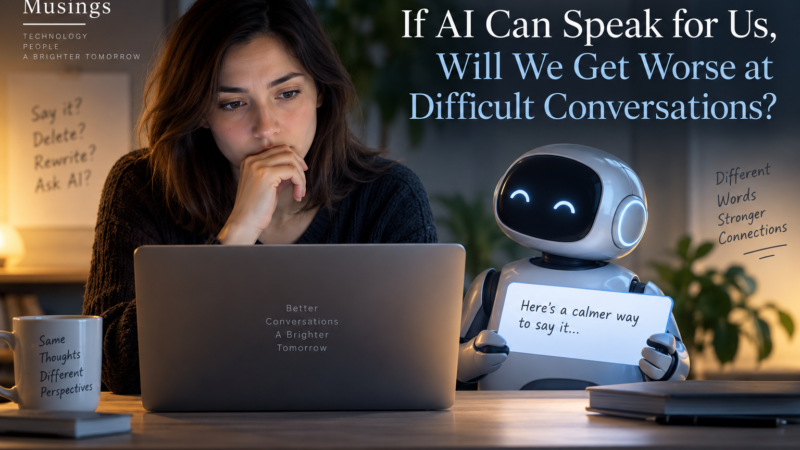
There has been a lot of discussion about “prompt engineering” and the ability to communicate effectively with AI. Asking better questions certainly matters. Clear context and instructions can dramatically improve what an AI produces.
But I don’t think the future advantage will simply belong to whoever knows the cleverest prompt.
Prompts themselves can be copied. Templates can be shared. AI can even help people write better prompts. If your entire advantage is knowing a particular sequence of words to type into an AI system, that advantage may not last very long.
The more durable skill is knowing what you are trying to achieve in the first place.
Someone who deeply understands marketing can use AI differently from someone who only understands prompting. Someone who understands software architecture can judge generated code differently from someone who only knows how to ask for it. Someone who understands storytelling can recognise why one AI-generated scene works and another doesn’t.
AI skills matter, but subject knowledge still matters too.
Students Will Have to Think About This
This question becomes particularly interesting in education. Imagine a classroom where every student has access to the same AI assistant. The teacher gives everyone the same assignment, and most students ask AI to help.
If everyone can generate a well-structured answer, how do we distinguish between students?
Perhaps education will gradually place more value on how students reached their conclusions, how they defend their arguments, whether they can explain the subject in their own words and whether they can connect ideas to personal observations or original research.
A perfectly written assignment may become less impressive if perfect writing can be generated within seconds.
The important question may become: What did the student actually contribute?
That doesn’t mean students shouldn’t use AI. Used properly, AI can be an extraordinary learning tool. But copying a generated answer and understanding a subject are still two very different things.
When everyone has access to the same assistant, the student who actually understands the subject may still have the biggest advantage.
The Same Thing Could Happen at Work
Now imagine two employees in the same company. Both have access to the same AI tools. Both can generate emails, summarise reports, analyse documents and brainstorm ideas.
If AI handles more of the routine work, companies may begin placing greater value on the things that remain difficult to automate: understanding customers, making judgement calls, communicating with people, taking responsibility, identifying the right problem and knowing when the obvious answer is wrong.
The employee who simply knows how to ask AI to complete tasks may eventually become ordinary. The employee who knows which tasks matter, why they matter and what should happen next could remain valuable.
AI may therefore change what productivity means. Completing more tasks may become easier. Deciding which tasks are worth completing could become the harder part.
Creativity May Become More About Direction
We often imagine creativity as producing something from nothing. A writer creates words, an artist creates an image, a musician creates a melody and a designer creates a visual concept.
AI complicates that idea because generation becomes extremely cheap. You can create ten images instead of one, fifty headlines instead of five and several versions of an idea almost instantly.
When generation becomes abundant, creativity may shift partly towards direction.
What should we create? What feeling should it have? Which version is worth developing? What should be removed? What does this work actually say? Does it represent what we intended?
A film director doesn’t personally perform every role involved in creating a movie. Their value comes partly from having a vision and guiding many different pieces towards that vision.
Perhaps AI will make more of us work like directors. The machine can help produce possibilities, but we still need to know where we’re trying to go.
Your Perspective May Become the Real Advantage
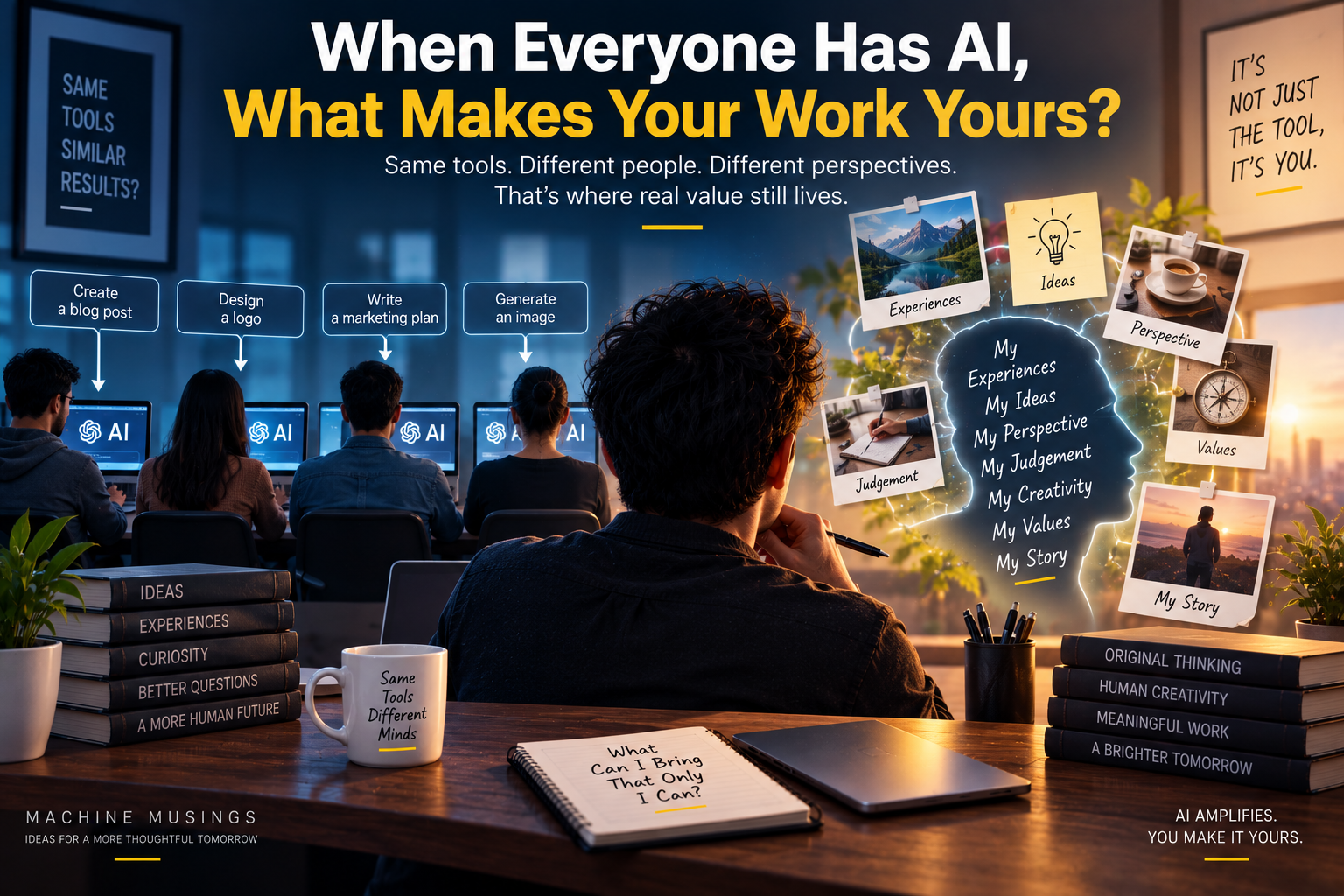
This brings us back to the original question: when everyone has AI, what makes your work yours?
Maybe the answer isn’t the words, pixels or code alone.
It is the decisions behind them.
Your experiences influence what you notice. Your personality influences what you find interesting. Your values influence what you consider important. Your mistakes influence what you avoid. Your curiosity influences which questions you ask. Your judgement influences which AI-generated ideas you keep and which ones you throw away.
Two people can use the same tool and still produce completely different work because they are not the same person.
That may become increasingly important as AI grows more capable.
Don’t Just Ask AI to Give You an Answer
Perhaps one of the easiest ways to preserve individuality while using AI is to stop beginning every task with, “Create this for me.”
Start with yourself.
What do you think about the subject? What are you trying to communicate? What have you personally observed? What feels wrong about the obvious answer? What would you do differently?
Then bring AI into the process.
Ask it to challenge your thinking, organise your ideas, find weaknesses, suggest alternatives or help improve the final result. That way, the AI is working with your perspective rather than becoming your perspective.
The difference may seem small, but over time it could become enormous.
Final Thoughts
Artificial Intelligence is making powerful capabilities available to more people than ever before. Someone without years of technical training can create things that would once have required specialised skills, expensive software or an entire team. That is an exciting development because it lowers barriers and gives more people the ability to turn ideas into something real.
But accessibility creates a new challenge. When everyone can generate impressive work, simply producing something impressive may no longer be enough.
The differentiator may increasingly become the part AI cannot simply hand to us: our judgement, experiences, curiosity, taste, values and perspective.
AI can give ten people the same capabilities, but those ten people don’t have to produce the same result. The technology may be shared, while the thinking behind how it is used remains personal.
Perhaps that is where originality will live in an AI-powered world.
Not in refusing to use Artificial Intelligence and not in allowing Artificial Intelligence to do everything for us, but in learning how to use a common tool to express something that could only have come from our own way of seeing the world.
Because when everyone has access to AI, saying “I used AI to make this” may eventually mean very little.
The more interesting question will be:
“What did you bring to it that nobody else could?”