When AI Knows What You Want Before You Ask
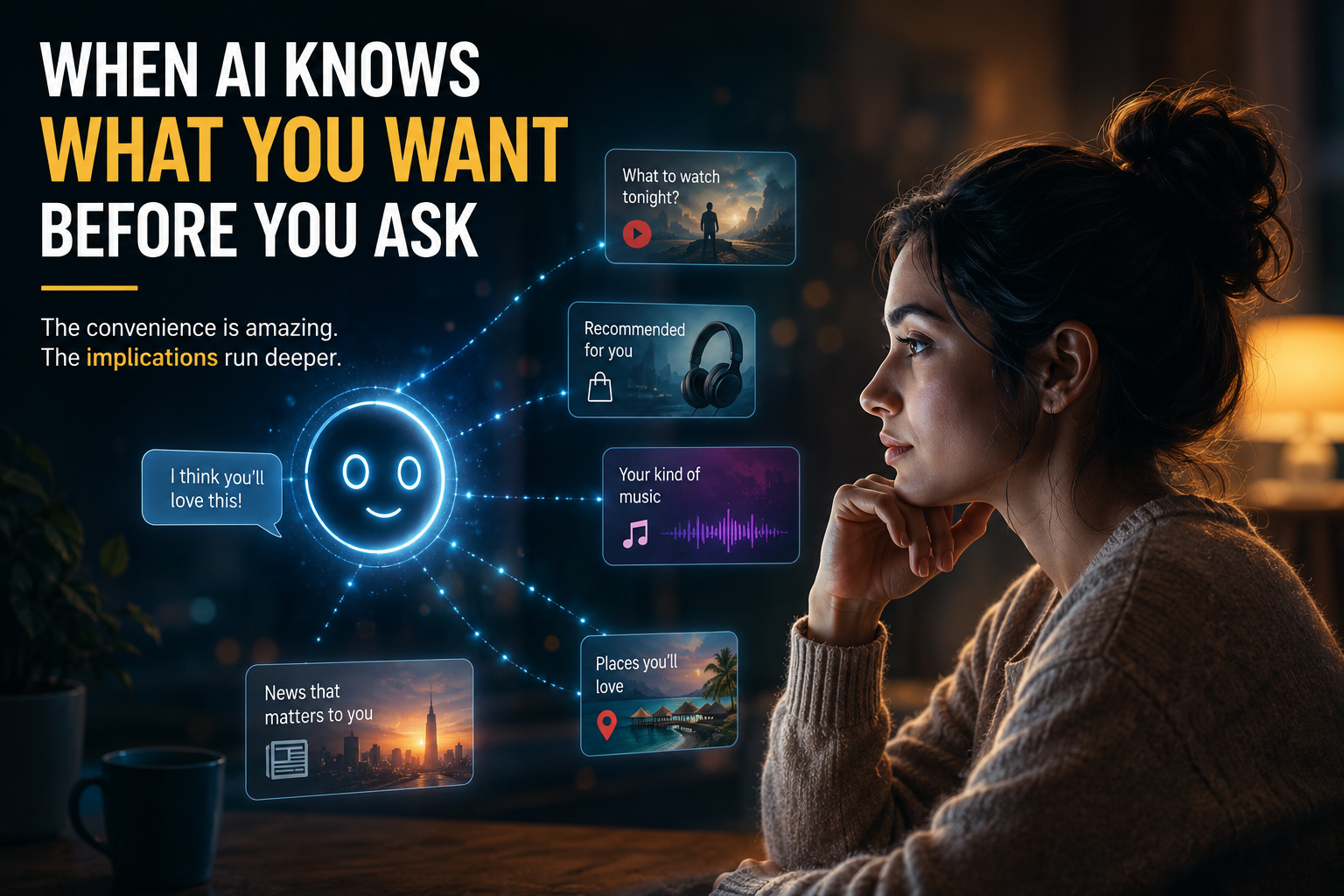
Have you ever opened YouTube just to watch one video, only to find another video on the homepage that somehow feels exactly like what you wanted to watch? Or perhaps you finish watching a movie and the next recommendation seems almost perfect. You search for a product once, and suddenly similar products start appearing everywhere. You listen to a particular kind of music for a few days, and before long, your recommendations seem to understand your new taste.
Sometimes, you don’t even remember telling these platforms what you like. Yet somehow, they seem to know. And this raises an interesting question: What happens when machines begin to understand what we want before we even ask for it?
The Machine Is Watching Our Choices
Whenever we use the internet, we make hundreds of tiny decisions without giving them much thought. We click something and ignore something else. We watch one video until the end but leave another after thirty seconds. We search for something, like a post, save another one or repeatedly listen to the same song.
Individually, these actions might not mean much. But put thousands of them together and they begin to form a picture of us. Recommendation systems already work in this way. Netflix, for example, says its recommendations consider signals such as what you have watched, how you rated titles, what people with similar tastes enjoy, the device you’re using, the time of day and even how long you watched something.
Machine learning does not necessarily need us to explicitly say, “I like this.” Sometimes, our behaviour says it for us. And that is where things become interesting.
From Recommendations to Understanding
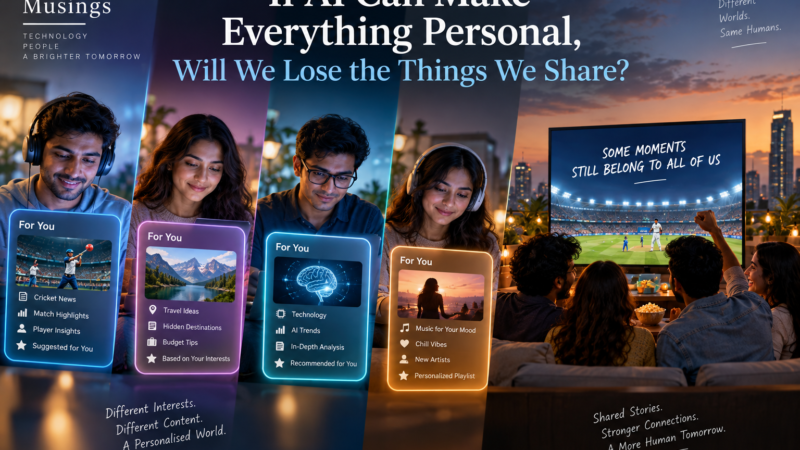
For years, recommendation systems have been relatively straightforward from a user’s perspective. You watch action movies, so the platform recommends more action movies. You listen to Punjabi music, so it recommends similar artists. You frequently watch cooking videos, so more recipes appear.
But AI is making personalization capable of becoming much more conversational and contextual. Google, for example, now describes personalized AI responses that can use interests and previous searches to tailor an answer. Its AI Mode can also use previous searches and interactions over time when personalization and history features are enabled.
That represents an interesting shift. The machine isn’t simply asking, “What content is similar to what this person previously consumed?” Increasingly, the question can become, “What is this particular person probably trying to accomplish?” Those are two very different things.
Convenience Feels Wonderful
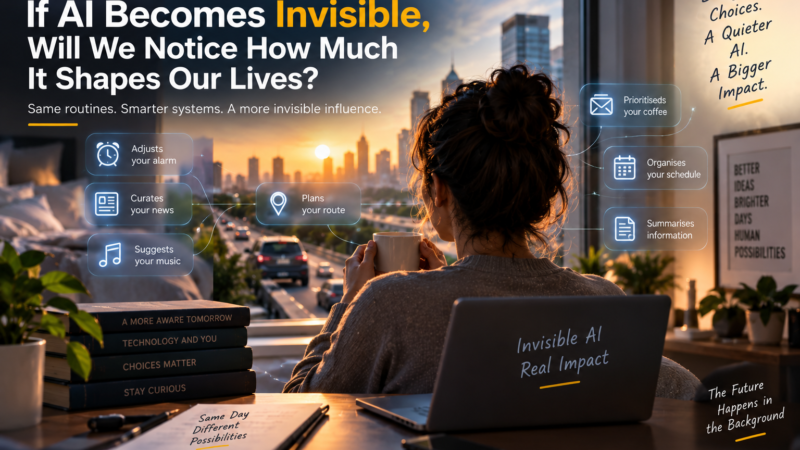
Imagine waking up one morning and your AI assistant already understands that you have an important meeting. It knows your usual travelling time, notices that traffic is worse than normal and reminds you to leave earlier. Maybe it knows that whenever you travel, you prefer an aisle seat, so when you ask it to find flights, it automatically considers that preference.
When you ask for somewhere to eat, it already remembers the kinds of food you normally enjoy. When you’re shopping, it understands your usual budget instead of recommending products you would never consider buying. You don’t have to explain yourself every single time, and that sounds incredibly convenient.
Perhaps that is where personal AI is heading: not simply towards a machine waiting for commands, but towards a machine carrying some context from one interaction to another. The better it understands us, the less we need to explain ourselves. But that convenience creates another question.
How Much Should a Machine Know About Us?
Suppose an AI knows what you like and dislike, what you buy, where you prefer to travel, which foods you enjoy, what subjects interest you, what you usually search for and perhaps even how your preferences have changed over the years. At what point does personalization become uncomfortable?
There is an important difference between “This machine remembers that I like coffee” and “This machine has built an extremely detailed picture of who I am.” Personalization inevitably raises questions about data, privacy and control.
That’s why the controls surrounding these systems matter. Google, for example, allows users to turn certain personalized recommendations on or off and manage or delete associated activity. Perhaps the future shouldn’t simply be about making AI know more about us. It should also be about allowing us to know what AI knows about us.
But There Is Another Problem
Privacy isn’t the only thing that interests me here. There is a more subtle question: What if AI becomes so good at predicting what we like that we stop discovering things it thinks we won’t like?
Think about music. Maybe there is an entire genre you would love, but you’ve never listened to anything similar before. Would an algorithm recommend it? Maybe. Maybe not. Or consider opinions. If a system learns what kinds of articles, videos and viewpoints keep you interested, naturally it becomes better at showing you more of them.
That feels good because everything becomes relevant. But sometimes, the most valuable things we encounter are things we weren’t looking for. It could be a random book, a conversation with someone completely different from us, a movie we thought we’d hate, a place we visited accidentally, a song someone else played or an opinion that made us uncomfortable enough to reconsider our own.
Human curiosity has always involved a certain amount of unpredictability. If machines become extraordinarily good at giving us exactly what they think we want, we should probably make sure they leave some room for surprise.
Does AI Discover Our Taste — or Shape It?
And this brings me to the question I find most interesting. Suppose an AI recommends something. I see it and I like it, so the system learns that I like that kind of thing and recommends more of it. I consume more, and the system becomes increasingly confident that this is what I like.
But now there is a strange loop. Did the machine discover my preference, or did repeatedly showing me something help create that preference? Maybe both.
Recommendation systems are designed to predict preferences from previous interactions. Google’s own machine-learning documentation describes recommendation models as using past interactions and similarities to predict what a user may prefer. But once recommendations influence what we encounter next, prediction and influence become difficult to separate completely.
The machine learns from our choices, but our choices are partly made from what the machine puts in front of us. Then the machine learns from those choices again, and the cycle continues.
Knowing Me Better Than I Know Myself?
There may eventually be moments when an AI predicts something about our preferences before we consciously recognise it ourselves. Maybe it notices that our music taste is changing. Maybe our reading habits are moving towards a completely different subject. Maybe our spending behaviour shows that our priorities have changed.
The machine doesn’t necessarily understand why. It recognises patterns. But those patterns could sometimes reveal something that we haven’t consciously noticed yet, and that’s both fascinating and slightly unsettling.
For most of human history, understanding ourselves was something we assumed belonged primarily to us. Now we are creating machines capable of building models of our behaviour at enormous scale. Researchers are already discussing how AI assistants could move personalization beyond separate profiles locked inside individual platforms, while arguing that future systems should make those representations more understandable and controllable by users.
Perhaps that control will become one of the most important parts of personal AI. The question shouldn’t simply be, “How much can AI learn about me?” It should also be, “How much do I want it to learn about me?”
The Future May Not Be About Asking
Today, most of our relationship with computers still begins with an action. We search, click, type or ask, and the computer responds. But increasingly personalized AI points towards something different: a machine that already has context, remembers preferences, anticipates what might be useful and sometimes offers something before we explicitly request it.
That could make technology feel remarkably natural, but it could also give technology far more influence over our everyday decisions. And perhaps that’s the trade-off we will have to think about.
I don’t necessarily want a machine that knows absolutely everything about me. But I also can’t deny how useful it can be when technology remembers the little things I don’t want to explain again and again.
Maybe the ideal AI isn’t one that knows everything. Maybe it’s one that knows enough to help, understands when not to interfere, occasionally allows us to be surprised, and lets us decide what it gets to remember.
Because the most interesting question may no longer be whether AI can predict what we want. It might be: When AI knows what we want before we ask, will it still be helping us make our choices — or will it slowly begin making those choices for us?