What Happens When We Can No Longer Tell What Is Real Online?
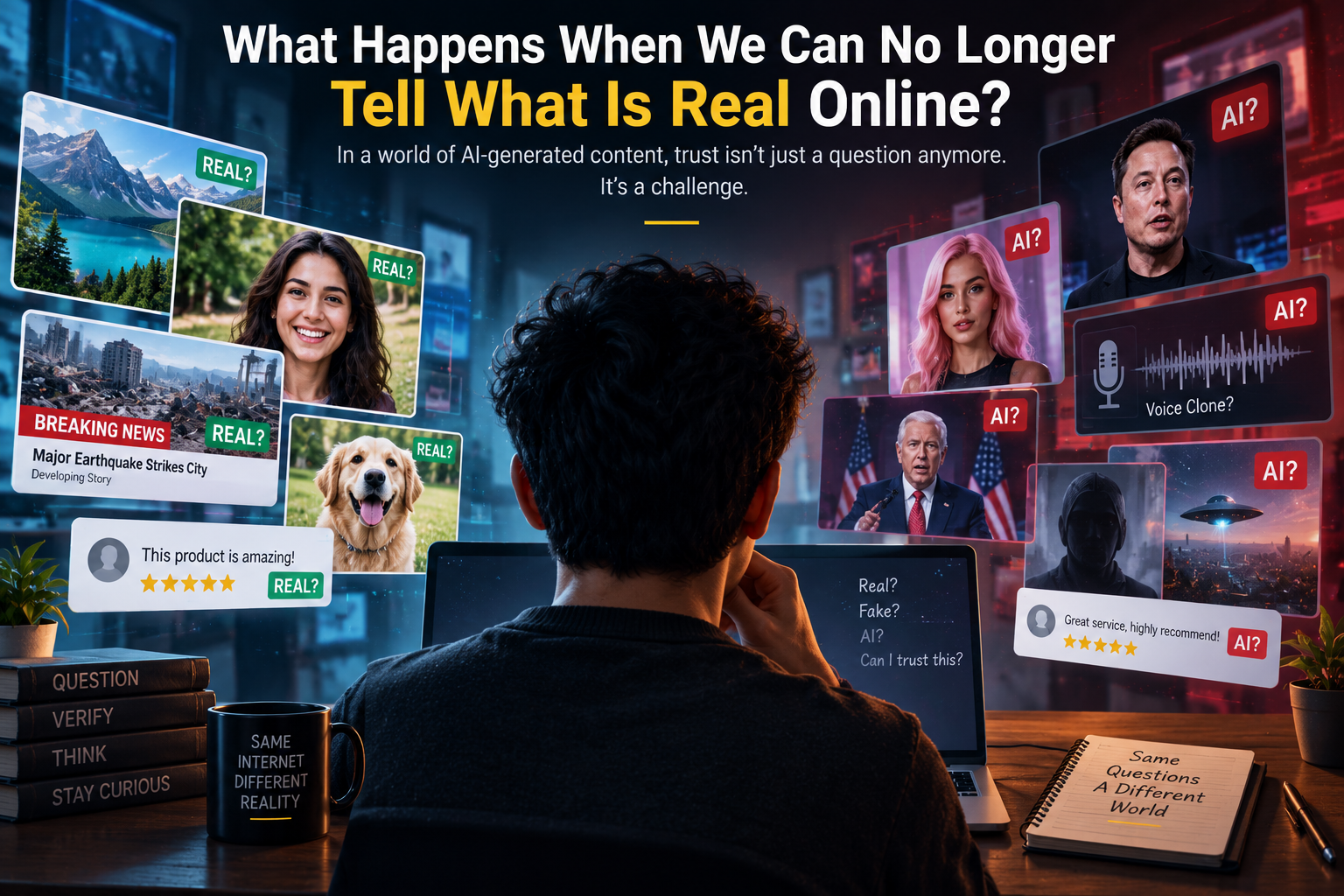
Imagine scrolling through social media and coming across a video of a famous person saying something completely unexpected. The face looks real, the voice sounds convincing, the expressions seem natural, and the surroundings don’t immediately give you any reason to doubt what you’re watching. A few years ago, your first reaction might have been surprise. Today, there is another question increasingly sitting at the back of our minds: “Is this real, or is this AI?”
Artificial Intelligence has reached a point where creating realistic-looking images, voices, videos and written content has become remarkably easy. What once required professional editing skills, expensive software and considerable time can increasingly be created simply by describing what you want to a machine. This is an extraordinary technological achievement, but it also creates a strange new problem for the internet. If almost anything can be generated, edited or imitated, how do we know what to believe?
Seeing Is No Longer Believing
For a long time, photographs and videos carried a certain kind of authority. If someone told you that something unusual had happened, you might ask them for proof. A photograph made the story more believable, and a video seemed even stronger. We became accustomed to the idea that seeing something with our own eyes brought us closer to the truth.
Of course, photographs have always been editable, and videos have always been capable of manipulation. Misleading information existed long before Artificial Intelligence. What AI changes is the speed, accessibility and potential scale at which convincing synthetic content can be produced. A person no longer necessarily needs advanced editing knowledge to create something that looks believable. AI can generate people who never existed, imitate voices, alter photographs and create increasingly realistic videos. As these systems improve, simply looking carefully at an image or video may not always be enough to determine whether it is genuine. That changes one of the internet’s oldest assumptions: seeing something is not necessarily the same as proving something.
Everyone Can Become Someone Else
Voice generation makes this issue even more personal. Imagine receiving a call that sounds exactly like someone you know. The voice has the same tone, the same style of speaking and perhaps even familiar expressions. The person says they are in trouble and urgently need money. Your instinct may tell you to help because you recognise the voice, but what if the person on the other side isn’t actually your friend or relative?
As AI-generated voices and impersonations become more convincing, recognising someone’s face or voice may gradually become less reliable as proof of identity. That could change the way we think about trust online and even over ordinary phone calls. Perhaps families will eventually develop their own ways of verifying unusual requests, businesses may rely more heavily on additional authentication, and journalists may need stronger methods for verifying digital evidence. The more convincing artificial content becomes, the more important verification becomes.
The Problem Isn’t Only Fake Content
At first, the problem seems straightforward: AI can create fake things that look real. But there is another side that I find even more interesting: What happens when real things start looking fake?
Imagine someone publishes a genuine photograph of an extraordinary event. People look at it and immediately comment, “That’s AI.” A genuine recording appears online and someone dismisses it as a deepfake. A real photograph looks slightly unusual because of lighting or camera processing, and thousands of people assume it was generated. In other words, AI doesn’t only give fake content the ability to appear real; it can also give us a reason to doubt genuine content.
That could become a much bigger problem than simply detecting generated images. For years, misinformation largely involved convincing people to believe something false. In an AI-heavy internet, another possibility emerges: convincing people that nothing can be trusted at all.
“That’s AI” Could Become an Easy Escape
There is an uncomfortable consequence of this uncertainty. If realistic fake content exists, someone confronted with genuine digital evidence could simply claim that it was generated by AI. A real photograph could be dismissed as “AI-generated,” a real recording as a “deepfake,” and a genuine voice recording as a “voice clone.”
Whether people believe such a denial would depend on evidence, verification and the credibility of the sources involved. But the existence of convincing synthetic media makes denial easier because the possibility is no longer ridiculous. This creates an unusual situation where advances in artificial content don’t merely help people create false evidence; they may also make real evidence easier to question. The internet could therefore face two problems at the same time: people believing things that never happened and people refusing to believe things that actually did.
What About Everything Else We Read Online?
Images and videos receive most of the attention because they are visually impressive, but AI-generated content goes much further. Articles, product reviews and social-media comments can all be generated. Profile pictures can belong to people who don’t exist, and entire conversations can potentially involve automated accounts.
Imagine searching for a product and finding hundreds of positive reviews. How many were written by actual customers? Imagine reading a heated discussion underneath a political or social post. How many comments represent genuine individuals? Imagine discovering an account that posts photographs, stories and opinions every day. Is there necessarily a real person behind it?
This doesn’t mean we should assume everything online is artificial. Most of our everyday interactions still involve real people. But the possibility of synthetic participation creates a new question that previous generations of internet users rarely had to consider: Am I interacting with a person, or with something designed to behave like one?
The Internet Could Become Full of Perfect People
There is another curious possibility. AI-generated personalities don’t need to sleep, become tired, have bad hair days or struggle to produce content. A virtual influencer could theoretically appear in perfect locations, wear perfect clothes, post consistently and maintain exactly the personality its creators want. That sounds harmless when used transparently as entertainment, but the situation becomes more complicated when people don’t know whether the personality they are following is real.
Social media already creates pressure because we compare ordinary life with carefully selected versions of other people’s lives. AI could take that comparison one step further. We may eventually find ourselves comparing our imperfect human lives not merely with edited humans, but with people who never existed in the first place. There is something strangely funny about losing confidence because a fictional person appears to have a better life than us, but underneath the humour is a genuine question about what authenticity will mean in the future.
AI Detection May Not Solve Everything
The obvious solution seems to be technology that detects AI-generated content. If AI creates something, perhaps another AI can examine it and tell us whether it is artificial. That may help, but relying entirely on detection creates its own difficulties. Generation technology continues improving, content can be modified after generation, and detection systems can make mistakes. A false positive could label something genuine as artificial, while a false negative could allow synthetic material to pass as real.
Another approach is to provide information about where digital content came from and how it was created or modified. Instead of simply looking at an image and guessing whether it seems fake, future systems may increasingly help us examine its history and source. That may eventually change our behaviour. Rather than asking only, “Does this look real?”, we may learn to ask, “Where did this come from?”
Trust May Move From Content to Source
Perhaps that is one of the biggest changes ahead. For much of the internet era, we often judged individual pieces of content directly. Does this photograph look believable? Does this video seem genuine? Does this screenshot look authentic? In a world filled with increasingly convincing synthetic media, however, the source may become just as important as the content itself.
We may increasingly need to ask who published something, whether there is an original source, whether multiple independent sources have confirmed it, whether additional context exists, whether the material has been edited and whether its origin can be verified. That sounds like the kind of work journalists and researchers already do, but ordinary internet users may increasingly need some version of the same habit. We may all have to become slightly better investigators.
The Danger of Doubting Everything
There is also a risk of going too far in the opposite direction. Once people become aware that AI can generate convincing content, it is tempting to become suspicious of everything. Every unusual photograph becomes “AI,” every strange video becomes “fake,” every well-written comment becomes “ChatGPT,” and every surprising story becomes misinformation.
That isn’t healthy either. A world in which we believe everything we see online is obviously dangerous, but a world in which we believe nothing may be just as problematic. Trust is necessary for communication, communities, journalism, business and relationships. The challenge therefore isn’t simply learning to distrust digital content. It is learning when trust is justified, and that requires something more complicated than scepticism. It requires judgement.
Perhaps Being Human Will Become Valuable Again
Interestingly, an internet filled with generated perfection may eventually make imperfections more meaningful. A photograph that isn’t perfectly composed, a video with awkward pauses, writing that contains someone’s unusual expressions, a creator admitting they don’t know something, a person changing their mind or a conversation that doesn’t sound carefully optimised may begin to feel more valuable precisely because it feels human.
For years, the internet encouraged us to polish everything: better photographs, cleaner videos, perfect captions and carefully managed profiles. AI can take perfection much further. Perhaps people will eventually start craving the opposite — something messy, spontaneous and unmistakably human. Authenticity may become valuable precisely because artificial content becomes so easy to create.
Final Thoughts
Artificial Intelligence is giving us extraordinary creative capabilities. Someone with an idea can generate an image without being an illustrator, experiment with music without owning a studio, create videos without a production team and communicate ideas in ways that previously required specialised skills. That accessibility can unlock enormous creativity, but every powerful capability comes with consequences.
The question isn’t simply whether AI-generated content will become indistinguishable from human-created content. In some situations, that distinction may become increasingly difficult to make. The deeper question is what happens after we know that anything could be artificial. Maybe we become more careful, verification becomes an ordinary part of using the internet, trusted sources become more valuable and authentic human voices become easier to appreciate. Or perhaps we enter an uncomfortable period where nobody is completely sure what to believe.
For most of the internet’s history, the challenge was finding information. Then the challenge became finding the right information. The next challenge may be something different entirely: proving that what we’re looking at actually came from the person, place or event it claims to represent.
And perhaps that is the strangest Machine Musing of all. AI doesn’t have to convince us that everything fake is real. It only has to make us wonder whether anything real might be fake.