Are We Using AI, or Is AI Slowly Changing How We Think?
Artificial Intelligence has made many things easier. If you have a long email to write, you can ask AI. If you don’t understand a difficult topic, you can ask AI to explain it. If you need ideas for a presentation, AI can give you twenty within seconds. If you have written some code and can’t find the error, AI can help debug it. Even a long document that might take an hour to read can now be summarised within seconds.
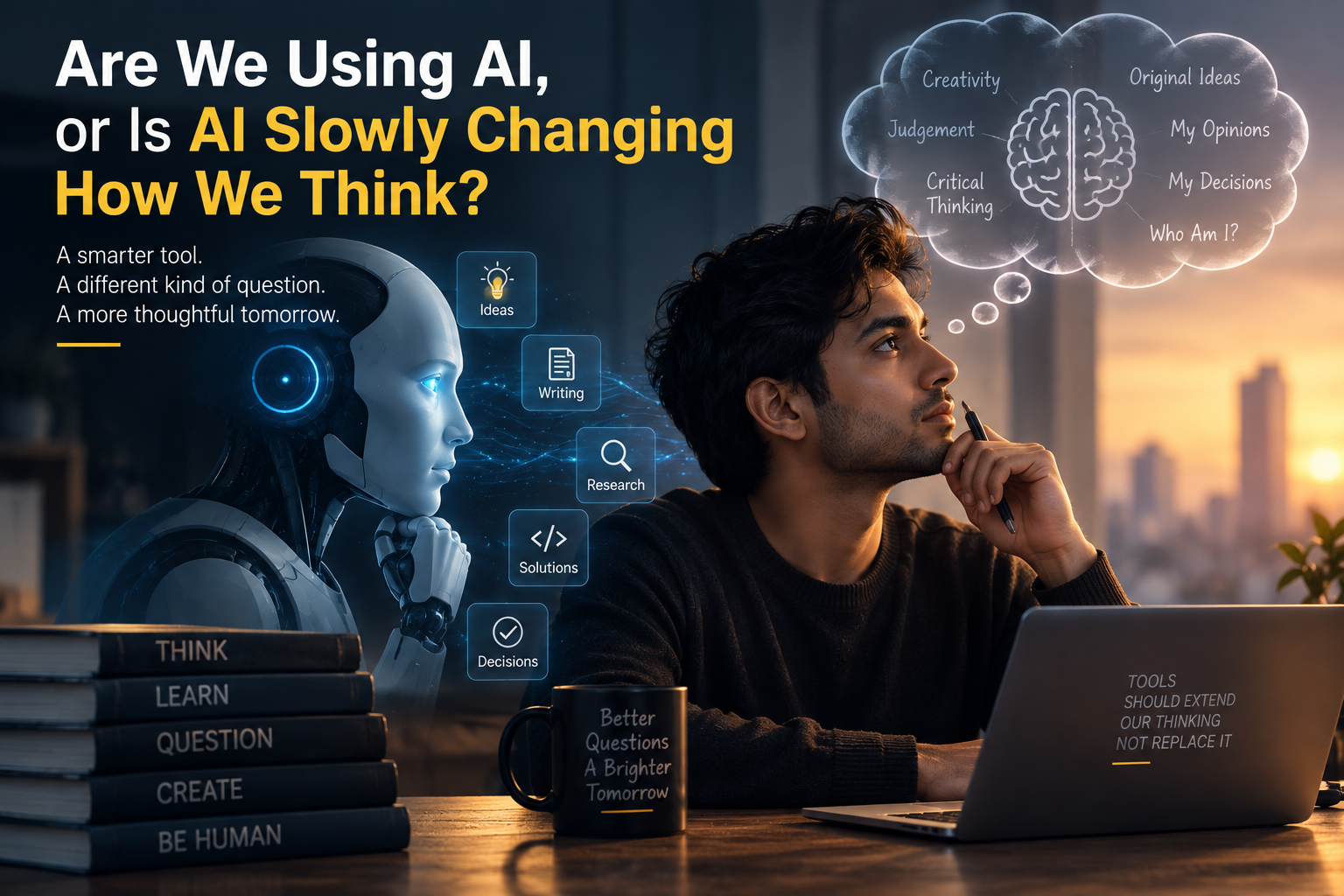
There is something genuinely remarkable about having access to a tool that can help us write, analyse, learn and create almost instantly. Tasks that once required hours can sometimes be completed within minutes. But somewhere between all this convenience, I think there is another question worth asking: Are we simply using AI as a tool, or is regularly using AI slowly changing the way we think?
We Have Always Used Tools to Make Thinking Easier
This isn’t the first time technology has reduced the amount of mental effort required to do something. Calculators made arithmetic easier, search engines made finding information easier, GPS made navigation easier, spell-checkers made correcting writing easier, and smartphones made remembering phone numbers almost unnecessary.
Think about how many phone numbers you actually remember today. Maybe your own number, your parents’ numbers and perhaps one or two others. Years ago, remembering several phone numbers was completely normal. Today, there isn’t much reason to do it because our phones remember them for us. Technology didn’t suddenly destroy our memory; it simply changed what we needed to remember.
AI could create a similar shift, except this time technology isn’t only helping us remember information or calculate something. It can help us produce thoughts, arguments, ideas and even decisions. And that makes this change much more interesting.
The Temptation to Ask AI Immediately
Imagine you’re writing something and suddenly get stuck. You could sit there for ten minutes, think about the problem, delete a few sentences, write them again and eventually find the right words. Or you could open an AI assistant and type, “Can you write this paragraph for me?” Within seconds, you have something that probably sounds pretty good.
Which option are most people going to choose? Probably the easier one. And there is nothing necessarily wrong with that. If a tool saves time, naturally we are going to use it. The problem begins when asking AI becomes our first reaction to every difficult thought.
We don’t understand something, so we ask AI. We don’t know what to write, so we ask AI. We can’t decide between two things, so we ask AI. We need an opinion, so we ask AI. We encounter a difficult problem and, before giving ourselves even five minutes to think about it, we ask AI for the solution.
Slowly, something that started as assistance can become dependence.
Struggling Is Sometimes Part of Thinking
We generally don’t enjoy struggling with problems because it feels frustrating. But struggle has a purpose. Remember solving mathematics problems at school. Sometimes you would spend fifteen or twenty minutes trying different methods before finally understanding the answer. The important part wasn’t simply getting the correct answer. The struggle itself forced your brain to work.
The same thing happens when writing. Sometimes you don’t know how to begin a paragraph. You write something terrible, delete it, try again, change a few words and eventually arrive at a sentence that expresses exactly what you were trying to say. That process can be annoying, but it is also part of learning how to communicate.
Now imagine skipping that process every time. Instead of struggling with an idea, we immediately ask AI to solve it. We still receive the answer, but did we go through the thinking required to reach it?
There is a difference between knowing an answer and understanding how you arrived at that answer.
AI Can Make Us Think Better Too
This doesn’t mean AI is making everyone lazy or that using it somehow damages our ability to think. In fact, AI can do exactly the opposite when we use it properly. It can challenge our ideas, explain something from another perspective, point out weaknesses in an argument, help us discover information we didn’t know existed and allow us to explore a subject much faster than before.
Suppose you have an opinion about a topic. Instead of asking AI to write that opinion for you, you could first write down what you actually think and then ask AI, “What are the strongest arguments against my position?” Suddenly, AI isn’t replacing your thinking. It is challenging it.
You could ask, “What am I missing here?”, “Can you explain why someone might disagree with me?”, or “What assumptions am I making?” Used this way, AI can become something closer to a thinking partner rather than a machine that simply provides finished answers.
That distinction matters.
Are We Outsourcing Our Decisions Too?
Writing and studying are only part of the story. AI is increasingly capable of helping us make everyday decisions as well. We can ask which laptop to buy, which course to study, where to travel, what restaurant to visit, what career might suit us, how to respond to somebody or whether one option is better than another.
Again, there is nothing wrong with getting assistance. We have always asked other people for advice. We ask parents, friends, teachers, colleagues and experts for their opinions. AI simply gives us another source of information.
But what happens when we stop asking AI for information and begin asking it to make the decision for us?
There is a subtle difference between saying, “Give me the advantages and disadvantages of these two options” and saying, “Tell me which one I should choose.” In the first case, AI helps us think. In the second, there is a possibility that we allow it to do part of the thinking on our behalf.
And because AI can respond confidently and instantly, following its recommendation can sometimes feel easier than sitting with uncertainty and making the decision ourselves.
What Happens to Original Thought?
There is another part of this conversation that interests me: originality. If millions of people begin asking similar AI systems to write emails, generate ideas, create presentations, suggest captions and form arguments, could our communication gradually start becoming more similar?
You can sometimes already recognise writing that feels heavily AI-generated. It may be grammatically perfect and beautifully structured, yet somehow feel as though nobody is actually behind the words. There may be plenty of sentences but very little personality.
Human communication has never been perfect. We repeat ourselves. We use strange expressions. We make grammatical mistakes. We tell unnecessary stories. We sometimes take too long to reach the point. But those imperfections can also carry personality.
If everybody starts allowing the same kinds of systems to polish every thought before it reaches another person, we may gain clarity while accidentally losing some individuality.
Perhaps the future value of human writing will not come from being perfectly written. It may come from being recognisably ours.
Students May Face the Biggest Question
This becomes particularly important for students. Imagine receiving an assignment and immediately asking AI to write it. You might submit an excellent answer and perhaps even receive good marks, but what exactly did you learn?
The purpose of an assignment isn’t only to produce a document. The process of researching, thinking, organising information and explaining it in your own words is supposed to develop your understanding of the subject.
AI can absolutely help with that process. A student can use it to understand difficult concepts, ask questions, receive examples, practise problems or get feedback on something they have already written. In those cases, AI can be an extraordinary learning tool.
But there is a huge difference between using AI to help you learn and using AI to avoid learning.
The final document may look similar in both cases. What happened inside the student’s mind is completely different.
Convenience Has Always Changed Human Behaviour
Whenever technology makes something easier, human behaviour changes around it. We don’t walk somewhere if a vehicle can take us there quickly. We don’t calculate complicated numbers manually when a calculator is available. We don’t memorise directions when Google Maps can guide us turn by turn.
Usually, that is progress. Humans create tools precisely because we don’t want to spend our limited time doing everything the difficult way.
So the answer isn’t to stop using AI simply because it makes thinking easier. That would be like refusing to use a calculator because people once performed calculations manually.
The more important question is which parts of thinking are worth keeping for ourselves.
Maybe we don’t need to spend thirty minutes formatting a routine email. AI can help with that. Maybe we don’t need to manually summarise hundreds of pages just to locate a particular piece of information. AI can help there too.
But forming our opinions, questioning information, making important decisions, developing creativity and understanding why we believe something may be different. Those are abilities we probably shouldn’t outsource too easily.
The Danger Isn’t AI Becoming Smarter
People often worry about how intelligent AI will become. We talk about models becoming more capable, machines performing increasingly complicated tasks and AI eventually doing things that currently require highly skilled humans.
Those are important conversations. But perhaps there is another risk that receives less attention.
What if AI becomes more capable while we become less willing to think without it?
Imagine reaching a point where writing a paragraph without AI feels difficult, making a decision without asking an assistant feels uncomfortable, or researching something ourselves feels unnecessarily exhausting. AI wouldn’t have forced us into that situation. We would simply have become accustomed to convenience.
And convenience is incredibly difficult to give up once we become used to it.
AI Should Extend Our Thinking, Not Replace It
Perhaps the healthiest relationship with AI is similar to our relationship with other powerful tools. Use it for what it does well, but understand what you are giving up when you hand a task over to it.
Ask AI to explain something, but try to understand the explanation. Ask it to improve your writing, but make sure the ideas are still yours. Ask it for suggestions, but decide which suggestion actually makes sense. Ask it to challenge your opinion instead of simply asking it to create one for you.
Most importantly, occasionally try solving the problem before asking AI.
You might be surprised by what your own mind comes up with.
Final Thoughts
I don’t think the answer is to use less AI simply for the sake of using less AI. Artificial Intelligence is an incredibly useful technology, and pretending otherwise doesn’t accomplish much. It can save time, improve accessibility, help people learn, increase productivity and give individuals capabilities that previously required specialised knowledge or expensive resources.
But every powerful technology changes us in some way. Smartphones changed how we communicate. Search engines changed how we find information. Social media changed how we share our lives. AI may change something even more fundamental: how we approach thinking itself.
Maybe that change will be positive. Perhaps AI will free us from repetitive mental work and allow us to spend more time thinking about difficult and meaningful problems. But that will only happen if we continue doing some of the thinking ourselves.
So perhaps the question isn’t simply, “Are we using AI too much?”
A better question might be:
“When AI helps me think, is it making my thinking better — or am I slowly allowing it to think for me?”
Because AI becoming better at thinking doesn’t necessarily have to mean humans become worse at it.
But making sure that doesn’t happen may ultimately be up to us.