Are We More Connected Than Ever, Yet Somehow More Alone
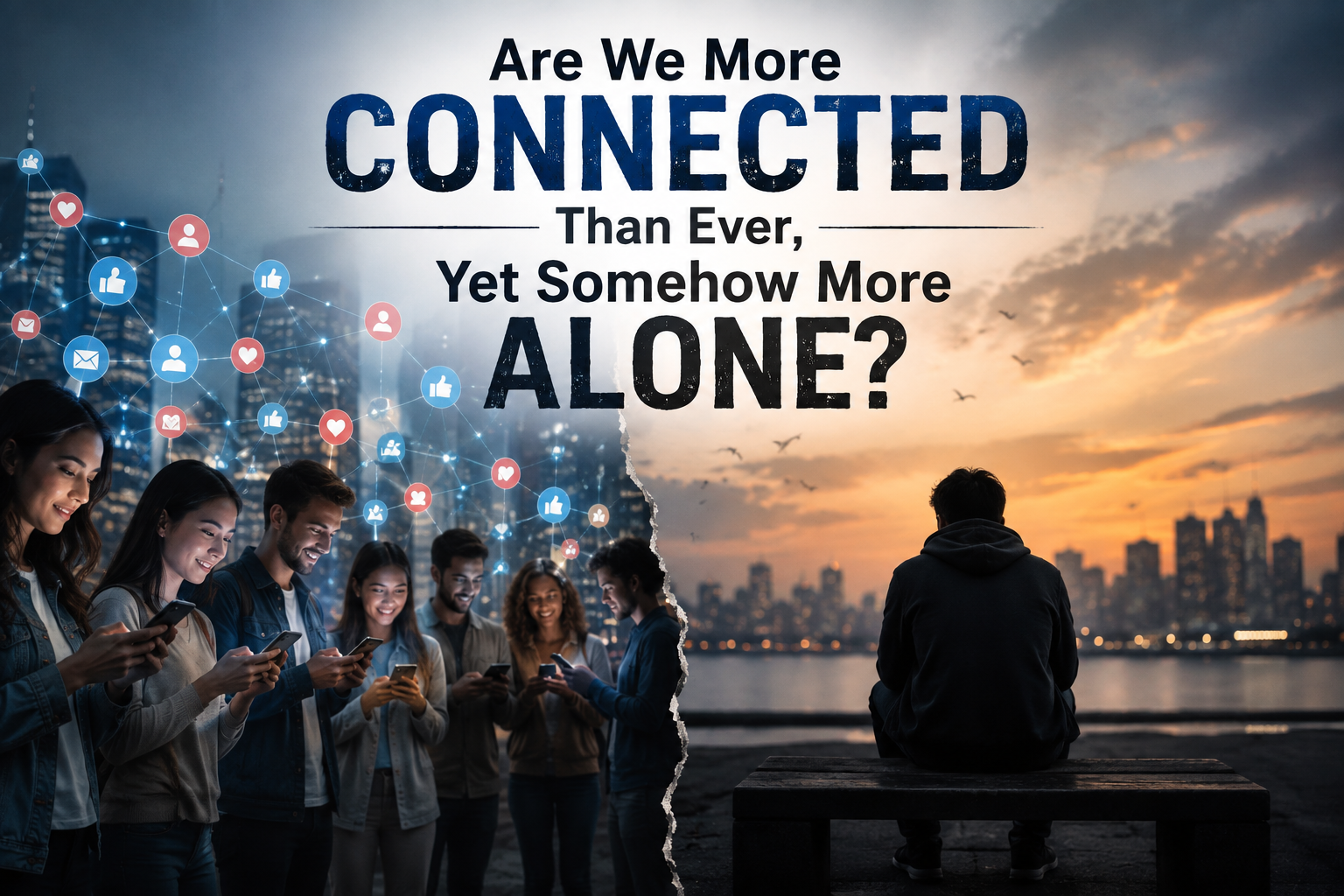
People are posting their daily life updates on social media platforms like Instagram, Facebook, YouTube, and many others. They post everything from basic daily activities to birthdays, special events, outfits, trips, and much more. But what is the reason behind making these posts? Is it simply to get validation from others? To know whether we are looking good? To show a high-class lifestyle? Or, sometimes, simply to show off in front of others?
Getting likes, shares, and comments on social media may make us feel connected, but does it really mean that we are connected? Or, in reality, are we spending hours in front of our phones and laptops just to share updates about our lives with other people?
Is this really a good thing, or do we need to rethink our routines and improve some of our daily habits? Let us discuss this further.
Social media can certainly be considered a boon for many of us, but sometimes it can also have negative effects on people’s lives. If we need to talk to someone in the same city, another state, or even another country, calling or texting is one of the easiest options. But what if you call someone and they don’t pick up? You will probably send them a text message, hoping that they will see it and call you back.
And what happens if they don’t respond?
This is where another feature of modern communication comes into play. If you have that person added on a social media or messaging platform, you can message them there. Some platforms even allow you to see whether your message has been delivered or read—for example, WhatsApp’s blue ticks.
Social media and messaging platforms offer many more benefits than this. We can share text, images, audio, videos, documents, and important moments with people almost instantly. Many platforms also provide security and privacy features designed to protect our communications.
However, we should never assume that anything we put online is completely risk-free. What if the information we share falls into the wrong hands—for example, through a hacked account, scam, data leak, or poor privacy settings? Personal information, photographs, conversations, and other details could potentially be misused.
Hopefully, most of us will never experience something like that. But privacy is only one side of this discussion. Let us continue with the bigger question: how can something designed to keep us connected sometimes leave us feeling more alone?
There is no doubt that social media allows us to share our lives with the people we care about. At the same time, we receive validation from them in the form of likes, comments, views, shares, and reactions.
But what happens when those numbers suddenly begin to fall?
Why have people stopped liking my content?
Is my content not good enough anymore?
Am I doing something wrong?
Why are people keeping their distance from me?
A lot of questions can start appearing in our minds. But have we ever stopped to think about how this cycle began?
Think back to when you created your first social media account.
In the beginning, everything probably felt simple. You might have used social media to chat with friends, share basic updates, post your game scores, upload a few photographs, or challenge your friends to beat your latest high score. There wasn’t necessarily a deeper purpose behind every post. It was simply another way to have fun and stay connected.
But somewhere along the way, things may have changed.
Basic social activity can slowly turn into documenting our daily routines, lifestyles, outfits, meals, vacations, home tours, purchases, or even ordinary moments that we might otherwise have simply experienced. For some people, vlogging and content creation may even become a career. But for others, posting can gradually become tied to something much simpler: getting likes, hearts, views, and reactions.
And that is where the problem can begin.
Without realizing it, we may start measuring an experience not by how much we enjoyed it, but by how much attention it received online. A good photograph needs to be posted. A beautiful meal needs to become a story. A trip needs an album. A special moment somehow feels incomplete until other people have seen it.
The platform itself may not be the trap. The trap can be the habit we unknowingly build around it.
Eventually, you may find yourself sitting alone in a quiet place, scrolling through your phone whenever you have some free time and constantly checking what everyone else is doing.
Someone is travelling.
Someone bought something new.
Someone is celebrating.
Someone got a new job.
Someone seems to be living an amazing life.
You keep scrolling, but it doesn’t necessarily make you happier. Instead, you may enter a constant loop of checking your device every few minutes to see whether someone has posted something new—or whether somebody has reacted to what you posted.
And strangely enough, while knowing more and more about everyone else’s life, you might actually be sitting there alone.
Perhaps the solution isn’t to abandon social media completely. Social media itself isn’t necessarily the enemy. It has given us extraordinary ways to communicate, learn, share ideas, maintain long-distance relationships, and meet people we may never have encountered otherwise.
The real question is whether we are controlling how we use social media, or social media is beginning to control how we live.
Even if our habits have already changed, it isn’t too late to reconsider them. But the first decision has to come from us: sometimes we need to socialize without social media—to meet people, talk without constantly checking a screen, spend time together, and experience the physical presence of other human beings.
Because being able to reach hundreds of people through a screen doesn’t necessarily mean we feel close to any of them.